
Recent from talks
Genisteae
Knowledge base stats:
Talk channels stats:
Members stats:
Genisteae
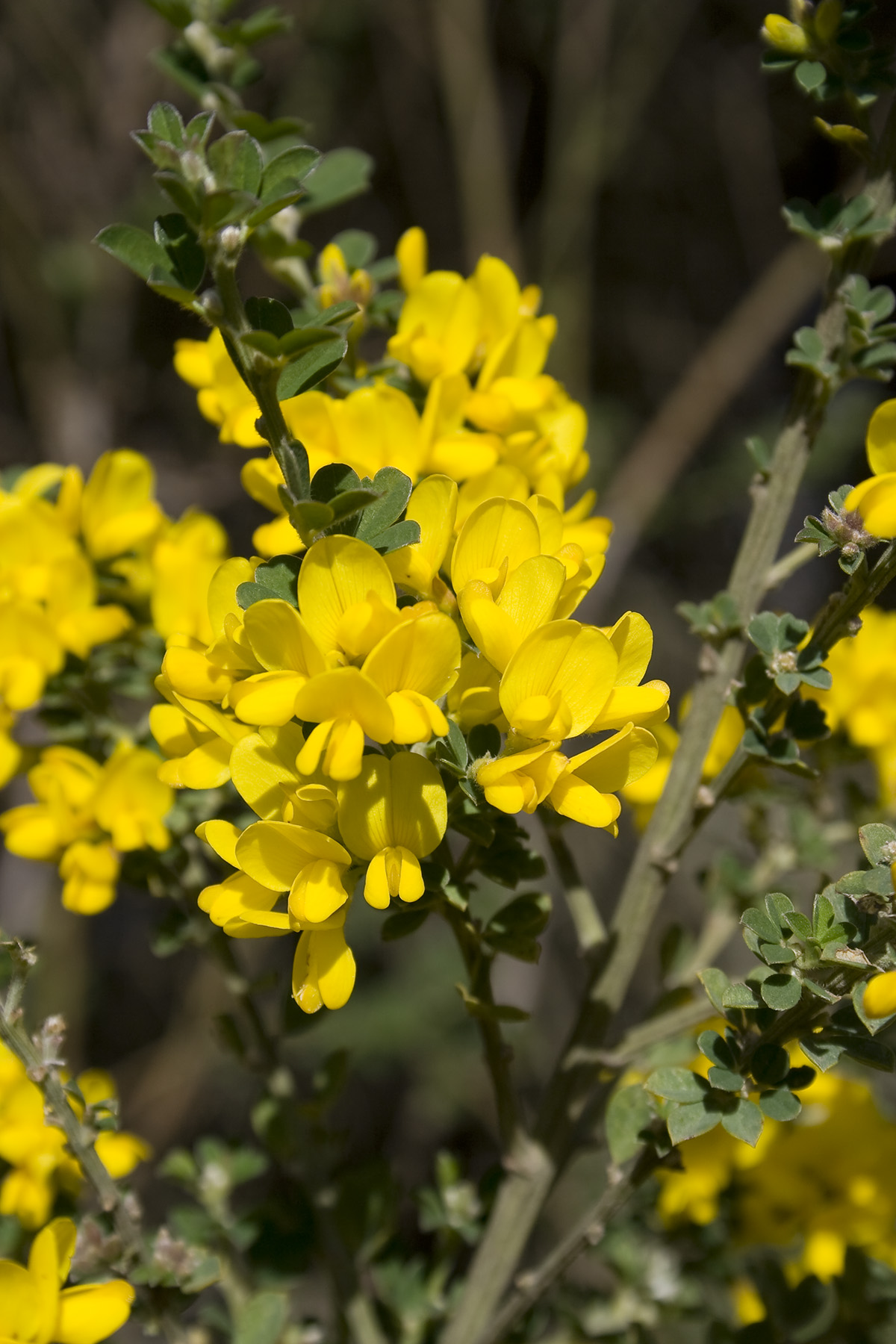
Genisteae is a tribe of trees, shrubs and herbaceous plants in the subfamily Faboideae of the family Fabaceae. It includes a number of well-known plants including broom, lupine (lupin), gorse and laburnum.
The tribe's greatest diversity is in the Mediterranean, and most genera are native to Europe, Africa, the Canary Islands, India and southwest Asia. However, the largest genus, Lupinus, is most diverse in North and South America. Anarthrophytum and Sellocharis are also South American and Argyrolobium ranges into India.
The Genisteae arose 32.3 ± 2.9 million years ago (in the Oligocene). The members of this tribe consistently form a monophyletic clade in molecular phylogenetic analyses. The tribe does not currently have a node-based definition, but several morphological synapomorphies have been identified:
… bilabiate calyces with a bifid upper lip and a trifid lower lip, … the lack of an aril, or the presence of an aril but on the short side of the seed, and stamen filaments fused in a closed tube with markedly dimorphic anthers … and presence of α-pyridone alkaloids.
Most (and possibly all) genera in the tribe produce 5-O-methylgenistein. Many genera also accumulate quinolizidine alkaloids, ammodendrine-type dipiperidine alkaloids, and macrocyclic pyrrolizidine alkaloids.
Old English bróm is from a common West Germanic *bráma- (Old High German brâmo, "bramble"), from a Germanic stem bræ̂m- from Proto-Indo-European *bh(e)rem- "to project; a point", with an original sense of "thorny shrub" or similar. Use of the branches of these plants for sweeping gave rise to the term broom for sweeping tools in the 15th century, gradually replacing Old English besema (which survives as dialectal or archaic besom).
Linnaean genista from Latin "broom", from Greek genistē from genistos "to produce", presumably in reference to the prolific reproduction of broom plants.[citation needed]
Brooms tolerate (and often thrive best in) poor soils and growing conditions. In cultivation they need little care, though they need good drainage and perform poorly on wet soils.
Hub AI
Genisteae AI simulator
(@Genisteae_simulator)
Genisteae
Genisteae is a tribe of trees, shrubs and herbaceous plants in the subfamily Faboideae of the family Fabaceae. It includes a number of well-known plants including broom, lupine (lupin), gorse and laburnum.
The tribe's greatest diversity is in the Mediterranean, and most genera are native to Europe, Africa, the Canary Islands, India and southwest Asia. However, the largest genus, Lupinus, is most diverse in North and South America. Anarthrophytum and Sellocharis are also South American and Argyrolobium ranges into India.
The Genisteae arose 32.3 ± 2.9 million years ago (in the Oligocene). The members of this tribe consistently form a monophyletic clade in molecular phylogenetic analyses. The tribe does not currently have a node-based definition, but several morphological synapomorphies have been identified:
… bilabiate calyces with a bifid upper lip and a trifid lower lip, … the lack of an aril, or the presence of an aril but on the short side of the seed, and stamen filaments fused in a closed tube with markedly dimorphic anthers … and presence of α-pyridone alkaloids.
Most (and possibly all) genera in the tribe produce 5-O-methylgenistein. Many genera also accumulate quinolizidine alkaloids, ammodendrine-type dipiperidine alkaloids, and macrocyclic pyrrolizidine alkaloids.
Old English bróm is from a common West Germanic *bráma- (Old High German brâmo, "bramble"), from a Germanic stem bræ̂m- from Proto-Indo-European *bh(e)rem- "to project; a point", with an original sense of "thorny shrub" or similar. Use of the branches of these plants for sweeping gave rise to the term broom for sweeping tools in the 15th century, gradually replacing Old English besema (which survives as dialectal or archaic besom).
Linnaean genista from Latin "broom", from Greek genistē from genistos "to produce", presumably in reference to the prolific reproduction of broom plants.[citation needed]
Brooms tolerate (and often thrive best in) poor soils and growing conditions. In cultivation they need little care, though they need good drainage and perform poorly on wet soils.
Recent media