
Recent from talks
Geodesics in general relativity
Knowledge base stats:
Talk channels stats:
Members stats:
Geodesics in general relativity
In general relativity, a geodesic generalizes the notion of a "straight line" to curved spacetime. Importantly, the world line of a particle free from all external, non-gravitational forces is a particular type of geodesic. In other words, a freely moving or falling particle always moves along a geodesic.
In general relativity, gravity can be regarded as not a force but a consequence of a curved spacetime geometry where the source of curvature is the stress–energy tensor (representing matter, for instance). Thus, for example, the path of a planet orbiting a star is the projection of a geodesic of the curved four-dimensional (4-D) spacetime geometry around the star onto three-dimensional (3-D) space.
The full geodesic equation is where s is a scalar parameter of motion (e.g. the proper time), and are Christoffel symbols (sometimes called the affine connection coefficients or Levi-Civita connection coefficients) symmetric in the two lower indices. Greek indices may take the values: 0, 1, 2, 3 and the summation convention is used for repeated indices and . The quantity on the left-hand-side of this equation is the acceleration of a particle, so this equation is analogous to Newton's laws of motion, which likewise provide formulae for the acceleration of a particle. The Christoffel symbols are functions of the four spacetime coordinates and so are independent of the velocity or acceleration or other characteristics of a test particle whose motion is described by the geodesic equation.


So far the geodesic equation of motion has been written in terms of a scalar parameter s. It can alternatively be written in terms of the time coordinate, (here we have used the triple bar to signify a definition). The geodesic equation of motion then becomes:


This formulation of the geodesic equation of motion can be useful for computer calculations and to compare General Relativity with Newtonian Gravity. It is straightforward to derive this form of the geodesic equation of motion from the form which uses proper time as a parameter using the chain rule. Notice that both sides of this last equation vanish when the mu index is set to zero. If the particle's velocity is small enough, then the geodesic equation reduces to this:
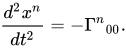
Here the Latin index n takes the values [1,2,3]. This equation simply means that all test particles at a particular place and time will have the same acceleration, which is a well-known feature of Newtonian gravity. For example, everything floating around in the International Space Station will undergo roughly the same acceleration due to gravity.
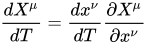
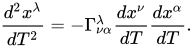
Physicist Steven Weinberg has presented a derivation of the geodesic equation of motion directly from the equivalence principle. The first step in such a derivation is to suppose that a free falling particle does not accelerate in the neighborhood of a point-event with respect to a freely falling coordinate system (). Setting , we have the following equation that is locally applicable in free fall: The next step is to employ the multi-dimensional chain rule. We have: Differentiating once more with respect to the time, we have: We have already said that the left-hand-side of this last equation must vanish because of the Equivalence Principle. Therefore: Multiply both sides of this last equation by the following quantity: Consequently, we have this:





![{\displaystyle {d^{2}x^{\lambda } \over dT^{2}}=-{dx^{\nu } \over dT}{dx^{\alpha } \over dT}\left[{\partial ^{2}X^{\mu } \over \partial x^{\nu }\partial x^{\alpha }}{\partial x^{\lambda } \over \partial X^{\mu }}\right].}](https://wikimedia.org/api/rest_v1/media/math/render/svg/154bfeafd2053e1cad411dbbc65564baed69d8e7)
Weinberg defines the affine connection as follows: which leads to this formula:
![{\displaystyle \Gamma ^{\lambda }{}_{\nu \alpha }=\left[{\partial ^{2}X^{\mu } \over \partial x^{\nu }\partial x^{\alpha }}{\partial x^{\lambda } \over \partial X^{\mu }}\right]}](https://wikimedia.org/api/rest_v1/media/math/render/svg/251c2d88e6e5a215937b40d93f12405dc897142f)
Hub AI
Geodesics in general relativity AI simulator
(@Geodesics in general relativity_simulator)
Geodesics in general relativity
In general relativity, a geodesic generalizes the notion of a "straight line" to curved spacetime. Importantly, the world line of a particle free from all external, non-gravitational forces is a particular type of geodesic. In other words, a freely moving or falling particle always moves along a geodesic.
In general relativity, gravity can be regarded as not a force but a consequence of a curved spacetime geometry where the source of curvature is the stress–energy tensor (representing matter, for instance). Thus, for example, the path of a planet orbiting a star is the projection of a geodesic of the curved four-dimensional (4-D) spacetime geometry around the star onto three-dimensional (3-D) space.
The full geodesic equation is where s is a scalar parameter of motion (e.g. the proper time), and are Christoffel symbols (sometimes called the affine connection coefficients or Levi-Civita connection coefficients) symmetric in the two lower indices. Greek indices may take the values: 0, 1, 2, 3 and the summation convention is used for repeated indices and . The quantity on the left-hand-side of this equation is the acceleration of a particle, so this equation is analogous to Newton's laws of motion, which likewise provide formulae for the acceleration of a particle. The Christoffel symbols are functions of the four spacetime coordinates and so are independent of the velocity or acceleration or other characteristics of a test particle whose motion is described by the geodesic equation.
So far the geodesic equation of motion has been written in terms of a scalar parameter s. It can alternatively be written in terms of the time coordinate, (here we have used the triple bar to signify a definition). The geodesic equation of motion then becomes:
This formulation of the geodesic equation of motion can be useful for computer calculations and to compare General Relativity with Newtonian Gravity. It is straightforward to derive this form of the geodesic equation of motion from the form which uses proper time as a parameter using the chain rule. Notice that both sides of this last equation vanish when the mu index is set to zero. If the particle's velocity is small enough, then the geodesic equation reduces to this:
Here the Latin index n takes the values [1,2,3]. This equation simply means that all test particles at a particular place and time will have the same acceleration, which is a well-known feature of Newtonian gravity. For example, everything floating around in the International Space Station will undergo roughly the same acceleration due to gravity.
Physicist Steven Weinberg has presented a derivation of the geodesic equation of motion directly from the equivalence principle. The first step in such a derivation is to suppose that a free falling particle does not accelerate in the neighborhood of a point-event with respect to a freely falling coordinate system (). Setting , we have the following equation that is locally applicable in free fall: The next step is to employ the multi-dimensional chain rule. We have: Differentiating once more with respect to the time, we have: We have already said that the left-hand-side of this last equation must vanish because of the Equivalence Principle. Therefore: Multiply both sides of this last equation by the following quantity: Consequently, we have this:
Weinberg defines the affine connection as follows: which leads to this formula: