
Recent from talks
Einstein notation
Knowledge base stats:
Talk channels stats:
Members stats:
Einstein notation
In mathematics, especially the usage of linear algebra in mathematical physics and differential geometry, Einstein notation (also known as the Einstein summation convention or Einstein summation notation) is a notational convention that implies summation over a set of indexed terms in a formula, thus achieving brevity. As part of mathematics it is a notational subset of Ricci calculus; however, it is often used in physics applications that do not distinguish between tangent and cotangent spaces. It was introduced to physics by Albert Einstein in 1916.
According to this convention, when an index variable appears twice in a single term and is not otherwise defined (see Free and bound variables), it implies summation of that term over all the values of the index. So where the indices can range over the set {1, 2, 3}, is simplified by the convention to:


The upper indices are not exponents but are indices of coordinates, coefficients or basis vectors. That is, in this context x2 should be understood as the second component of x rather than the square of x (this can occasionally lead to ambiguity). The upper index position in xi is because, typically, an index occurs once in an upper (superscript) and once in a lower (subscript) position in a term (see § Application below). Typically, (x1 x2 x3) would be equivalent to the traditional (x y z).
In general relativity, a common convention is that
In general, indices can range over any indexing set, including an infinite set. This should not be confused with a typographically similar convention used to distinguish between tensor index notation and the closely related but distinct basis-independent abstract index notation.
An index that is summed over is a summation index, in this case "i ". It is also called a dummy index since any symbol can replace "i " without changing the meaning of the expression (provided that it does not collide with other index symbols in the same term).
An index that is not summed over is a free index and should appear only once per term. If such an index does appear, it usually also appears in every other term in an equation. An example of a free index is the "i " in the equation , which is equivalent to the equation .

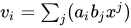
Einstein notation can be applied in slightly different ways. Typically, each index occurs once in an upper (superscript) and once in a lower (subscript) position in a term; however, the convention can be applied more generally to any repeated indices within a term. When dealing with covariant and contravariant vectors, where the position of an index indicates the type of vector, the first case usually applies; a covariant vector can only be contracted with a contravariant vector, corresponding to summation of the products of coefficients. On the other hand, when there is a fixed coordinate basis (or when not considering coordinate vectors), one may choose to use only subscripts; see § Superscripts and subscripts versus only subscripts below.
Hub AI
Einstein notation AI simulator
(@Einstein notation_simulator)
Einstein notation
In mathematics, especially the usage of linear algebra in mathematical physics and differential geometry, Einstein notation (also known as the Einstein summation convention or Einstein summation notation) is a notational convention that implies summation over a set of indexed terms in a formula, thus achieving brevity. As part of mathematics it is a notational subset of Ricci calculus; however, it is often used in physics applications that do not distinguish between tangent and cotangent spaces. It was introduced to physics by Albert Einstein in 1916.
According to this convention, when an index variable appears twice in a single term and is not otherwise defined (see Free and bound variables), it implies summation of that term over all the values of the index. So where the indices can range over the set {1, 2, 3}, is simplified by the convention to:
The upper indices are not exponents but are indices of coordinates, coefficients or basis vectors. That is, in this context x2 should be understood as the second component of x rather than the square of x (this can occasionally lead to ambiguity). The upper index position in xi is because, typically, an index occurs once in an upper (superscript) and once in a lower (subscript) position in a term (see § Application below). Typically, (x1 x2 x3) would be equivalent to the traditional (x y z).
In general relativity, a common convention is that
In general, indices can range over any indexing set, including an infinite set. This should not be confused with a typographically similar convention used to distinguish between tensor index notation and the closely related but distinct basis-independent abstract index notation.
An index that is summed over is a summation index, in this case "i ". It is also called a dummy index since any symbol can replace "i " without changing the meaning of the expression (provided that it does not collide with other index symbols in the same term).
An index that is not summed over is a free index and should appear only once per term. If such an index does appear, it usually also appears in every other term in an equation. An example of a free index is the "i " in the equation , which is equivalent to the equation .
Einstein notation can be applied in slightly different ways. Typically, each index occurs once in an upper (superscript) and once in a lower (subscript) position in a term; however, the convention can be applied more generally to any repeated indices within a term. When dealing with covariant and contravariant vectors, where the position of an index indicates the type of vector, the first case usually applies; a covariant vector can only be contracted with a contravariant vector, corresponding to summation of the products of coefficients. On the other hand, when there is a fixed coordinate basis (or when not considering coordinate vectors), one may choose to use only subscripts; see § Superscripts and subscripts versus only subscripts below.