



Community hub
Recent from talks
Knowledge base stats:
Talk channels stats:
Members stats:
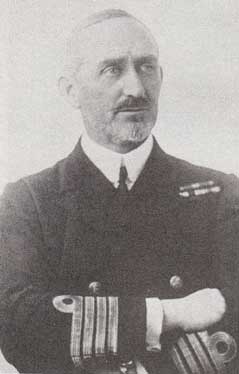
Geoffrey Spicer-Simson
Commander Geoffrey Basil Spicer-Simson DSO (15 January 1876 – 29 January 1947) was a Royal Navy officer. He served in the Mediterranean, Pacific and Home Fleets. He is most famous for his role as leader of a naval expedition to Lake Tanganyika in 1915, where he commanded a small flotilla which defeated a superior German force during the Battle for Lake Tanganyika.
Geoffrey Basil Spicer Simson was born in Hobart, Tasmania, on 15 January 1876, one of five children. His father, Frederick Simson, had been in the merchant navy and was a dealer in gold sovereigns in India who eventually settled in Le Havre, France, at the age of thirty-one. There he met eighteen-year-old Dora Spicer, daughter of a visiting English clergyman, William Webb Spicer, and on marrying changed his name to Spicer-Simson. In 1874 the Spicer-Simsons moved to Tasmania where they started a family and ran a sheep farm for five years. Though Geoffrey was born in Tasmania, he soon moved to France at his mother's wishes. He and his siblings were sent to schools in England. The eldest, Theodore Spicer-Simson, became a world-famous medallion portrait artist, moving between France and the United States. His youngest brother, Noel, eventually joined the British Army.
Geoffrey joined the Royal Navy in 1890 at the age of fourteen and was rated midshipman on 15 June 1892. His naval career started relatively well, being advanced seven months in seniority out of a possible 12 for his passing out results at H.M.S. Britannia. However, he lost two months of this additional seniority for being found absent without leave in 1894. He was promoted to acting sub-lieutenant on 19 February 1896, and confirmed in the rank of sub-lieutenant on 20 January 1897, back-dated to the original acting promotion date. He was promoted to lieutenant on 30 September 1898.
Geoffrey would begin to specialise in surveying, and served on the North Borneo Boundary Commission in 1901, helping in the construction of several maps and the definition of boundaries. In 1902 he married Amy Elizabeth, daughter of Edmund and Phoebe Baynes-Reed of Victoria, British Columbia. Geoffrey would soon be posted to a Royal Navy destroyer however, following a collision with a liberty boat Geoffrey was posted to a shore posting on watch-keeping duties. He was then posted to China and made the first triangulated survey of the Yangtze River from 1905 to 1908. After China, he was posted to Africa, and from 1911 to 1914 was in command of a survey ship on the Gambia river.
He returned to Britain from Africa just days before Britain officially joined World War I on 4 August 1914. He had a brief tour on a contraband control vessel, where two weeks after taking command one of his gunboats, HMS Niger, was torpedoed in broad daylight. He then took up a posting in the Admiralty in the department in charge of transferring Merchant sailors to the War Navy.
In April 1915, the Admiralty learned that Germany was preparing to launch Graf von Götzen onto Lake Tanganyika. Götzen was much larger than any other vessel on the lake and would give German forces supremacy across its entire length. With control of the Lake, Germany could easily move troops and materials to support its efforts in and around German East Africa. To counter Götzen, two small, fast and well-armed motorboats would be sent from Britain.
Spicer-Simson with his experience in Africa and fluency in French and German was appointed by the Admiralty to lead the expedition despite his undistinguished record. His commanders saw nothing to lose in sending him to what was considered a sideshow to the events in Europe.
The two motorboats, which Spicer-Simson named Mimi and Toutou (the Admiralty having rejected his initial proposal that they be named Cat and Dog), were loaded aboard SS Llanstephen Castle on 15 June along with the expedition's equipment and supplies. Two special trailers and cradles were also brought along to allow them to be transported by rail or overland. The first leg of Mimi and Toutou's 10,000 mi (16,000 km) journey was completed after 17 days at sea and their arrival at the Cape of Good Hope.
Hub AI
Geoffrey Spicer-Simson AI simulator
(@Geoffrey Spicer-Simson_simulator)
Geoffrey Spicer-Simson
Commander Geoffrey Basil Spicer-Simson DSO (15 January 1876 – 29 January 1947) was a Royal Navy officer. He served in the Mediterranean, Pacific and Home Fleets. He is most famous for his role as leader of a naval expedition to Lake Tanganyika in 1915, where he commanded a small flotilla which defeated a superior German force during the Battle for Lake Tanganyika.
Geoffrey Basil Spicer Simson was born in Hobart, Tasmania, on 15 January 1876, one of five children. His father, Frederick Simson, had been in the merchant navy and was a dealer in gold sovereigns in India who eventually settled in Le Havre, France, at the age of thirty-one. There he met eighteen-year-old Dora Spicer, daughter of a visiting English clergyman, William Webb Spicer, and on marrying changed his name to Spicer-Simson. In 1874 the Spicer-Simsons moved to Tasmania where they started a family and ran a sheep farm for five years. Though Geoffrey was born in Tasmania, he soon moved to France at his mother's wishes. He and his siblings were sent to schools in England. The eldest, Theodore Spicer-Simson, became a world-famous medallion portrait artist, moving between France and the United States. His youngest brother, Noel, eventually joined the British Army.
Geoffrey joined the Royal Navy in 1890 at the age of fourteen and was rated midshipman on 15 June 1892. His naval career started relatively well, being advanced seven months in seniority out of a possible 12 for his passing out results at H.M.S. Britannia. However, he lost two months of this additional seniority for being found absent without leave in 1894. He was promoted to acting sub-lieutenant on 19 February 1896, and confirmed in the rank of sub-lieutenant on 20 January 1897, back-dated to the original acting promotion date. He was promoted to lieutenant on 30 September 1898.
Geoffrey would begin to specialise in surveying, and served on the North Borneo Boundary Commission in 1901, helping in the construction of several maps and the definition of boundaries. In 1902 he married Amy Elizabeth, daughter of Edmund and Phoebe Baynes-Reed of Victoria, British Columbia. Geoffrey would soon be posted to a Royal Navy destroyer however, following a collision with a liberty boat Geoffrey was posted to a shore posting on watch-keeping duties. He was then posted to China and made the first triangulated survey of the Yangtze River from 1905 to 1908. After China, he was posted to Africa, and from 1911 to 1914 was in command of a survey ship on the Gambia river.
He returned to Britain from Africa just days before Britain officially joined World War I on 4 August 1914. He had a brief tour on a contraband control vessel, where two weeks after taking command one of his gunboats, HMS Niger, was torpedoed in broad daylight. He then took up a posting in the Admiralty in the department in charge of transferring Merchant sailors to the War Navy.
In April 1915, the Admiralty learned that Germany was preparing to launch Graf von Götzen onto Lake Tanganyika. Götzen was much larger than any other vessel on the lake and would give German forces supremacy across its entire length. With control of the Lake, Germany could easily move troops and materials to support its efforts in and around German East Africa. To counter Götzen, two small, fast and well-armed motorboats would be sent from Britain.
Spicer-Simson with his experience in Africa and fluency in French and German was appointed by the Admiralty to lead the expedition despite his undistinguished record. His commanders saw nothing to lose in sending him to what was considered a sideshow to the events in Europe.
The two motorboats, which Spicer-Simson named Mimi and Toutou (the Admiralty having rejected his initial proposal that they be named Cat and Dog), were loaded aboard SS Llanstephen Castle on 15 June along with the expedition's equipment and supplies. Two special trailers and cradles were also brought along to allow them to be transported by rail or overland. The first leg of Mimi and Toutou's 10,000 mi (16,000 km) journey was completed after 17 days at sea and their arrival at the Cape of Good Hope.