Recent from talks
Nothing was collected or created yet.
Geography of Bihar
View on Wikipedia
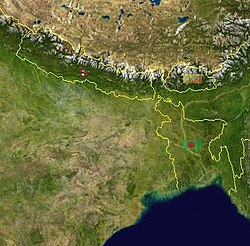
Bihar is located in the eastern region[4] of India, between latitudes 24°20'10"N and 27°31'15"N and longitudes 83°19'50"E and 88°17'40"E. It is an entirely land–locked state, in a subtropical region of the temperate zone. Bihar lies between the humid West Bengal in the east and the sub humid Uttar Pradesh in the west, which provides it with a transitional position in respect of climate, economy and culture. It is bounded by Nepal in the north and by Jharkhand in the south. Bihar plain is divided into two unequal halves (North Bihar and South Bihar) by the river Ganges[5] which flows through the middle from west to east. Bihar's land has average elevation above sea level of 173 feet.
Key Information
Physical and Structural Geography
[edit]Bihar has three parts on the basis of physical and structural conditions: The Southern Plateau Region, Bihar's Gangetic Plain, and the Shivalik Region. [6] The Southern Plateau Region is located between Kaimur district in the West to Banka in the East. It is made up of hard rocks like gneiss, schist and granite. This region has many conical hills which are made up of batholim like Pretshil, Ramshila and Jethian hill. Bihar's Plain is located between the Southern Plateau and the Northern Mountains. It is bounded by the 150m contour line in the north as well as in the south. The vast stretch of fertile Bihar Plain is divided by the Ganges River into two unequal parts - North Bihar and the South Bihar.[7] Northern Bihar's Plain is located in East Champaran & West Champaran (Terai area with higher elevation), and plains of Samastipur, Begusarai, Saharsa and Katihar . Region is drained by Saryu, Gandak, Burhi Gandak, Bagmati, Kamla-Balan, Kosi and Mahananda and their tributaries. Southern Bihar's Plain is narrow than northern plain of Bihar and triangular in shape because many hills are located in this region such as hills of Gaya, Rajgir, Giriyak, Bihar Sharif, Sheikhpura, Jamalpur and Kharagpur hills. Third, Shivalik Region in sub-Himalayan foothills of Shivalik range's shadows the state from Northern part of West Champaran over an area 32 km long and 6–8 km wide. West Champaran district are clad in a belt of moist deciduous forest. As well as trees, this consists of scrub, grass and reeds.
Political geography
[edit]The state is divided into 9 divisions, 38 districts, 101 subdivisions and 534 circles.[8] 12 municipal corporations, 49 Nagar Parishads and 80 Nagar Panchayats for administrative purposes.[9][10][11][12][13]
| Division | Headquarters | Districts | District map of Bihar |
|---|---|---|---|
| Patna
|
Patna | Bhojpur, Buxar, Kaimur, Patna, Rohtas, Nalanda | |
| Magadh | Gaya | Arwal, Aurangabad, Gaya, Jehanabad, Nawada | |
| Saran | Chapra | Saran, Siwan , Gopalganj | |
| Tirhut | Muzaffarpur | East Champaran, Muzaffarpur, Sheohar, Sitamarhi, Vaishali, West Champaran | |
| Purnia | Purnia | Araria, Katihar, Kishanganj, Purnia | |
| Bhagalpur | Bhagalpur | Banka, Bhagalpur | |
| Darbhanga | Darbhanga | Darbhanga, Madhubani, Samastipura | |
| Kosi | Saharsa | Madhepura, Saharsa, Supaul | |
| Munger | Munger | Begusarai,Jamui, Khagaria, Munger, Lakhisarai, Sheikhpura |
Geology
[edit]Bihar is in Indo-Gangetic plain so naturally fertile soil is one asset of the state.[citation needed] Thus Indo-Gangetic plain's soil is the backbone of agricultural and industrial development. The Indo-Gangetic plain in Bihar consists of a thick alluvial mantle of drift origin overlying in most part, the siwalik and older tertiary rocks. The soil is mainly little young loam rejuvenated every year by constant deposition of silt, clay and sand brought by streams but mainly by floods in Bihar[14]
This soil is deficient in phosphoric acid, nitrogen and humus, but potash and lime are usually present in sufficient quantity.[citation needed] The most common soil in Bihar is Gangetic alluvium of Indo-Gangetic plain region, Piedmont Swamp Soil which is found in northwestern part of West Champaran district and Terai Soil which is found in eastern part of Bihar along the border of Nepal.[15] clay soil, sand soil and loamy soil are common in Bihar.[16]
Natural resources
[edit]Bihar is mainly a vast stretch of very fertile flat land. It is drained by the Ganges River, including northern tributaries of other river. The Bihar plain is divided into two unequal halves by the river Ganges which flows through the middle from west to east. Other Ganges tributaries are the Son, Budhi Gandak, Chandan, Orhani and Phalgu. The Himalayas begin at foothills a short distance inside Nepal but influence Bihar's landforms, climate, hydrology and culture. Central parts of Bihar have some small hills, for example the Rajgir hills. The Himalayan Mountains are to the north of Bihar, in Nepal. To the south is the Chota Nagpur plateau, which was part of Bihar until 2000 but now is part of a separate state called Jharkhand.
Forest
[edit]Bihar has notified forest area of 6,764.14 km2, which is 7.1 per cent of its geographical area.[17] The sub Himalayan foothill of Someshwar and Dun ranges in Champaran district another belt of moist deciduous forests. These also consists of shrub, grass and reeds. Here the rainfall is above 1,600 mm and thus promotes luxuriant Sal forests in the favoured areas. The hot and dry summer gives the deciduous forests. The most important trees are Shorea Robusta (Sal), Shisham, Cedrela Toona, Khair, and Semal. This type of forests also occurs in Saharsa district and Purnia district.[18]
Minerals
[edit]Bihar is a producer of Steatite (945 tonnes), Pyrites (9,539 tonnes/year), Quartzite (14,865 tonnes/year), Crude Mica (53 tonnes/year), Limestone (4,78,000 tonnes/year). Bihar has also some good resource of Bauxite in Jamui district, Cement Mortar in Bhabhua, dolomite in Bhabhua, Glass sand in Bhabhua, Mica in Muzaffarpur, Nawada, Jamui, Gaya and salt in Gaya and Jamui, Uranium and Beryllium are found in Gaya District, Coal in Rajmahal Coalfield, Gold In Jamui. [19]
Water bodies
[edit]- Ajay River
- Bagmati
- Budhi Gandak
- Bhutahi Balan
- Gandak
- Ganges
- Ghaghara
- Phalgu
- Gandaki River
- Kamala
- Karmanasha
- Koshi River
- Mahananda River
- Mohana
- Punpun
- Sapt Koshi
- Son River
- Dhua Kund Falls
- Kakolat Waterfall
- Karkat Waterfall
- Madhuvdhandam Falls
- Manjhar Kund Waterfall
- North Tank Waterfall
- Telhar Waterfall
Spring (hydrosphere)
[edit]- Anupam Lake
- Kharagpur Lake
- Kanwar Lake Begusarai
- Ghora Katora Darbhanga
- Gogabil Lake Katihar
- Matsyagandha Lake
Pond
[edit]Hills and Caves
[edit]Hills
[edit]Source:[20]
- Barabar hills
- Brahmayoni hills Gaya Dist
- Brahmajuni Hills
- Bateshwar hills
- Dungeshwari hills
- Gridhakuta hills
- Gurpa hills
- Kavadol Hills/Kauvadol
- Kaimur Range
- Mandar Hills
- Mundeshwari Hills
- Nagarjuni Hills
- Pretshila Hills
- Pragbodhi hills
- Ramshila Hills
- Rajgir hills
- Ramshila hills
- Vaibhar Hills
Caves
[edit]Source:[21]
Natural hazards
[edit]Flood
[edit]Bihar is India's most flood-prone state, with 76% of the population in the north Bihar living under the recurring threat of flood devastation.[24] According to some historical data, 16.5% of the total flood affected area in India is located in Bihar while 22.1% of the flood affected population in India lives in Bihar.[25] About 68,800 square kilometres (26,600 sq mi) out of total geographical area of 94,160 square kilometres (36,360 sq mi) comprising 73.06% is flood affected. Floods in Bihar are a recurring disaster which on an annual basis destroys thousands of human lives apart from livestock and assets worth millions.[24]
Drought & Famine
[edit]Climate
[edit]Bihar has cool winters, the lowest temperatures being around 0–10 degrees Celsius (33 to 50 degrees Fahrenheit). Winter months are December and January. It is hot in the summer with average highs around 35–45 Celsius ( 95–105 Fahrenheit). April to mid June are the hot months. The monsoon months of June, July, August, and September see good rainfall. October & November and February & March have cool, pleasant climate.
See also
[edit]References and footnotes
[edit]- ^ "State Profile". Archived from the original on 2009-04-09. Retrieved 2008-11-27.
- ^ Fort Someshwar, West Champaran district, Bihar
- ^ Singh, Pradyuman (19 January 2021). Bihar General Knowledge Digest. Prabhat Prakashan. ISBN 978-93-5266-769-7.
- ^ "GSI – Eastern Region". Geographical Survey of India, Government of India. Archived from the original on 24 September 2015. Retrieved 11 June 2014.
- ^ "Bihar Area". mapsofindia.com. Archived from the original on 24 June 2014. Retrieved 11 June 2014.
- ^ by (2017-12-20). "Geographical location of Bihar". Bihar PSC Exam Notes. Retrieved 2021-05-09.
- ^ "Geographical Structure of Bihar: Geology | Physiology | Plain |Plateau". Jagranjosh.com. 2020-12-10. Retrieved 2021-05-09.
- ^ "Indexing Gender Parity and Estimation of Child Marriage: A comprehensive study of 534 Blocks in Bihar". Business Standard India. 25 September 2017. Archived from the original on 2017-09-25.
- ^ "Bihar Civic elections likely in May 2017". Archived from the original on 2017-03-31.
- ^ "बिहार : नगर विकास एवं आवास विभाग की पहल, पुनर्गठन से नगर परिषदों की बढ़ जायेगी संख्या". Archived from the original on 2017-03-24.
- ^ "पहली बार कोई महिला बनेगी पटना नगर निगम की मेयर". Archived from the original on 2017-03-24.
- ^ "Ward delimitation begins in Chhapra". The Times of India. Archived from the original on 2017-02-27.
- ^ "छपरा को निगम बख्तियारपुर को मिला नगर परिषद का दर्जा". Archived from the original on 2017-03-24.
- ^ Das, K.K.L.; Das, K.N. (1981), "Alluvial Morphology of the North Bihar Plain – A study in applied geomorphology", in Sharma, Hari Shanker (ed.), Perspectives in geomorphology, vol. 4, New Delhi: Naurung Rai Concept Publishing Company, pp. 85 ff, retrieved April 9, 2011
- ^ Soil of Bihar Archived 2011-09-28 at the Wayback Machine
- ^ other common soil in Bihar Archived 2008-07-06 at the Wayback Machine
- ^ "State Profile". Gov. of India. Archived from the original on 2008-12-18.
- ^ "Forest in Bihar". Forest Ministry of Bihar. Archived from the original on 2009-04-10.
- ^ "Bihar Mineral Map, Mineral Resources of Bihar". Archived from the original on 2008-12-26. Retrieved 2008-11-27.
- ^ "Bihar". Archived from the original on 2021-02-26. Retrieved 2021-04-06.
- ^ "Bihar". Cpreecenvis.nic.in. 2020-08-28. Retrieved 2022-08-05.
- ^ Disaster Management in Bihar Archived 2008-10-23 at the Wayback Machine
- ^ Disaster Management in Bihar – Statistics Archived 2008-10-19 at the Wayback Machine
- ^ a b Flood Management Information System – History of Flood in Bihar Archived 2010-04-19 at the Wayback Machine
- ^ India Water Portal – Bihar Floods 2008 Archived 2009-02-01 at the Wayback Machine
Geography of Bihar
View on GrokipediaLocation and Boundaries
Geographical Coordinates and Extent
Bihar is situated in the eastern part of India, extending between 24°20'10" N and 27°31'15" N latitudes and 83°19'50" E and 88°17'40" E longitudes, encompassing a rectangular landmass primarily within the subtropical zone.[8] [9] This positioning places the state roughly 345 kilometers from north to south and 483 kilometers from east to west, reflecting its elongated east-west orientation.[10] [11] The total geographical area of Bihar measures 94,163 square kilometers, accounting for approximately 2.86% of India's land area and ranking it as the 12th largest state by extent.[1] This area is entirely landlocked, with no maritime boundaries, and its coordinates align with the Gangetic plain's flat topography, influencing its uniform elevation averaging around 53 meters above sea level.[11] The state's extent supports a dense network of rivers draining southward into the Ganges, underscoring its hydrological significance within the Indo-Gangetic region.[3]Political Divisions and Administrative Boundaries
Bihar's external political boundaries define its territorial extent, sharing a northern international border of approximately 744 kilometers with Nepal, a western boundary with Uttar Pradesh, a southern frontier with Jharkhand, and an eastern edge with West Bengal.[12] These boundaries, largely following natural features like the Ganges River and historical administrative lines, encompass a total land area of 94,163 square kilometers.[13] Internally, Bihar is divided into nine administrative divisions—Patna, Tirhut, Saran, Darbhanga, Kosi, Purnia, Bhagalpur, Munger, and Magadh—for coordinated governance and resource management.[14] Each division comprises multiple districts, totaling 38 as of 2025, with Patna serving as the administrative headquarters of the state and its namesake division.[15] These districts, such as Arwal, Aurangabad, and Banka, are further subdivided into 101 sub-divisions and over 530 community development blocks to facilitate local administration, land revenue collection, and developmental planning aligned with geographical variations across the Gangetic plains and southern uplands.[16] The administrative structure supports geographical oversight, with divisions like Magadh encompassing southern districts prone to mineral-rich terrains and Kosi covering flood-vulnerable northern areas, enabling targeted policies on issues like erosion and irrigation.[17] District boundaries often reflect historical princely states and colonial demarcations, adjusted post-2000 Jharkhand bifurcation to optimize administrative efficiency without altering core geographical divisions.Physiography and Landforms
Gangetic Plains and Alluvial Features
The Gangetic Plains dominate Bihar's landscape, forming an extensive alluvial tract within the Indo-Gangetic depositional basin, where sediments from the Ganges and its tributaries have accumulated over geological time. This physiographic unit, characterized by low relief and flat topography, results from aggradational processes involving fluvial deposition since the Miocene, creating a thick veneer of Quaternary alluvium overlying older Tertiary and Siwalik formations. The plains exhibit a gentle northward slope, with surface elevations typically ranging from 150 meters in the southern margins to under 50 meters near the Himalayan foothills, facilitating drainage towards the Ganges but also contributing to seasonal flooding.[18][19] Bisected by the Ganges River, the plains divide into the Northern Bihar Plain, covering approximately 56,980 square kilometers north of the river, and the smaller Southern Bihar Plain to the south. The northern section comprises younger, finer-grained alluvium deposited by dynamic rivers like the Gandak, Burhi Gandak, and Bagmati, rendering it highly fertile yet vulnerable to frequent inundations due to the rivers' braided patterns and high sediment loads. In contrast, the southern plain features older, coarser alluvial deposits, offering greater stability and reduced flood risk, though still reliant on irrigation from the Ganges and tributaries such as the Son and Punpun. These alluvial features include prominent natural levees along riverbanks, meander scars, and oxbow lakes formed by channel avulsions and lateral migrations over millennia.[11][20] Predominantly Gangetic alluvium soils prevail, consisting of silty loams and clays that are nutrient-rich and well-suited for agriculture, supporting Bihar's role as a major producer of cereals and pulses through their high water-holding capacity and porosity. The alluvial sequence reaches thicknesses of several hundred meters in places, as evidenced by borehole data, underscoring the ongoing tectonic subsidence in the foreland basin that accommodates continuous sediment influx from the eroding Himalayas. This depositional regime not only enhances soil fertility via periodic nutrient replenishment but also poses challenges through erosion and deposition cycles that reshape the landscape.[19][3]Hilly Regions and Escarpments
The southern plateau region of Bihar features the state's primary hilly terrains and escarpments, occupying roughly 7% of the state's land area and rising 200–600 meters above sea level as the northern extension of the Vindhyan and Chota Nagpur highlands. This zone spans districts from Kaimur and Rohtas in the west to Gaya, Nawada, and Banka in the east, comprising hard crystalline rocks like gneiss, schist, and granite, with localized sedimentary overlays from the Vindhyan Supergroup. These elevations contrast sharply with the surrounding Gangetic plains, influencing microclimates, soil erosion patterns, and biodiversity hotspots such as deciduous forests.[20][3] The Kaimur Plateau, also termed the Rohtas Plateau, dominates the western hilly sector in Rohtas and Kaimur districts, covering an undulating tableland of approximately 800 square kilometers formed by Vindhyan sedimentary rocks. Elevations here peak at 469 meters at Rohtasgarh Fort, with the northern Kaimur escarpment—a steep scarp of the Vindhyan range—dropping 150–300 meters to the alluvial plains and serving as a watershed divide between the Son and Ganga river basins. This escarpment, extending over 300 kilometers eastward, features rugged cliffs, seasonal streams, and prehistoric rock shelters, contributing to localized groundwater recharge but also prone to landslides during monsoons.[21][22][23] In central Bihar, the Rajgir Hills in Nalanda district form a compact cluster of five granite hills encircling a valley, reaching heights of 200–400 meters and characterized by cyclic topography with hot springs emerging from fault lines. These hills, part of an older Archaean formation, include escarpment-like slopes and caves, supporting unique flora like sal forests amid otherwise plain-dominated surroundings. Eastern extensions, such as the Kharagpur Hills in Munger and Jamui, blend into lower plateaus with minor escarpments, transitioning to the Rajmahal traps and hosting iron ore deposits.[3] These hilly and escarpment features, while limited in extent, play a critical role in Bihar's hydrology by intercepting monsoon runoff and feeding tributaries like the Son and Punpun rivers, though deforestation and mining have accelerated soil degradation since the mid-20th century. Conservation efforts, including the Kaimur Wildlife Sanctuary established in 1979 across 1,300 square kilometers of hilly terrain, aim to preserve these landscapes amid pressures from agriculture and urbanization.[22][23]Caves and Karst Formations
The karst formations and natural caves of Bihar are predominantly located in the southwestern part of the state, encompassing the Rohtas Plateau and Kaimur Hills in Rohtas and Kaimur districts, where Proterozoic limestone formations of the Vindhyan Supergroup are exposed or thinly covered by overlying sandstones. These soluble carbonate rocks undergo chemical dissolution by carbonic acid in percolating groundwater, resulting in subterranean passages, caverns, and surface features such as sinkholes, depressions, khohs (steep ravines), and subsided valleys that characterize the dissected plateau topography.[24][25] The process is enhanced by the region's tropical monsoon climate, which promotes high rainfall infiltration and episodic karstification, though sandstone caps limit widespread surface expression compared to classic karst terrains.[24] Guptadham Cave, situated in a valley of the Kaimur Hills approximately 60 km from Bhabua, exemplifies these features as a galleried cavern with extensive horizontal tunnels, junction chambers resembling amphitheaters, and secondary mineral deposits including stalactites and a natural lime-precipitated Shivling formation revered as Gupteshwar Mahadev.[26][27][24] Formed through solutional widening of fractures in Rohtas-stage limestones buried under up to 90 m of sandstone, the cave extends via multiple passages, some leading to underground streams, highlighting active phreatic karst development.[24] Other karst-influenced sites in the Kaimur range include natural limestone caves at locations such as Mokwas, Patesar, and Jhapia Hill, often associated with ravine bottoms and prehistoric rock shelters containing paleolithic art panels dated to over 10,000 years old, evidencing early human adaptation to these landforms.[28][29] These features contrast with Bihar's anthropogenic rock-cut caves, such as the Mauryan-era Barabar group hewn into granite gneiss, underscoring that true karst phenomena here stem from endogenic dissolution rather than mechanical excavation.[24]Geology and Soils
Geological Formation and Structure
Bihar's geological structure is characterized by a vast alluvial plain in the north and central regions, overlying older sedimentary and crystalline basement rocks exposed or near-surface in the southern plateau areas. The state forms part of the Indo-Gangetic foreland basin, resulting from the tectonic collision between the Indian and Eurasian plates, which initiated around 50 million years ago and led to flexural subsidence and sediment infilling from Himalayan erosion. This basin structure features a northward-dipping monocline, with sediment thickness exceeding 1,000 meters in northern Bihar, thinning southward toward the Peninsular Indian Shield.[30] The stratigraphic sequence begins with Precambrian crystalline rocks in the south, including the Archaean Chhotanagpur Granite Gneiss Complex (CGGC), comprising gneisses, schists, and migmatites formed 3,000–2,500 million years ago, intruded by meta-basics and pegmatites. Overlying these are Proterozoic formations such as the Vindhyan Supergroup in districts like Rohtas and Kaimur, consisting of quartzites, shales, and limestones deposited in shallow marine to fluvial environments between 1,800–600 million years ago. Mesozoic Gondwana Supergroup rocks, including sandstones, shales, and coal measures, occur patchily in southern Bihar, associated with rift basins predating Himalayan uplift. Tertiary Siwalik Group sediments, with sandstones, shales, and conglomerates, fringe northern Bihar, representing Miocene-Pliocene fluvial and deltaic deposits from early Himalayan erosion.[30][31] Dominating the surface geology is the Quaternary Gangetic Alluvium, a 10–20 km thick sequence of unconsolidated to semi-consolidated clay, silt, sand, gravel, and kankar nodules, deposited by the Ganga, Gandak, Kosi, and Son rivers since the Pleistocene. This alluvium forms two subunits: newer (Holocene) khadar soils in active floodplains and older (Pleistocene) bhangar terraces, reflecting episodic aggradation and incision linked to monsoon variability and base-level changes. Southern Bihar exhibits structural features like the east-west trending Rajgir-Munger fault zone, which juxtaposes metasediments and volcanics against the alluvial cover, influencing local seismicity and groundwater flow.[30][31]Soil Types and Distribution
Bihar's soils are overwhelmingly alluvial, comprising approximately 96% of the state's 94,163 square kilometers, primarily deposited by the Ganga River and its tributaries including the Gandak, Kosi, and Son, which annually replenish silt, clay, and sand to sustain high agricultural productivity.[32] These soils exhibit loamy textures enriched with potash and lime but deficient in nitrogen and organic matter, with northern variants coarser and sandier due to Himalayan sediment influx, while southern portions trend toward finer clay loams from localized fluvial deposition.[33][34] Tal soils occupy low-lying, backwater zones along the Ganga's meanders, extending from Buxar through Patna, Vaishali, and Samastipur to Banka districts, covering intermittently flooded depressions where heavy clay accumulation impedes drainage and fosters waterlogging, resulting in grey to dark grey hues, neutral to slightly alkaline pH, and reduced fertility from anaerobic conditions.[35][36] Karail soils characterize central and southern plains from Rohtas to Bhagalpur, featuring dense calcareous clay loams with brown to yellow coloration, alkaline reactions, and moderate fertility suited to rainfed crops but prone to cracking upon drying.[35][37] In southern escarpments like the Kaimur plateau, Balthar soils prevail, derived from weathered uplands and displaying sandy, yellowish-red profiles high in iron, low in nitrogen, and acidic, with poor water retention that limits cultivation to hardy millets without irrigation or liming.[33][32] Lateritic soils appear patchily in hilly terrains such as Rajgir and southern plateaus, formed by intense leaching of basaltic parent material under monsoon leaching, yielding porous, iron-aluminum enriched layers reddish in color and marginally productive for plantation crops.[34] Piedmont swamp and Terai soils fringe northern Bihar's foothills near Nepal, with swamp variants in waterlogged depressions exhibiting peaty, acidic traits from organic accumulation, while Terai types offer finer, more fertile alluvium supporting dense vegetation and rice paddies.[34] Overall distribution reflects physiographic gradients: alluvial dominance in the vast Gangetic flats, transitional clays in central basins, and residual sands/clays in southern uplands, influencing cropping patterns where northern sands favor pulses and southern clays bolster paddy yields.[35]| Soil Type | Primary Distribution | Key Characteristics |
|---|---|---|
| Alluvial | Northern to southern plains (96%) | Loamy to clayey; fertile with potash; nitrogen-deficient; renewed by floods.[33] |
| Tal | Ganga lowlands (Buxar-Banka) | Heavy clay; waterlogged; grey; low permeability.[35] |
| Karail | Central-southern plains | Calcareous clay loam; alkaline; brown-yellow; crack-prone.[35] |
| Balthar | Kaimur plateau | Sandy loam; acidic; iron-rich; low retention.[33] |
| Laterite | Southern hills (e.g., Rajgir) | Porous; leached; reddish; iron-aluminum dominant.[34] |
Hydrology and Water Bodies
River Systems and Drainage Patterns
Bihar's river systems are predominantly Himalayan-fed tributaries draining into the Ganga, which forms the state's primary east-west axial channel. The Ganga enters Bihar from Uttar Pradesh near Chausa in Bhojpur district, traversing approximately 445 kilometers eastward through districts such as Patna, Bhagalpur, and Katihar before exiting into West Bengal. This river receives inflows from seven major northern (left-bank) basins—Ghaghra, Gandak, Burhi Gandak, Bagmati-Adhwara, Kamla-Balan, Kosi, and Mahananda—all originating in the Himalayas, traversing Nepal, and carrying substantial silt loads that shape the alluvial terrain. Southern (right-bank) tributaries, including the Son (784 km total length, originating in Madhya Pradesh's Maikala range), Punpun, Kiul, and Karmanasa, contribute lesser volumes but drain the Vindhyan plateau fringes.[7][38] Drainage patterns in Bihar exhibit a transitional morphology: dendritic to trellis in the northern foothill catchments due to structural controls from Siwalik and older alluvial fans, evolving into parallel-to-subparallel and braided configurations across the vast Gangetic plains. The northern rivers flow southward into the Ganga, with high-gradient upper reaches fostering radial drainage near entry points, while flat gradients (typically under 0.1 m/km) in the middle and lower basins promote meandering, avulsion, and sediment deposition, resulting in unstable, multi-channel systems. For instance, the Kosi River (260 km in Bihar) displays a classic braided pattern, shifting westward over 120 km since 1736 due to aggradation exceeding incision capacity, altering local drainage divides. Southern rivers maintain more stable, incised channels with dendritic patterns, reflecting lower sediment yields from crystalline and sedimentary source rocks.[39][40][41] The overall hydrology integrates into the Ganga basin's 861,452 sq km extent in India, with Bihar encompassing about 40,000 sq km of active floodplains where drainage density averages 0.5-1 km/sq km, modulated by monsoon discharges peaking at 10,000-20,000 cumecs for major tributaries. Groundwater recharge relies on these patterns, with northern alluvial aquifers showing higher transmissivity (up to 1,000 m²/day) from river leakage, while southern red soils limit infiltration. Embankments and barrages, such as those on the Gandak (catchment 40,553 sq km total, 4,188 sq km in Bihar), have partially stabilized patterns but induced upstream sedimentation, compressing active channels.[7]Lakes, Ponds, and Wetlands
Bihar's lakes primarily consist of oxbow formations arising from the meandering courses of rivers like the Gandak and Burhi Gandak, with Kanwar Lake (also known as Kabartal or Kanwar Taal) standing as the largest freshwater oxbow lake in Asia, spanning approximately 6,700 hectares originally in Begusarai district, though encroachment and siltation have reduced its effective area.[42] This rainfed lake supports diverse aquatic life and serves as a critical habitat for over 150 bird species, including migratory waterfowl, earning Ramsar Wetland of International Importance status for its role in flood mitigation and biodiversity conservation.[43] Other notable lakes include Muchalinda Lake near Rajgir, historically linked to Buddhist lore and covering a smaller perennial area used for local recreation; Ghora Katora Lake in Rohtas district, a seasonal body aiding groundwater recharge; and Simri-Bakhtiyarpur Lake in Saharsa, formed similarly from river cut-offs and supporting fisheries.[44] Wetlands in Bihar, often integrated with these lakes, encompass marshes, swamps, and floodplain depressions that buffer annual floods from the Ganga and its tributaries, hosting Ramsar-designated sites such as Kanwar Lake alongside recent additions like Gokul Jalashay (448 hectares oxbow lake in Buxar district) and Udaipur Jheel in West Champaran, recognized in September 2025 for their ecological services including carbon sequestration and habitat for endangered species like the Gangetic dolphin in associated riverine zones.[45] Additional Ramsar wetlands include Nakti Lake and Nagi-Nakti Bird Sanctuary in [Jamui district](/page/Jamui district), spanning oxbow and reservoir features that sustain over 150 avian, reptilian, and floral species amid seasonal inundation.[46] These sites, totaling five in Bihar as of 2025, face threats from agricultural expansion and pollution, yet provide essential ecosystem services like water purification and fish production.[47] Ponds and tanks, largely artificial depressions excavated for irrigation and pisciculture, dominate Bihar's inland water bodies, numbering over 1.4 million ponds (59.5% of enumerated waterbodies) and 381,805 tanks (15.7%), distributed across the alluvial plains to capture monsoon runoff and support rice paddy cultivation in a state where 80% of agriculture relies on such sources. These small-scale reservoirs, often community-managed under traditional systems like ahars and pynes in southern Bihar, contribute significantly to inland fisheries, yielding an estimated 1.5-2 lakh tonnes annually from pond-based aquaculture, though siltation and eutrophication from untreated effluents degrade water quality in densely populated districts.[48] Restoration efforts, including desilting under state schemes, aim to enhance their capacity amid recurring droughts and floods that alternately strain and replenish these vital features.[49]Waterfalls, Springs, and Reservoirs
Bihar features several waterfalls primarily in its southern and eastern hilly districts, such as Kaimur, Nawada, and Rohtas, where seasonal streams cascade over escarpments during monsoons.[50] Kakolat Waterfall, located in Nawada district near the Bihar-Jharkhand border, drops approximately 160 feet (49 meters) into a natural pool, fed by the Kakolat stream and attracting visitors for its scenic surroundings.[51] Other notable falls include Karkat Waterfall in Kaimur district, Dhua Kund in Rohtas district near Sasaram, and Telhar Waterfall, all originating from tributaries of the Son and Karmanasa rivers, with heights ranging from 50 to 100 feet and peaking in flow from July to September.[52] [50] Natural springs in Bihar are concentrated in the Rajgir hills of Nalanda district, where geothermal activity produces hot springs with temperatures between 30°C and 70°C, attributed to underground mineral-rich aquifers.[53] The Rajgir Hot Springs, known as Saptarshi (seven sages), include Brahmakund, a large pool formed by converging streams believed to have therapeutic properties for skin ailments and rheumatism due to sulfur and other minerals, drawing pilgrims year-round.[54] [55] Additional springs nearby, such as Surya Kund, Satdhara Kund, and Makhdum Kund, emerge at the base of Vaibhava Hill and are used for ritual bathing, with water emerging at rates sufficient to fill communal pools.[56] Reservoirs in Bihar are mostly created by irrigation dams on smaller rivers, supporting agriculture in the plains amid limited highland topography. The Indrapuri Barrage on the Son River in Rohtas district, completed in the mid-20th century, impounds water for irrigating over 100,000 hectares downstream and generates minor hydropower, with a storage capacity aiding flood moderation during monsoons.[57] Other key facilities include the Kolmahadeo Dam in Nawada district on the Kol River, designed for irrigation storage, and the Morwy Dam in Lakhisarai, both earth-fill structures with capacities under 10 million cubic meters focused on local water supply rather than large-scale generation.[58] Bihar's reservoirs collectively cover about 50,000 hectares, vulnerable to siltation from Ganga basin erosion, necessitating periodic dredging for sustained efficacy.[59]Natural Resources
Forests and Vegetation Cover
Bihar's forest cover spans 7,380.79 square kilometers, accounting for 7.84% of the state's total geographical area of 94,163 square kilometers, according to the India State of Forest Report 2021.[60] This includes 3,260 square kilometers of dense forest (canopy density >70%), 3,799 square kilometers of open forest (40-70% canopy), and smaller scrub areas, with the highest concentrations in districts such as Kaimur (1,051.56 km²), West Champaran, and Jamui.[60] Forest cover is unevenly distributed, predominantly along the southern plateau fringes and northern Himalayan foothills, reflecting the state's tropical monsoon climate that supports deciduous formations rather than evergreen types.[1] The predominant vegetation consists of tropical dry deciduous forests, classified under Champion and Seth's system into four major groups encompassing 13 subtypes, with sal (Shorea robusta) as the dominant species covering much of the southern regions.[1] In higher-rainfall northern areas like West Champaran, tropical moist deciduous forests prevail, featuring species such as sal, mahua (Madhuca longifolia), bamboo, and khair (Acacia catechu).[6] Associated flora includes sisu (Dalbergia sissoo), tendu (Diospyros melanoxylon), asan (Terminalia tomentosa), and salai (Boswellia serrata), adapted to seasonal shedding during prolonged dry periods from November to May.[61] Scrub and grassland patches intersperse these forests, supporting wildlife but indicating degradation from historical deforestation for agriculture and fuelwood.[62] Protected areas safeguard representative vegetation: Valmiki Tiger Reserve in West Champaran preserves moist deciduous sal forests across 899 km², while Kaimur Wildlife Sanctuary in the south maintains dry deciduous sal and mixed hardwood stands over 1,300 km².[63] Other sanctuaries like Bhimbandh and Pant (Rajgir) feature similar deciduous types with teak (Tectona grandis) and gamhar (Gmelina arborea) in hilly terrains.[64] These reserves, totaling about 2,000 km² under protection, mitigate fragmentation, though overall forest density remains low compared to national averages due to intensive human land use.[65]Mineral Deposits and Extraction
Bihar's mineral deposits are predominantly non-metallic and minor in scale, a consequence of the 2000 bifurcation that transferred most metallic ore-rich regions to Jharkhand.[66] Key deposits include limestone, mica, pyrite, quartzite, steatite, and silica sand, with limestone serving as the state's primary major mineral for extraction.[67] These resources support limited industrial applications, such as cement production and refractory materials, though overall output remains modest compared to national totals, contributing less than 0.03% to India's mineral value in recent years.[68] Limestone extraction dominates Bihar's mining activity, concentrated in the southern districts of Rohtas, Kaimur (Bhabhua), and Munger (Monghyr), where Vindhyan supergroup formations yield high-quality deposits suitable for cement manufacturing.[67] As the sole major mineral produced, limestone output has sustained local cement plants, with production values reflecting steady demand despite environmental regulations curbing expansion.[66] The Indian Bureau of Mines reported no interruption in limestone mining through 2022, underscoring its role in regional infrastructure development.[67] Mica, historically significant from pegmatite veins in Nawada and Gaya districts, sees minimal current extraction, with annual crude mica output at approximately 53 tonnes as of recent estimates.[69] Pyrite deposits, valued for sulfur content, are extracted from Amjhore in Rohtas district, yielding around 9,539 tonnes annually, primarily for chemical industries.[69] Other minor minerals include quartzite (14,865 tonnes/year from various sites) and steatite (945 tonnes/year), mined for construction and ceramics, respectively.[69] The Bihar State Mining Corporation Limited manages these operations, emphasizing sustainable practices amid regulatory oversight.[70]| Mineral | Key Districts | Primary Use | Approximate Annual Production (tonnes) |
|---|---|---|---|
| Limestone | Rohtas, Kaimur, Munger | Cement manufacturing | Major mineral; specific tonnage varies by demand[66] |
| Mica | Nawada, Gaya | Electrical insulators | 53[69] |
| Pyrite | Rohtas (Amjhore) | Sulfur extraction | 9,539[69] |
| Quartzite | Various | Construction aggregates | 14,865[69] |
| Steatite | Scattered | Ceramics, refractories | 945[69] |
Climate Patterns
Climatic Zones and Classification
Bihar's climate is classified as humid subtropical under the Köppen-Geiger system (Cwa), characterized by hot, humid summers, mild winters, and a distinct monsoon period with dry winters.[73] This classification applies across the state's alluvial plains, where mean annual temperatures range from 25–27°C, with summer highs exceeding 40°C in May and June and winter lows dipping to 5–10°C in December and January.[73] The subtype Cwa reflects the dry winter season (October to March) with negligible precipitation, contrasted by heavy monsoon rains from June to September, averaging 1,000–1,500 mm annually statewide.[73] Climatic variations within Bihar arise primarily from topography, elevation, and proximity to moisture-laden winds, leading to a north-south gradient in rainfall rather than discrete zones. Northern Bihar, encompassing the Gangetic floodplains near the Himalayan foothills, receives higher monsoon precipitation (1,200–1,800 mm annually) due to orographic enhancement and frequent cyclonic depressions from the Bay of Bengal.[74] Southern Bihar, in contrast, experiences lower rainfall (800–1,200 mm) influenced by rain-shadow effects from local highlands and greater distance from primary moisture sources, resulting in semi-arid tendencies in pockets like the Chotanagpur plateau fringes.[74] These patterns align with the state's three agro-climatic zones, which incorporate climatic data for agricultural planning: Zone I (northwestern alluvial plains, e.g., West Champaran to Vaishali) with moderate rainfall; Zone II (northeastern alluvial plains, e.g., Darbhanga to Katihar) with the highest precipitation; and Zone III (southern plains, e.g., Patna to Gaya) with drier conditions and higher evapotranspiration.[74] Alternative classifications, such as Stamp's system, place Bihar in a transitional subtropical monsoon region between heavy-rainfall eastern India and semi-arid northwestern areas, emphasizing the role of the southwest monsoon in delivering 80–90% of annual rainfall.[75] Empirical data from the India Meteorological Department confirm minimal spatial divergence in temperature regimes, with humidity and wind patterns showing uniformity except during localized fog in winters or thunderstorms (locally called kal baishakhi) in pre-monsoon periods.[73] Recent analyses indicate subtle shifts, such as increasing aridity in southern districts due to delayed monsoons, but the overarching Cwa framework persists without evidence of transition to tropical wet-dry (Aw) or steppe (BSk) subtypes.[76]Temperature, Rainfall, and Seasonal Variations
Bihar exhibits a humid subtropical climate characterized by distinct seasonal variations in temperature and rainfall, primarily driven by the monsoon system and continental influences. The state experiences four main seasons: winter (December–February), pre-monsoon or hot season (March–May), monsoon (June–September), and post-monsoon (October–November). Annual mean land surface air temperature averages around 24.0°C based on recent observations, with a slight increasing trend in maximum temperatures (+0.54°C per century from 1901–2021) and decreasing minimums. Rainfall totals approximately 1,164 mm annually on average, with over 83–90% concentrated in the monsoon period, leading to high variability and about 50 rainy days statewide.[77][78] In winter, temperatures are mild during the day (mean maximum 22.4–24.8°C) but cooler at night (mean minimum 7.8–11.9°C), with occasional cold waves dropping to extremes like -1.0°C recorded in Dehri on 18 January 1977. Rainfall is minimal, contributing only about 2% of the annual total (roughly 20–30 mm), mostly from western disturbances. The season features foggy conditions and low humidity, with negligible rainy days.[77] The pre-monsoon hot season brings extreme heat, with mean maximum temperatures rising to 34–40.5°C in May and minimums of 19.6–26.3°C; the statewide record high is 49.5°C in Dehri on 11 May 1988. Pre-monsoon showers account for 6% of annual rainfall (around 70–100 mm), often as thunderstorms (locally called kal baisakhi), increasing toward May but remaining erratic and district-dependent. This period marks the hottest and driest phase before monsoon onset, exacerbating heat stress in southern and western districts like Gaya and Rohtas.[77] Monsoon dominates with hot, humid conditions (daytime highs around 30–35°C) and heavy precipitation, peaking in July (28% of annual total) and August (24%), totaling 83–90% of yearly rainfall (approximately 1,000 mm statewide). Northeastern districts like Kishanganj receive up to 2,215 mm annually, while southwestern areas like Buxar get as low as 898 mm, reflecting topographic and proximity-to-mountains gradients. Rainy days surge to 81% of the annual figure during this time, with high variability—e.g., 2021 saw 103% of long-period average monsoon rainfall but interannual fluctuations linked to events like the 1971 floods or 1966 drought. Post-monsoon transitions to milder temperatures (October mean max 31.2–32.4°C) with retreating rains contributing another 6% (50–70 mm), tapering off by November.[77][79]| Season | Temperature Range (°C) | Rainfall Contribution (%) | Key Characteristics |
|---|---|---|---|
| Winter (Dec–Feb) | Max: 22–25; Min: 8–12 | ~2 | Mild days, cold nights, fog |
| Pre-monsoon (Mar–May) | Max: 34–40+; Min: 20–26 | ~6 | Intense heat, thunderstorms |
| Monsoon (Jun–Sep) | Max: 30–35; Min: 25–28 | 83–90 | Heavy, erratic rains; humidity |
| Post-monsoon (Oct–Nov) | Max: 28–32; Min: 15–20 | ~6 | Cooling, sporadic showers |
