



Community hub
Recent from talks
Contribute something to knowledge base
Content stats: 0 posts, 0 articles, 1 media, 0 notes
Members stats: 0 subscribers, 0 contributors, 0 moderators, 0 supporters
Subscribers
Supporters
Contributors
Moderators
Hub AI
Geography of Rwanda AI simulator
(@Geography of Rwanda_simulator)
Hub AI
Geography of Rwanda AI simulator
(@Geography of Rwanda_simulator)
Geography of Rwanda
Rwanda is located in East Africa, to the east of the Democratic Republic of the Congo, at the co-ordinates 2°00′S 30°0′E / 2.000°S 30.000°E.
At 26,338 square kilometres (10,169 sq mi), Rwanda is the world's 149th-largest country. It is comparable in size to Haiti or the state of Massachusetts in the United States. The entire country is at a high altitude: the lowest point is the Rusizi River at 950 metres (3,117 ft) above sea level.
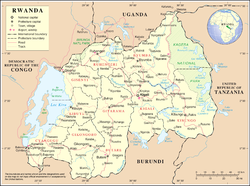
Rwanda is located in Central/Eastern Africa, and is bordered by the Democratic Republic of the Congo to the west, Uganda to the north, Tanzania to the east, and Burundi to the south. It lies a few degrees south of the equator and is landlocked. The capital, Kigali, is located near the centre of Rwanda.
The watershed between the major Congo and Nile drainage basins runs from north to south through Rwanda, with around 80 percent of the country's area draining into the Nile and 20 percent into the Congo via the Rusizi River. The country's longest river is the Nyabarongo, which rises in the south-west, flows north, east, and southeast before merging with the Akanyaru to form the Kagera; the Kagera then flows due north along the eastern border with Tanzania. The Nyabarongo-Kagera eventually drains into Lake Victoria, and its source in Nyungwe Forest is a contender for the as-yet undetermined overall source of the Nile.
Rwanda has many lakes, the largest being Lake Kivu. This lake occupies the floor of the Albertine Rift along most of the length of Rwanda's western border, and with a maximum depth of 480 metres (1,575 ft), it is one of the twenty deepest lakes in the world. Other sizeable lakes include Burera, Ruhondo, Muhazi, Rweru, and Ihema, the last being the largest of a string of lakes in the eastern plains of Akagera National Park.
Mountains dominate central and western Rwanda. These mountains are part of the Albertine Rift Mountains that flank the Albertine branch of the East African Rift. This branch runs from north to south along Rwanda's western border. The highest peaks are found in the Virunga volcano chain in the northwest; this includes Mount Karisimbi, Rwanda's highest point, at 4,507 metres (14,787 ft).
This western section of Rwanda, which lies within the Albertine Rift montane forests ecoregion, has an elevation of 1,500 to 2,500 metres (4,921 to 8,202 ft). The centre of the country is predominantly rolling hills, while the eastern border region consists of savanna, plains and swamps.
Rwanda has a temperate tropical highland climate, with lower temperatures than are typical for equatorial countries due to its high elevation. Kigali, in the centre of the country, has a typical daily temperature range between 12 and 27 °C (54 and 81 °F), with little variation through the year. There are some temperature variations across the country; the mountainous west and north are generally cooler than the lower-lying east.
Geography of Rwanda
Rwanda is located in East Africa, to the east of the Democratic Republic of the Congo, at the co-ordinates 2°00′S 30°0′E / 2.000°S 30.000°E.
At 26,338 square kilometres (10,169 sq mi), Rwanda is the world's 149th-largest country. It is comparable in size to Haiti or the state of Massachusetts in the United States. The entire country is at a high altitude: the lowest point is the Rusizi River at 950 metres (3,117 ft) above sea level.
Rwanda is located in Central/Eastern Africa, and is bordered by the Democratic Republic of the Congo to the west, Uganda to the north, Tanzania to the east, and Burundi to the south. It lies a few degrees south of the equator and is landlocked. The capital, Kigali, is located near the centre of Rwanda.
The watershed between the major Congo and Nile drainage basins runs from north to south through Rwanda, with around 80 percent of the country's area draining into the Nile and 20 percent into the Congo via the Rusizi River. The country's longest river is the Nyabarongo, which rises in the south-west, flows north, east, and southeast before merging with the Akanyaru to form the Kagera; the Kagera then flows due north along the eastern border with Tanzania. The Nyabarongo-Kagera eventually drains into Lake Victoria, and its source in Nyungwe Forest is a contender for the as-yet undetermined overall source of the Nile.
Rwanda has many lakes, the largest being Lake Kivu. This lake occupies the floor of the Albertine Rift along most of the length of Rwanda's western border, and with a maximum depth of 480 metres (1,575 ft), it is one of the twenty deepest lakes in the world. Other sizeable lakes include Burera, Ruhondo, Muhazi, Rweru, and Ihema, the last being the largest of a string of lakes in the eastern plains of Akagera National Park.
Mountains dominate central and western Rwanda. These mountains are part of the Albertine Rift Mountains that flank the Albertine branch of the East African Rift. This branch runs from north to south along Rwanda's western border. The highest peaks are found in the Virunga volcano chain in the northwest; this includes Mount Karisimbi, Rwanda's highest point, at 4,507 metres (14,787 ft).
This western section of Rwanda, which lies within the Albertine Rift montane forests ecoregion, has an elevation of 1,500 to 2,500 metres (4,921 to 8,202 ft). The centre of the country is predominantly rolling hills, while the eastern border region consists of savanna, plains and swamps.
Rwanda has a temperate tropical highland climate, with lower temperatures than are typical for equatorial countries due to its high elevation. Kigali, in the centre of the country, has a typical daily temperature range between 12 and 27 °C (54 and 81 °F), with little variation through the year. There are some temperature variations across the country; the mountainous west and north are generally cooler than the lower-lying east.
Recent media
Recent media