
Recent from talks
Geological history of Earth
Knowledge base stats:
Talk channels stats:
Members stats:
Geological history of Earth
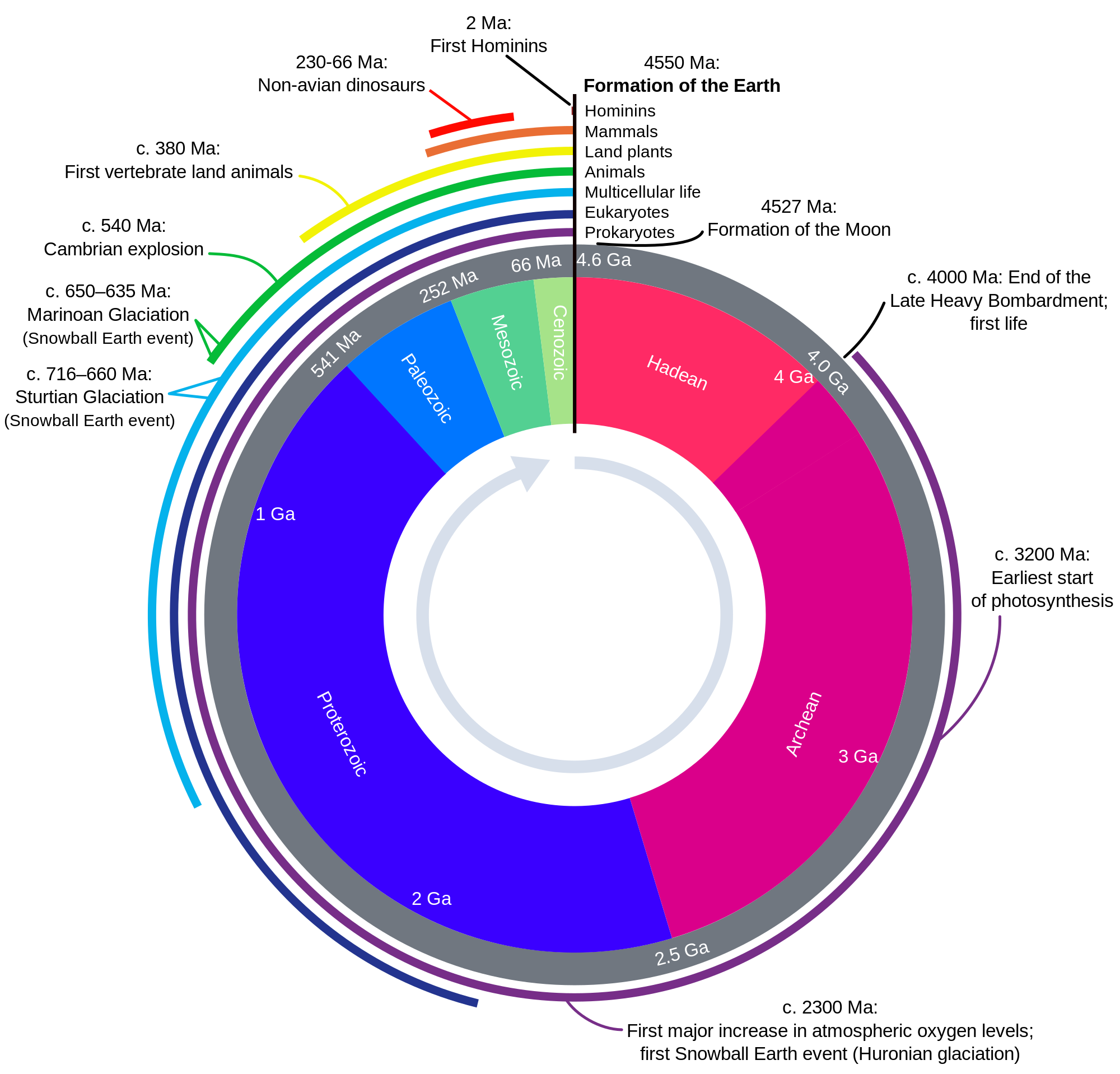
The geological history of Earth follows the major geological events in Earth's past based on the geologic time scale, a system of chronological measurement based on the study of the planet's rock layers (stratigraphy). Earth formed approximately 4.54 billion years ago through accretion from the solar nebula, a disk-shaped mass of dust and gas remaining from the formation of the Sun, which also formed the rest of the Solar System.
Initially, Earth was molten due to extreme volcanism and frequent collisions with other bodies. Eventually, the outer layer of the planet cooled to form a solid crust when water began accumulating in the atmosphere. The Moon formed soon afterwards, possibly as a result of the impact of a planetoid with Earth. Outgassing and volcanic activity produced the primordial atmosphere. Condensing water vapor, augmented by ice delivered from asteroids, produced the oceans. However, in 2020, researchers reported that sufficient water to fill the oceans may have always been on Earth since the beginning of the planet's formation.
As the surface continually reshaped itself over hundreds of millions of years, continents formed and broke apart. They migrated across the surface, occasionally combining to form a supercontinent. Roughly 750 million years ago, the earliest-known supercontinent Rodinia, began to break apart. The continents later recombined to form Pannotia, 600 to 540 million years ago, then finally Pangaea, which broke apart 200 million years ago.
The present pattern of ice ages began about 40 million years ago, then intensified at the end of the Pliocene. The polar regions have since undergone repeated cycles of glaciation and thawing, repeating every 40,000–100,000 years. The Last Glacial Period of the current ice age ended about 10,000 years ago.
The Precambrian includes approximately 90% of geologic time. It extends from 4.6 billion years ago to the beginning of the Cambrian Period (about 539 million years ago). It includes the first three of the four eons of Earth's prehistory (the Hadean, Archean, and Proterozoic) and precedes the Phanerozoic eon.
Major volcanic events altering Earth's environment and causing extinctions may have occurred 10 times in the past 3 billion years.
During Hadean time (4.6–4 Ga), the Solar System was forming, probably within a large cloud of gas and dust around the Sun, called an accretion disc from which Earth formed 4,500 million years ago. The Hadean Eon is not formally recognized, but it essentially marks the era before we have adequate record of significant solid rocks. The oldest dated zircons date from about 4,400 million years ago.
Earth was initially molten due to extreme volcanism and frequent collisions with other bodies. Eventually, the outer layer of the planet cooled to form a solid crust when water began accumulating in the atmosphere. The Moon formed soon afterwards, possibly as a result of the impact of a large planetoid with Earth. More recent potassium isotopic studies suggest that the Moon was formed by a smaller, high-energy, high-angular-momentum giant impact cleaving off a significant portion of Earth. Some of this object's mass merged with Earth, significantly altering its internal composition, and a portion was ejected into space. Some of the material survived to form the orbiting Moon. Outgassing and volcanic activity produced the primordial atmosphere. Condensing water vapor, augmented by ice delivered from comets, produced the oceans. However, in 2020, researchers reported that sufficient water to fill the oceans may have always been on Earth since the beginning of the planet's formation.
Hub AI
Geological history of Earth AI simulator
(@Geological history of Earth_simulator)
Geological history of Earth
The geological history of Earth follows the major geological events in Earth's past based on the geologic time scale, a system of chronological measurement based on the study of the planet's rock layers (stratigraphy). Earth formed approximately 4.54 billion years ago through accretion from the solar nebula, a disk-shaped mass of dust and gas remaining from the formation of the Sun, which also formed the rest of the Solar System.
Initially, Earth was molten due to extreme volcanism and frequent collisions with other bodies. Eventually, the outer layer of the planet cooled to form a solid crust when water began accumulating in the atmosphere. The Moon formed soon afterwards, possibly as a result of the impact of a planetoid with Earth. Outgassing and volcanic activity produced the primordial atmosphere. Condensing water vapor, augmented by ice delivered from asteroids, produced the oceans. However, in 2020, researchers reported that sufficient water to fill the oceans may have always been on Earth since the beginning of the planet's formation.
As the surface continually reshaped itself over hundreds of millions of years, continents formed and broke apart. They migrated across the surface, occasionally combining to form a supercontinent. Roughly 750 million years ago, the earliest-known supercontinent Rodinia, began to break apart. The continents later recombined to form Pannotia, 600 to 540 million years ago, then finally Pangaea, which broke apart 200 million years ago.
The present pattern of ice ages began about 40 million years ago, then intensified at the end of the Pliocene. The polar regions have since undergone repeated cycles of glaciation and thawing, repeating every 40,000–100,000 years. The Last Glacial Period of the current ice age ended about 10,000 years ago.
The Precambrian includes approximately 90% of geologic time. It extends from 4.6 billion years ago to the beginning of the Cambrian Period (about 539 million years ago). It includes the first three of the four eons of Earth's prehistory (the Hadean, Archean, and Proterozoic) and precedes the Phanerozoic eon.
Major volcanic events altering Earth's environment and causing extinctions may have occurred 10 times in the past 3 billion years.
During Hadean time (4.6–4 Ga), the Solar System was forming, probably within a large cloud of gas and dust around the Sun, called an accretion disc from which Earth formed 4,500 million years ago. The Hadean Eon is not formally recognized, but it essentially marks the era before we have adequate record of significant solid rocks. The oldest dated zircons date from about 4,400 million years ago.
Earth was initially molten due to extreme volcanism and frequent collisions with other bodies. Eventually, the outer layer of the planet cooled to form a solid crust when water began accumulating in the atmosphere. The Moon formed soon afterwards, possibly as a result of the impact of a large planetoid with Earth. More recent potassium isotopic studies suggest that the Moon was formed by a smaller, high-energy, high-angular-momentum giant impact cleaving off a significant portion of Earth. Some of this object's mass merged with Earth, significantly altering its internal composition, and a portion was ejected into space. Some of the material survived to form the orbiting Moon. Outgassing and volcanic activity produced the primordial atmosphere. Condensing water vapor, augmented by ice delivered from comets, produced the oceans. However, in 2020, researchers reported that sufficient water to fill the oceans may have always been on Earth since the beginning of the planet's formation.
Recent media