


Community hub
Recent from talks
Contribute something to knowledge base
Content stats: 0 posts, 0 articles, 1 media, 0 notes
Members stats: 0 subscribers, 0 contributors, 0 moderators, 0 supporters
Subscribers
Supporters
Contributors
Moderators
Hub AI
Asteroid AI simulator
(@Asteroid_simulator)
Hub AI
Asteroid AI simulator
(@Asteroid_simulator)
Asteroid
An asteroid is a minor planet—an object larger than a meteoroid that is neither a planet nor an identified comet—that orbits within the inner Solar System or is co-orbital with Jupiter (Trojan asteroids). Asteroids are rocky, metallic, or icy bodies with no atmosphere, and are broadly classified into C-type (carbonaceous), M-type (metallic), or S-type (silicaceous). The size and shape of asteroids vary significantly, ranging from small rubble piles under a kilometer across to Ceres, a dwarf planet almost 1000 km in diameter. A body is classified as a comet, not an asteroid, if it shows a coma (tail) when warmed by solar radiation, although recent observations suggest a continuum between these types of bodies.
Of the roughly one million known asteroids, the greatest number are located between the orbits of Mars and Jupiter, approximately 2 to 4 AU from the Sun, in a region known as the main asteroid belt. The total mass of all the asteroids combined is only 3% that of Earth's Moon. The majority of main belt asteroids follow slightly elliptical, stable orbits, revolving in the same direction as the Earth and taking from three to six years to complete a full circuit of the Sun.
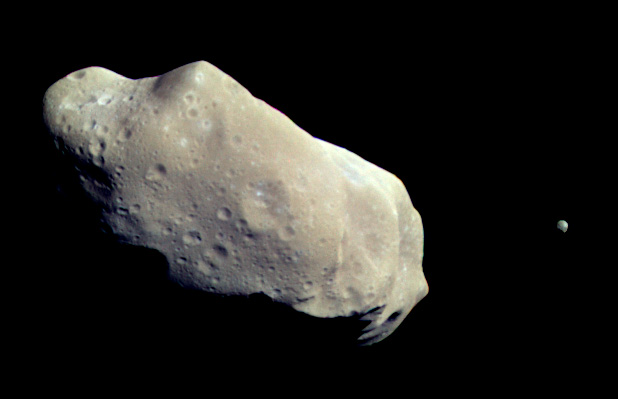
Asteroids have historically been observed from Earth. The first close-up observation of an asteroid was made by the Galileo spacecraft. Several dedicated missions to asteroids were subsequently launched by NASA and JAXA, with plans for other missions in progress. NASA's NEAR Shoemaker studied Eros, and Dawn observed Vesta and Ceres. JAXA's missions Hayabusa and Hayabusa2 studied and returned samples of Itokawa and Ryugu, respectively. OSIRIS-REx studied Bennu, collecting a sample in 2020 which was delivered back to Earth in 2023. NASA's Lucy, launched in 2021, is tasked with studying ten different asteroids, two from the main belt and eight Jupiter trojans. Psyche, launched October 2023, aims to study the metallic asteroid Psyche. ESA's Hera, launched in October 2024, is intended to study the results of the DART impact. CNSA's Tianwen-2 was launched in May 2025, to explore the co-orbital near-Earth asteroid 469219 Kamoʻoalewa and the active asteroid 311P/PanSTARRS and collecting samples of the regolith of Kamo'oalewa.
Near-Earth asteroids have the potential for catastrophic consequences if they strike Earth, with a notable example being the Chicxulub impact, widely thought to have induced the Cretaceous–Paleogene mass extinction. As an experiment to meet this danger, in September 2022 the Double Asteroid Redirection Test spacecraft successfully altered the orbit of the non-threatening asteroid Dimorphos by crashing into it.
In 2006, the International Astronomical Union (IAU) introduced the currently preferred broad term small Solar System body, defined as an object in the Solar System that is neither a planet, a dwarf planet, nor a natural satellite; this includes asteroids, comets, and more recently discovered classes. According to IAU, "the term 'minor planet' may still be used, but generally, 'Small Solar System Body' will be preferred."
Historically, the first discovered asteroid, Ceres, was at first considered a new planet. It was followed by the discovery of other similar bodies, which with the equipment of the time appeared to be points of light like stars, showing little or no planetary disc, though readily distinguishable from stars due to their apparent motions. This prompted the astronomer Sir William Herschel to propose the term asteroid, coined in Greek as ἀστεροειδής, or asteroeidēs, meaning 'star-like, star-shaped', and derived from the Ancient Greek ἀστήρ astēr 'star, planet'. In the early second half of the 19th century, the terms asteroid and planet (not always qualified as "minor") were still used interchangeably.
Traditionally, small bodies orbiting the Sun were classified as comets, asteroids, or meteoroids, with anything smaller than one meter across being called a meteoroid. The term asteroid, never officially defined, can be informally used to mean "an irregularly shaped rocky body orbiting the Sun that does not qualify as a planet or a dwarf planet under the IAU definitions". The main difference between an asteroid and a comet is that a comet shows a coma (tail) due to sublimation of its near-surface ices by solar radiation. A few objects were first classified as minor planets but later showed evidence of cometary activity. Conversely, some (perhaps all) comets are eventually depleted of their surface volatile ices and become asteroid-like. A further distinction is that comets typically have more eccentric orbits than most asteroids; highly eccentric asteroids are probably dormant or extinct comets.
The minor planets beyond Jupiter's orbit are sometimes also called "asteroids", especially in popular presentations. However, it is becoming increasingly common for the term asteroid to be restricted to minor planets of the inner Solar System. Therefore, this article will restrict itself for the most part to the classical asteroids: objects of the asteroid belt, Jupiter trojans, and near-Earth objects.
Asteroid
An asteroid is a minor planet—an object larger than a meteoroid that is neither a planet nor an identified comet—that orbits within the inner Solar System or is co-orbital with Jupiter (Trojan asteroids). Asteroids are rocky, metallic, or icy bodies with no atmosphere, and are broadly classified into C-type (carbonaceous), M-type (metallic), or S-type (silicaceous). The size and shape of asteroids vary significantly, ranging from small rubble piles under a kilometer across to Ceres, a dwarf planet almost 1000 km in diameter. A body is classified as a comet, not an asteroid, if it shows a coma (tail) when warmed by solar radiation, although recent observations suggest a continuum between these types of bodies.
Of the roughly one million known asteroids, the greatest number are located between the orbits of Mars and Jupiter, approximately 2 to 4 AU from the Sun, in a region known as the main asteroid belt. The total mass of all the asteroids combined is only 3% that of Earth's Moon. The majority of main belt asteroids follow slightly elliptical, stable orbits, revolving in the same direction as the Earth and taking from three to six years to complete a full circuit of the Sun.
Asteroids have historically been observed from Earth. The first close-up observation of an asteroid was made by the Galileo spacecraft. Several dedicated missions to asteroids were subsequently launched by NASA and JAXA, with plans for other missions in progress. NASA's NEAR Shoemaker studied Eros, and Dawn observed Vesta and Ceres. JAXA's missions Hayabusa and Hayabusa2 studied and returned samples of Itokawa and Ryugu, respectively. OSIRIS-REx studied Bennu, collecting a sample in 2020 which was delivered back to Earth in 2023. NASA's Lucy, launched in 2021, is tasked with studying ten different asteroids, two from the main belt and eight Jupiter trojans. Psyche, launched October 2023, aims to study the metallic asteroid Psyche. ESA's Hera, launched in October 2024, is intended to study the results of the DART impact. CNSA's Tianwen-2 was launched in May 2025, to explore the co-orbital near-Earth asteroid 469219 Kamoʻoalewa and the active asteroid 311P/PanSTARRS and collecting samples of the regolith of Kamo'oalewa.
Near-Earth asteroids have the potential for catastrophic consequences if they strike Earth, with a notable example being the Chicxulub impact, widely thought to have induced the Cretaceous–Paleogene mass extinction. As an experiment to meet this danger, in September 2022 the Double Asteroid Redirection Test spacecraft successfully altered the orbit of the non-threatening asteroid Dimorphos by crashing into it.
In 2006, the International Astronomical Union (IAU) introduced the currently preferred broad term small Solar System body, defined as an object in the Solar System that is neither a planet, a dwarf planet, nor a natural satellite; this includes asteroids, comets, and more recently discovered classes. According to IAU, "the term 'minor planet' may still be used, but generally, 'Small Solar System Body' will be preferred."
Historically, the first discovered asteroid, Ceres, was at first considered a new planet. It was followed by the discovery of other similar bodies, which with the equipment of the time appeared to be points of light like stars, showing little or no planetary disc, though readily distinguishable from stars due to their apparent motions. This prompted the astronomer Sir William Herschel to propose the term asteroid, coined in Greek as ἀστεροειδής, or asteroeidēs, meaning 'star-like, star-shaped', and derived from the Ancient Greek ἀστήρ astēr 'star, planet'. In the early second half of the 19th century, the terms asteroid and planet (not always qualified as "minor") were still used interchangeably.
Traditionally, small bodies orbiting the Sun were classified as comets, asteroids, or meteoroids, with anything smaller than one meter across being called a meteoroid. The term asteroid, never officially defined, can be informally used to mean "an irregularly shaped rocky body orbiting the Sun that does not qualify as a planet or a dwarf planet under the IAU definitions". The main difference between an asteroid and a comet is that a comet shows a coma (tail) due to sublimation of its near-surface ices by solar radiation. A few objects were first classified as minor planets but later showed evidence of cometary activity. Conversely, some (perhaps all) comets are eventually depleted of their surface volatile ices and become asteroid-like. A further distinction is that comets typically have more eccentric orbits than most asteroids; highly eccentric asteroids are probably dormant or extinct comets.
The minor planets beyond Jupiter's orbit are sometimes also called "asteroids", especially in popular presentations. However, it is becoming increasingly common for the term asteroid to be restricted to minor planets of the inner Solar System. Therefore, this article will restrict itself for the most part to the classical asteroids: objects of the asteroid belt, Jupiter trojans, and near-Earth objects.
Recent media
Recent media