
Recent from talks
Proterozoic
Knowledge base stats:
Talk channels stats:
Members stats:
Proterozoic
The Proterozoic (IPA: /ˌproʊtərəˈzoʊɪk, ˌprɒt-, -əroʊ-, -trə-, -troʊ-/ PROH-tər-ə-ZOH-ik, PROT-, -ər-oh-, -trə-, -troh-) is the third of the four geologic eons of Earth's history, spanning the time interval from 2500 to 538.8 Ma, and is the longest eon of Earth's geologic time scale. It is preceded by the Archean and followed by the Phanerozoic, and is the most recent part of the Precambrian "supereon".
The Proterozoic is subdivided into three geologic eras (from oldest to youngest): the Paleoproterozoic, Mesoproterozoic and Neoproterozoic. It covers the time from the appearance of free oxygen in Earth's atmosphere to just before the proliferation of complex life on the Earth during the Cambrian Explosion. The name Proterozoic combines two words of Greek origin: protero- meaning "former, earlier", and -zoic, meaning "of life".
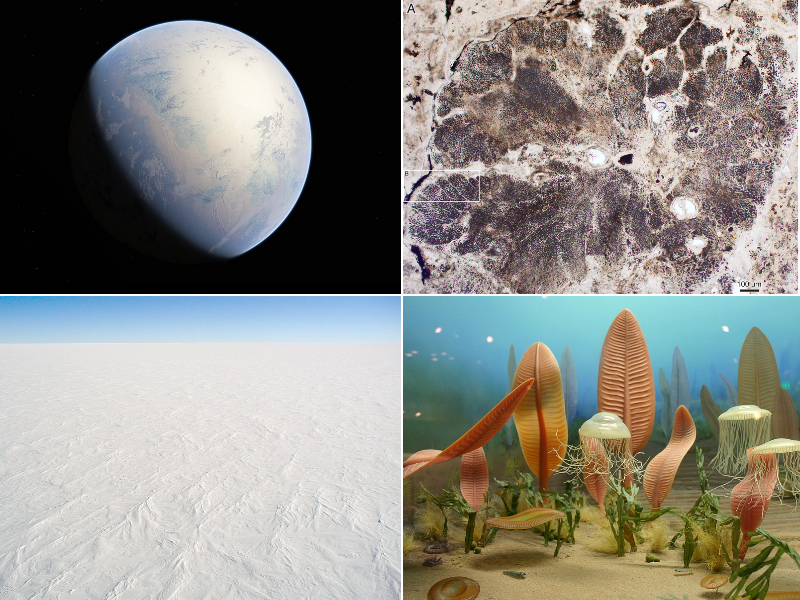
Well-identified events of this eon were the transition to an oxygenated atmosphere during the Paleoproterozoic; the evolution of eukaryotes via symbiogenesis; several global glaciations, which produced the 300 million years-long Huronian glaciation (during the Siderian and Rhyacian periods of the Paleoproterozoic) and the hypothesized Snowball Earth (during the Cryogenian period in the late Neoproterozoic); and the Ediacaran period (635–538.8 Ma), which was characterized by the evolution of abundant soft-bodied multicellular organisms such as sponges, algae, cnidarians, bilaterians and the sessile Ediacaran biota (some of which had evolved sexual reproduction) and provides the first obvious fossil evidence of life on Earth.
The geologic record of the Proterozoic Eon is more complete than that for the preceding Archean Eon. In contrast to the deep-water deposits of the Archean, the Proterozoic features many strata that were laid down in extensive shallow epicontinental seas; furthermore, many of those rocks are less metamorphosed than Archean rocks, and many are unaltered. Studies of these rocks have shown that the eon continued the massive continental accretion that had begun late in the Archean Eon. The Proterozoic Eon also featured the first definitive supercontinent cycles and wholly modern[clarify] mountain building activity (orogeny).
There is evidence that the first known glaciations occurred during the Proterozoic. The first began shortly after the beginning of the Proterozoic Eon, and evidence of at least four during the Neoproterozoic Era at the end of the Proterozoic Eon, possibly climaxing with the hypothesized Snowball Earth of the Sturtian and Marinoan glaciations.
One of the most important events of the Proterozoic was the accumulation of oxygen in the Earth's atmosphere. Though oxygen is believed to have been released by photosynthesis as far back as the Archean Eon, it could not build up to any significant degree until mineral sinks of unoxidized sulfur and iron had been exhausted. Until roughly 2.3 Ga, oxygen was probably only 1% to 2% of its current level. The banded iron formations, which provide most of the world's iron ore, are one mark of that mineral sink process. Their accumulation ceased after 1.9 Ga, after the iron in the oceans had all been oxidized.
Red beds, which are colored by hematite, indicate an increase in atmospheric oxygen 2 Ga. Such massive iron oxide formations are not found in older rocks. The oxygen buildup was probably due to two factors: Exhaustion of the chemical sinks, and an increase in carbon sequestration, which sequestered organic compounds that would have otherwise been oxidized by the atmosphere.
The first surge in atmospheric oxygen at the beginning of the Proterozoic is called the Great Oxygenation Event, or alternately the Oxygen Catastrophe – to reflect the mass extinction of almost all life on Earth, which at the time was virtually all obligate anaerobic. A second, later surge in oxygen concentrations is called the Neoproterozoic Oxygenation Event, occurred during the Middle and Late Neoproterozoic and drove the rapid evolution of multicellular life towards the end of the era.
Hub AI
Proterozoic AI simulator
(@Proterozoic_simulator)
Proterozoic
The Proterozoic (IPA: /ˌproʊtərəˈzoʊɪk, ˌprɒt-, -əroʊ-, -trə-, -troʊ-/ PROH-tər-ə-ZOH-ik, PROT-, -ər-oh-, -trə-, -troh-) is the third of the four geologic eons of Earth's history, spanning the time interval from 2500 to 538.8 Ma, and is the longest eon of Earth's geologic time scale. It is preceded by the Archean and followed by the Phanerozoic, and is the most recent part of the Precambrian "supereon".
The Proterozoic is subdivided into three geologic eras (from oldest to youngest): the Paleoproterozoic, Mesoproterozoic and Neoproterozoic. It covers the time from the appearance of free oxygen in Earth's atmosphere to just before the proliferation of complex life on the Earth during the Cambrian Explosion. The name Proterozoic combines two words of Greek origin: protero- meaning "former, earlier", and -zoic, meaning "of life".
Well-identified events of this eon were the transition to an oxygenated atmosphere during the Paleoproterozoic; the evolution of eukaryotes via symbiogenesis; several global glaciations, which produced the 300 million years-long Huronian glaciation (during the Siderian and Rhyacian periods of the Paleoproterozoic) and the hypothesized Snowball Earth (during the Cryogenian period in the late Neoproterozoic); and the Ediacaran period (635–538.8 Ma), which was characterized by the evolution of abundant soft-bodied multicellular organisms such as sponges, algae, cnidarians, bilaterians and the sessile Ediacaran biota (some of which had evolved sexual reproduction) and provides the first obvious fossil evidence of life on Earth.
The geologic record of the Proterozoic Eon is more complete than that for the preceding Archean Eon. In contrast to the deep-water deposits of the Archean, the Proterozoic features many strata that were laid down in extensive shallow epicontinental seas; furthermore, many of those rocks are less metamorphosed than Archean rocks, and many are unaltered. Studies of these rocks have shown that the eon continued the massive continental accretion that had begun late in the Archean Eon. The Proterozoic Eon also featured the first definitive supercontinent cycles and wholly modern[clarify] mountain building activity (orogeny).
There is evidence that the first known glaciations occurred during the Proterozoic. The first began shortly after the beginning of the Proterozoic Eon, and evidence of at least four during the Neoproterozoic Era at the end of the Proterozoic Eon, possibly climaxing with the hypothesized Snowball Earth of the Sturtian and Marinoan glaciations.
One of the most important events of the Proterozoic was the accumulation of oxygen in the Earth's atmosphere. Though oxygen is believed to have been released by photosynthesis as far back as the Archean Eon, it could not build up to any significant degree until mineral sinks of unoxidized sulfur and iron had been exhausted. Until roughly 2.3 Ga, oxygen was probably only 1% to 2% of its current level. The banded iron formations, which provide most of the world's iron ore, are one mark of that mineral sink process. Their accumulation ceased after 1.9 Ga, after the iron in the oceans had all been oxidized.
Red beds, which are colored by hematite, indicate an increase in atmospheric oxygen 2 Ga. Such massive iron oxide formations are not found in older rocks. The oxygen buildup was probably due to two factors: Exhaustion of the chemical sinks, and an increase in carbon sequestration, which sequestered organic compounds that would have otherwise been oxidized by the atmosphere.
The first surge in atmospheric oxygen at the beginning of the Proterozoic is called the Great Oxygenation Event, or alternately the Oxygen Catastrophe – to reflect the mass extinction of almost all life on Earth, which at the time was virtually all obligate anaerobic. A second, later surge in oxygen concentrations is called the Neoproterozoic Oxygenation Event, occurred during the Middle and Late Neoproterozoic and drove the rapid evolution of multicellular life towards the end of the era.
Recent media