Hubbry Logo
George SauerGeorge SauerMain
Open search
George Sauer
Community hub
George Sauer
logo
8 pages, 0 posts
0 subscribers
Be the first to start a discussion here.
George Sauer
George Sauer
from Wikipedia

George Henry Sauer Sr. (December 11, 1910 – February 5, 1994) was an American football player, coach, college sports administrator, and professional football executive.

Key Information

Career

[edit]

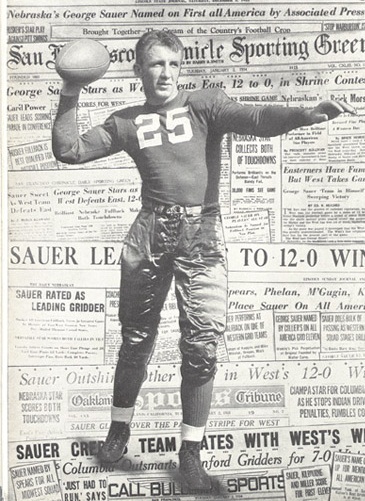
Sauer attended the University of Nebraska where he was an All-American halfback under Dana X. Bible from 1931 to 1933. After college, he played for the Green Bay Packers of the National Football League (NFL) from 1935 to 1937, helping them win the 1936 NFL championship as their starting left halfback. Sauer left professional football in 1937 and coached at the University of New Hampshire from 1937 to 1941, compiling a record of 22–18–1.[1] He left his coaching position and enlisted in the U.S. Navy in 1942 and was commissioned as an officer after completing the requisite training.[2] After he completed his military service, he coached for two years at University of Kansas, he compiled a 15–3–2 (.786) record, winning the conference title in each season.[3] After he left Kansas, Sauer coached at the United States Naval Academy (1948–1949), and Baylor University (1950–1955), compiling a career college football record of 78–55–9 and earning trips to both the Orange Bowl and the Gator Bowl.[4] Sauer remained at Baylor as Athletic Director until 1960 when he became the first General Manager of the New York Titans of the American Football League. The Titans later reorganized and in 1963 were renamed in as the New York Jets. As director of player personnel, Sauer drafted and signed his own son, George Sauer Jr. as a wide receiver.[5] Sauer remained with the Jets until 1969 when he was named general manager of the Boston Patriots.[6]

Sauer appeared as an imposter on the February 26, 1962, episode of the game show To Tell The Truth.[7]

Death and legacy

[edit]

Sauer died in 1994 after a 10 year battle with Alzheimer's disease. At the time of his death, he was survived by his wife Lillian; son, George Sauer Jr.; and daughter, Dana.[8]

Sauer was inducted into the College Football Hall of Fame as a player in 1954 and in 1998 was inducted into the University of New Hampshire Wildcats' Hall of Fame.[9]

Head coaching record

[edit]

Football

[edit]
Year Team Overall Conference Standing Bowl/playoffs Coaches# AP°
New Hampshire Wildcats (New England Conference) (1937–1941)
1937 New Hampshire 7–1 1–0 T–1st
1938 New Hampshire 3–6 1–1 3rd
1939 New Hampshire 3–5 1–1 T–2nd
1940 New Hampshire 5–3 2–0 1st
1941 New Hampshire 4–3–1 0–0–1 3rd
New Hampshire: 22–18–1 5–2–1
Kansas Jayhawks (Big Six Conference) (1946–1947)
1946 Kansas 7–2–1 4–1 T–1st
1947 Kansas 8–1–2 4–0–1 T–1st L Orange 12
Kansas: 15–3–3 8–1–1
Navy Midshipmen (Independent) (1948–1949)
1948 Navy 0–8–1
1949 Navy 3–5–1
Navy: 3–13–2
Baylor Bears (Southwest Conference) (1950–1955)
1950 Baylor 7–3 4–2 2nd 15
1951 Baylor 8–2–1 4–1–1 2nd L Orange 9 9
1952 Baylor 4–4–2 1–3–2 5th
1953 Baylor 7–3 4–2 3rd
1954 Baylor 7–4 4–2 T–3rd L Gator 18
1955 Baylor 5–5 2–4 T–5th
Baylor: 38–21–3 19–14–3
Total: 78–55–9
      National championship         Conference title         Conference division title or championship game berth

References

[edit]
[edit]
Revisions and contributorsEdit on WikipediaRead on Wikipedia
from Grokipedia
George Sauer was an American professional football wide receiver known for his standout career with the New York Jets from 1965 to 1970, during which he earned four Pro Bowl selections and played a key role in the team's historic upset victory in Super Bowl III. Born on November 10, 1943, in Sheboygan, Wisconsin, he was the son of George Sauer Sr., a former player, coach, and the Jets' director of player personnel during his son's tenure with the team. Sauer played college football at the University of Texas, where he was a member of the 1963 national championship squad before leaving early after his junior season to sign with the Jets. Drafted in the 1965 AFL Redshirt Draft, he quickly emerged as one of the league's top pass-catchers, leading the AFL in receptions in 1967 and achieving three consecutive 1,000-yard seasons from 1966 to 1968. He earned First-Team All-AFL honors in 1967 and 1968 and was a consistent Pro Bowl performer through 1969. In Super Bowl III, Sauer caught eight passes for 133 yards to help the Jets defeat the heavily favored Baltimore Colts 16-7 in one of professional football's greatest upsets. At age 27, Sauer abruptly retired after the 1970 season, citing the game's brutality and its restrictive treatment of players. He briefly returned to football in the World Football League in 1974 and later served as an assistant coach in a minor league. In his post-football life, he pursued writing, including poetry and an unfinished novel, while working various jobs and maintaining a private existence. Sauer died on May 7, 2013, in Westerville, Ohio, following a prolonged battle with Alzheimer's disease.

Early life

Birth and family background

George Henry Sauer Jr. was born on November 10, 1943, in Sheboygan, Wisconsin, to George H. Sauer Sr. and Lillian Sauer. He was raised in Waco, Texas. His father, George H. Sauer Sr., was a consensus All-American selection as a fullback at the University of Nebraska in 1933, where he played from 1931 to 1933. George Sauer Sr. went on to play professionally as a back for the Green Bay Packers for three seasons in the 1930s. He later had an extensive coaching career at institutions including the University of New Hampshire, University of Kansas, U.S. Naval Academy, and Baylor University in Waco from 1950 to 1959. His father's long-standing involvement in football as a player, coach, and later as director of player personnel for the New York Jets provided the foundation for the family's athletic heritage.

Youth and education

George Sauer Jr. spent his formative years in Waco, Texas, after his family relocated there during his childhood. His father, George Sauer Sr., a former NFL player with the Green Bay Packers and a longtime college coach—including a stint at Baylor University in Waco—introduced him to football early. As a young boy in Waco, Sauer served as the Baylor Bears' mascot while his father coached the team, and his father practiced pass-catching with him in their backyard, bouncing off trees to simulate game situations and predicting his potential as an end. Described as an outstanding student with broad interests and a poetic sensibility, Sauer nevertheless faced significant family pressure to pursue football, shaped by his father's accomplished athletic legacy. Sauer attended Waco City Schools and starred in football at Waco High School, where he blossomed into a key player during his junior year. He served as co-captain of the 1960 Waco High School Tigers and helped lead the team to a share of the Texas State High School Football Championship in the AAAA division. His high school performance drew attention from colleges, though his path to higher education was heavily influenced by family ties. Due to his father's prior connection with University of Texas coach Dana X. Bible (under whom Sauer Sr. had played at Nebraska), Sauer received a scholarship offer from Texas on the day he was born. This longstanding arrangement left Sauer with little real choice in his college destination, as the decision appeared pre-ordained by familial expectations and his father's football network.

College career

University of Texas Longhorns

George Sauer played college football as a wide receiver for the University of Texas Longhorns in the early 1960s, lettering during the 1963 and 1964 seasons after appearing on the sophomore squad in his initial year. He was a member of the undefeated 1963 Longhorns team that compiled an 11-0 record, defeated Navy in the Cotton Bowl, and claimed the national championship under head coach Darrell Royal. The team's offense emphasized a strong running game and stout defense, which limited passing opportunities and frustrated Sauer, who saw limited action as a sophomore with 6 receptions for 97 yards and 1 touchdown. Sauer continued as a wide receiver in 1964, contributing to a 10-1 Longhorns squad that suffered their lone loss to Arkansas but earned a berth in the Orange Bowl. He delivered a notable performance in the January 1965 Orange Bowl victory over Alabama, helping secure the win in what proved to be his final college game. Dissatisfied with the run-oriented scheme that restricted his role in the passing attack, Sauer opted to leave Texas early with remaining college eligibility, an uncommon decision for the era, to pursue a professional career. This led to his selection by the New York Jets in the 1965 AFL Draft. No major individual honors such as All-Conference or All-America recognition are documented from his collegiate tenure, reflecting the team's balanced approach over star-driven passing plays.

Professional career

New York Jets tenure

George Sauer joined the New York Jets after being selected in the fifth round (36th overall) of the 1965 American Football League Redshirt Draft. He skipped his final year of college eligibility at the University of Texas to sign with the team, where his father, George Sauer Sr., served as director of player personnel. Sauer played exclusively for the Jets throughout his professional career from 1965 to 1970, appearing in 84 games as a wide receiver without ever being traded or playing for another franchise. During his tenure, Sauer operated as a split end under head coach Weeb Ewbank, who led the Jets from 1963 to 1973. His years with the team spanned the final era of the standalone American Football League (1965–1969) and the first season after the AFL–NFL merger (1970), a period when the Jets transitioned from AFL competition to the unified National Football League structure. Sauer remained with the Jets through this organizational shift, contributing as a reliable pass catcher in a franchise that sought to establish itself in professional football's evolving landscape.

Key achievements and statistics

George Sauer established himself as one of the premier wide receivers in the American Football League during his six-season career with the New York Jets from 1965 to 1970. He amassed 309 receptions for 4,965 yards and 28 touchdowns in 84 regular-season games, averaging 16.1 yards per catch. Sauer was particularly dominant from 1966 to 1968, recording three consecutive 1,000-yard seasons with 1,079 yards in 1966, 1,189 yards in 1967, and 1,141 yards in 1968. His standout 1967 campaign saw him lead the AFL with 75 receptions for 1,189 yards and 6 touchdowns. In 1969, Sauer posted a career-high 8 touchdown receptions along with 45 catches for 745 yards. He earned four Pro Bowl selections consecutively from 1966 through 1969. Sauer also received multiple All-AFL honors, including First-Team All-AFL recognition in both 1967 and 1968 from outlets such as the Associated Press, Sporting News, and UPI, as well as Second-Team All-AFL in 1966. These achievements marked him as a consistently productive receiver who ranked among the league leaders in receptions, yards, and yards per game during the late AFL era.

Super Bowl III

Participation and contribution

George Sauer was a key contributor to the New York Jets' historic upset victory in Super Bowl III on January 12, 1969, when the Jets defeated the heavily favored Baltimore Colts 16-7 at the Orange Bowl in Miami. The Colts entered the game as 18-point favorites, making the result one of the most significant upsets in professional sports history. Jets quarterback Joe Namath had publicly guaranteed victory three nights earlier at the Touchdown Club of Miami awards dinner, stating, "I think we'll win it. I'll guarantee it." Despite the Jets' run-heavy offensive approach, which featured Matt Snell rushing for 121 yards and the game's only touchdown, Sauer emerged as the team's leading receiver. He recorded a game-high eight receptions for 133 yards, with a longest catch of 39 yards and no touchdowns. Sauer's performance stood out particularly with primary deep threat Don Maynard limited by a sore ankle and held without catches, allowing Sauer to become the focal point of the passing game. His receptions helped sustain Jets drives and contributed to building an insurmountable 16-0 lead before Baltimore scored its lone touchdown late in the fourth quarter.

Retirement and later life

Reasons for retirement

George Sauer announced his retirement from professional football in April 1971 following the 1970 season with the New York Jets, at the age of 27. He informed coach Weeb Ewbank of his decision, citing a general dissatisfaction with the way the game was being played at the time. Sauer was openly critical of the authoritarian structure in professional football, arguing that it treated players like children and prevented personal growth. In a 1971 interview, he stated, “When you get to the college and professional levels, the coaches still treat you as an adolescent.” He further explained that players were denied responsibility and self-discipline, as coaches controlled nearly every aspect of their lives: “They know damn well that you were never given a chance to become responsible or self-disciplined. Even in the pros, you were told when to go to bed, when to get up, what to eat, what to wear, what to do, what not to do. You were never allowed to grow up.” He also contended that the sport failed to live up to its professed values, declaring upon retirement, "Pro football does not do what it claims to do. It claims to teach self-discipline. It claims to teach courage. It claims to teach honor. It claims to teach all these things. But it does not." Sauer described the game's authority as "chauvinistic" and viewed the overall environment as dehumanizing.

Post-football activities

After retiring from the New York Jets following the 1970 season, George Sauer briefly returned to professional football in a rival league. He played wide receiver for the New York Stars in the World Football League in 1974. He also served as an assistant coach with the Carolina Chargers of the American Football Association in 1979. Sauer subsequently held a variety of occupations outside of football. These included working as a textbook editor and graphics specialist at Simon & Schuster in New York, as a construction worker, as a textbook graphics specialist, and as a grocery store shelf stacker at Sunshine Food Stores in Sioux Falls, South Dakota during the late 1990s. He pursued writing as a primary interest, composing poetry, working on novels, and producing book reviews. Sauer lived a low-profile and reclusive existence, deliberately avoiding public visibility and expressing discomfort with standing out. He made limited public appearances after his playing days, with one notable exception being a brief segment on a Monday Night Football broadcast for the 30th anniversary of the Jets' Super Bowl III victory. In his later years, Sauer resided reclusively in Ohio and battled Alzheimer's disease until his death on May 7, 2013.

Personal life

Personality and challenges

George Sauer was described as a rebel, a characterization that stemmed from his nonconformist personality and deep-seated resistance to regimentation and authority in structured environments such as professional football. His father, a longtime coach, once remarked that Sauer "definitely does not like to be regimented," highlighting a core trait that defined his outlook on life and work. This aversion to rigid control extended beyond his playing days, manifesting as a broader challenge in adapting to environments that limited personal autonomy. Sauer expressed frustration with systems that treated adults like adolescents, dictating daily routines. He preferred independence and privacy, opting for a quieter existence in later years that allowed him to pursue individual interests away from public scrutiny. Sauer was married and divorced several times. Despite these challenges, he maintained a commitment to his principles.

Death and legacy

Final years and impact

George Sauer spent his final years in Westerville, Ohio, where he battled Alzheimer's disease and received care at facilities including the Manor Care Health center. He died on May 7, 2013, at the age of 69 from congestive heart failure following a lengthy struggle with Alzheimer's disease. His sister Dana Keifer confirmed the cause of death, and a private family service was held. Sauer is remembered for his integral role in the New York Jets' historic Super Bowl III victory. Jets owner Woody Johnson stated that Sauer would be remembered for his contributions to the team's championship run and the strength of his convictions off the field, adding that his impact would always be part of the organization's history. Head coach Rex Ryan reflected on Sauer's performance in the biggest moment, noting that he stepped up when key teammates were limited. The Jets organization honored his legacy as a productive receiver from the AFL era whose achievements endure in franchise lore.

References

Add your contribution
Related Hubs
User Avatar
No comments yet.