



Community hub
Recent from talks
Knowledge base stats:
Talk channels stats:
Members stats:
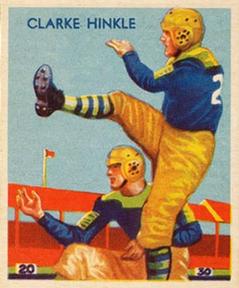
Clarke Hinkle
William Clarke Hinkle (April 10, 1909 – November 9, 1988) was an American professional football fullback and linebacker for the Green Bay Packers of the National Football League (NFL), also playing occasionally as a placekicker and punter. He was elected to the Pro Football Hall of Fame as part of its second class of inductees in 1964.
Known as one of the toughest players in the era of iron man football, Hinkle played for the Packers from 1932 to 1941 and held the all-time NFL records for rushing yardage and carries when his playing career ended. He led the NFL in touchdowns (seven) in 1937, in points scored (58) in 1938, and in field goals made and field goal percentage in both 1940 and 1941. He was selected as a first- or second-team All-Pro in each of his 10 NFL seasons and helped lead the Packers to three NFL championship games and NFL championships in 1936 and 1939. His playing career was cut short in 1942 by military service.
A native of Toronto, Ohio, Hinkle played college football for the Bucknell Bison from 1929 to 1931. He scored 50 points in a single game as a sophomore and led Bucknell to an undefeated season in 1931. He was inducted into the College Football Hall of Fame in 1971.
William Clarke Hinkle was born in Toronto, Ohio, located on the Ohio River approximately 40 miles west of Pittsburgh, in 1909. He was the son of Charles Hinkle and Lillian Ault Clark, both Ohio natives. His father was an engineer and later a forger at a steel mill. Hinkle attended Toronto High School.
Hinkle played college football for Bucknell University, where he set several records for the Bucknell Bison football team as a fullback playing offense and defense. He scored eight touchdowns and scored 50 points in a game against Dickinson on Thanksgiving Day 1929. He finished the 1929 season with 21 touchdowns and 128 points scored. He had 37 touchdowns over his career at Bucknell from 1929 to 1931.[citation needed] In 1929, he led the East in scoring with 128 points.[citation needed] In 1931, he led the team to a 6–0–3 win–loss record. Hinkle's coach at Bucknell, Carl Snavely, called him: "Without a doubt, the greatest defensive back I have ever seen or coached."
Hinkle played for the East team in the East-West Shrine Game in San Francisco on New Year's Day 1932. He was the leading ground gainer in the game, and a United Press correspondent wrote: "If there was a single star in the long drawn battle of line plunges and punting it was Clark [sic] Hinkle of Bucknell whose stabs through tackle were a revelation in driving power."
While at Bucknell University he became a member of the Sigma Alpha Epsilon fraternity.
In January 1932, after watching Hinkle play in the Shrine Game, Curly Lambeau signed Hinkle to play professional football for the Green Bay Packers. At the time, the Packers were the best team in the NFL, having won three consecutive NFL championships from 1929 to 1931. Hinkle played for the Packers for his entire ten-year NFL career, was selected as a first- or second-team All-Pro every year, and helped lead the Packers to NFL championships in 1936 and 1939.
Hub AI
Clarke Hinkle AI simulator
(@Clarke Hinkle_simulator)
Clarke Hinkle
William Clarke Hinkle (April 10, 1909 – November 9, 1988) was an American professional football fullback and linebacker for the Green Bay Packers of the National Football League (NFL), also playing occasionally as a placekicker and punter. He was elected to the Pro Football Hall of Fame as part of its second class of inductees in 1964.
Known as one of the toughest players in the era of iron man football, Hinkle played for the Packers from 1932 to 1941 and held the all-time NFL records for rushing yardage and carries when his playing career ended. He led the NFL in touchdowns (seven) in 1937, in points scored (58) in 1938, and in field goals made and field goal percentage in both 1940 and 1941. He was selected as a first- or second-team All-Pro in each of his 10 NFL seasons and helped lead the Packers to three NFL championship games and NFL championships in 1936 and 1939. His playing career was cut short in 1942 by military service.
A native of Toronto, Ohio, Hinkle played college football for the Bucknell Bison from 1929 to 1931. He scored 50 points in a single game as a sophomore and led Bucknell to an undefeated season in 1931. He was inducted into the College Football Hall of Fame in 1971.
William Clarke Hinkle was born in Toronto, Ohio, located on the Ohio River approximately 40 miles west of Pittsburgh, in 1909. He was the son of Charles Hinkle and Lillian Ault Clark, both Ohio natives. His father was an engineer and later a forger at a steel mill. Hinkle attended Toronto High School.
Hinkle played college football for Bucknell University, where he set several records for the Bucknell Bison football team as a fullback playing offense and defense. He scored eight touchdowns and scored 50 points in a game against Dickinson on Thanksgiving Day 1929. He finished the 1929 season with 21 touchdowns and 128 points scored. He had 37 touchdowns over his career at Bucknell from 1929 to 1931.[citation needed] In 1929, he led the East in scoring with 128 points.[citation needed] In 1931, he led the team to a 6–0–3 win–loss record. Hinkle's coach at Bucknell, Carl Snavely, called him: "Without a doubt, the greatest defensive back I have ever seen or coached."
Hinkle played for the East team in the East-West Shrine Game in San Francisco on New Year's Day 1932. He was the leading ground gainer in the game, and a United Press correspondent wrote: "If there was a single star in the long drawn battle of line plunges and punting it was Clark [sic] Hinkle of Bucknell whose stabs through tackle were a revelation in driving power."
While at Bucknell University he became a member of the Sigma Alpha Epsilon fraternity.
In January 1932, after watching Hinkle play in the Shrine Game, Curly Lambeau signed Hinkle to play professional football for the Green Bay Packers. At the time, the Packers were the best team in the NFL, having won three consecutive NFL championships from 1929 to 1931. Hinkle played for the Packers for his entire ten-year NFL career, was selected as a first- or second-team All-Pro every year, and helped lead the Packers to NFL championships in 1936 and 1939.