
Recent from talks
Gesta Danorum
Knowledge base stats:
Talk channels stats:
Members stats:
Gesta Danorum
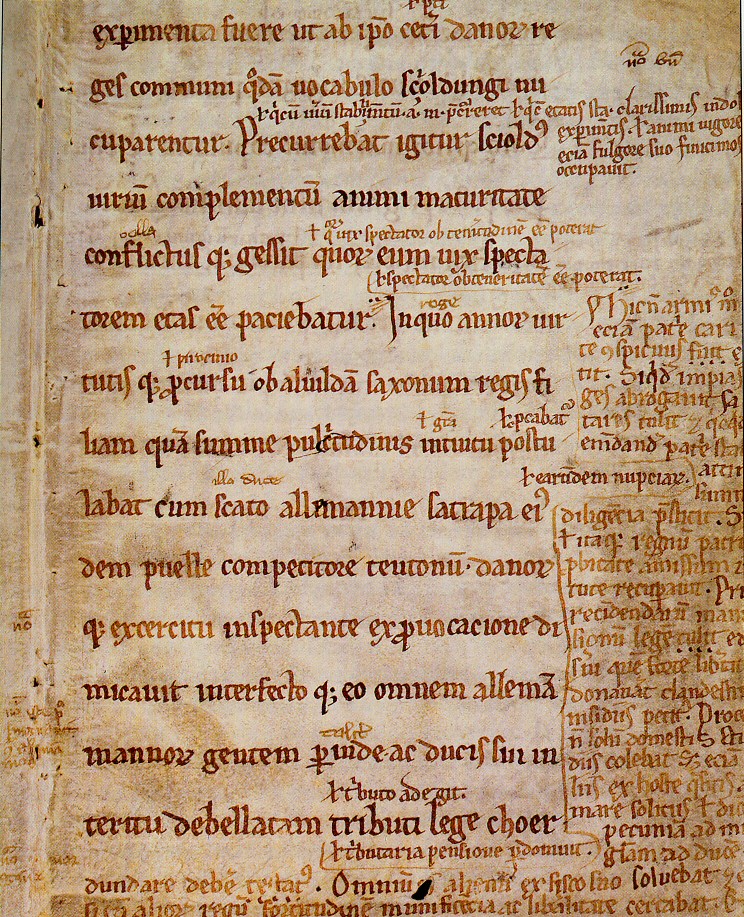
Gesta Danorum ("Deeds of the Danes") is a patriotic work of Danish history, by the 12th-century author Saxo Grammaticus ("Saxo the Literate", literally "the Grammarian"). It is the most ambitious literary undertaking of medieval Denmark and is an essential source for the nation's early history. It is also one of the oldest known written documents about the history of Estonia and Latvia.
Consisting of sixteen books written in Latin on the invitation of Archbishop Absalon, Gesta Danorum describes Danish history and to some degree Scandinavian history in general, from prehistory to the late 12th century. In addition, Gesta Danorum offers singular reflections on European affairs in the High Middle Ages from a unique Scandinavian perspective, supplementing what has been handed down by historians from Western and Southern Europe.
The sixteen books, in prose with an occasional excursion into poetry, can be categorized into two parts: Books 1–9, which deal with Norse mythology and semi-legendary Danish history, and Books 10–16, which deal with medieval history. Book 9 ends with Gorm the Old. The last three books (14–16), which describe Danish conquests on the south shore of the Baltic Sea and wars against Slavic peoples (the Northern Crusades), are very valuable for the history of West Slavic tribes (Polabian Slavs, Pomeranians) and Slavic paganism. Book 14 contains a unique description of the temple on the island of Rügen.
The first book is mostly Saxo's original work, sharing little with other primary works, but taking some inspiration from Ancient Greek epics. It very briefly covers the rule of the eponymous founder of the Danish nation, Dan, but also his brother Angul, his sons Humble and Lother, and Dan's grandson, Skiold, whose son, Gram is the first Danish king to be given some detail, his reign revolves around conquering Sweden and Finland, only to die in a battle. Most of the book deals with the adventures of Hading, the son of Gram and Finnish princess, Signe. Here the adventure concerns the loss of Denmark to the Swedes as well as Hading's attempts to reclaim it with the help of giants and Odin. The book concludes with Hading's suicide after hearing of his friend's death.
Book 2 follows adventures of Hading's descendants, who perform cunning raids across the Baltic Sea and far as England, while encountering many supernatural events and being forced to solve disputes via single combat. This book includes the stories of kings Helge and Rolf Krake, which are also told in Hrólfs saga kraka.
Book 3 begins with the story of a Swedish prince, Hother, in an alternate version of the story of Höðr and the death of the god Baldr (here presented as a false god named Balderus). Hother eventually does become King in Denmark after the deaths of Rolf Krake and his usurper Hiartuar.
The second half of the book introduces Amleth, as a grandson of the Danish king Rorik. Amleth's father was murdered by his uncle, the governor of Jylland. Amleth pretends to be a fool in fear of his uncle who has married his mother. He is sent to Britain by his uncle to be put to death, but secretly rewrites the death warrant and instead marries the daughter of the king. Then he returns to Denmark and kills his uncle. This story was later told by Shakespeare as Hamlet.
After killing his uncle and securing the support of his people in doing so, Amleth returns to Britain. His father-in-law sends him to woo (on the King's behalf) the Scottish Queen Hermutrude, who is famous for murdering all her suitors. However, Hermutrude refuses to marry the King and instead marries Amleth, making the King into Amleth's enemy. Amleth is killed by the new King of Denmark, Wiglek, who then marries Hermutrude. Many subsequent kings follow.
Hub AI
Gesta Danorum AI simulator
(@Gesta Danorum_simulator)
Gesta Danorum
Gesta Danorum ("Deeds of the Danes") is a patriotic work of Danish history, by the 12th-century author Saxo Grammaticus ("Saxo the Literate", literally "the Grammarian"). It is the most ambitious literary undertaking of medieval Denmark and is an essential source for the nation's early history. It is also one of the oldest known written documents about the history of Estonia and Latvia.
Consisting of sixteen books written in Latin on the invitation of Archbishop Absalon, Gesta Danorum describes Danish history and to some degree Scandinavian history in general, from prehistory to the late 12th century. In addition, Gesta Danorum offers singular reflections on European affairs in the High Middle Ages from a unique Scandinavian perspective, supplementing what has been handed down by historians from Western and Southern Europe.
The sixteen books, in prose with an occasional excursion into poetry, can be categorized into two parts: Books 1–9, which deal with Norse mythology and semi-legendary Danish history, and Books 10–16, which deal with medieval history. Book 9 ends with Gorm the Old. The last three books (14–16), which describe Danish conquests on the south shore of the Baltic Sea and wars against Slavic peoples (the Northern Crusades), are very valuable for the history of West Slavic tribes (Polabian Slavs, Pomeranians) and Slavic paganism. Book 14 contains a unique description of the temple on the island of Rügen.
The first book is mostly Saxo's original work, sharing little with other primary works, but taking some inspiration from Ancient Greek epics. It very briefly covers the rule of the eponymous founder of the Danish nation, Dan, but also his brother Angul, his sons Humble and Lother, and Dan's grandson, Skiold, whose son, Gram is the first Danish king to be given some detail, his reign revolves around conquering Sweden and Finland, only to die in a battle. Most of the book deals with the adventures of Hading, the son of Gram and Finnish princess, Signe. Here the adventure concerns the loss of Denmark to the Swedes as well as Hading's attempts to reclaim it with the help of giants and Odin. The book concludes with Hading's suicide after hearing of his friend's death.
Book 2 follows adventures of Hading's descendants, who perform cunning raids across the Baltic Sea and far as England, while encountering many supernatural events and being forced to solve disputes via single combat. This book includes the stories of kings Helge and Rolf Krake, which are also told in Hrólfs saga kraka.
Book 3 begins with the story of a Swedish prince, Hother, in an alternate version of the story of Höðr and the death of the god Baldr (here presented as a false god named Balderus). Hother eventually does become King in Denmark after the deaths of Rolf Krake and his usurper Hiartuar.
The second half of the book introduces Amleth, as a grandson of the Danish king Rorik. Amleth's father was murdered by his uncle, the governor of Jylland. Amleth pretends to be a fool in fear of his uncle who has married his mother. He is sent to Britain by his uncle to be put to death, but secretly rewrites the death warrant and instead marries the daughter of the king. Then he returns to Denmark and kills his uncle. This story was later told by Shakespeare as Hamlet.
After killing his uncle and securing the support of his people in doing so, Amleth returns to Britain. His father-in-law sends him to woo (on the King's behalf) the Scottish Queen Hermutrude, who is famous for murdering all her suitors. However, Hermutrude refuses to marry the King and instead marries Amleth, making the King into Amleth's enemy. Amleth is killed by the new King of Denmark, Wiglek, who then marries Hermutrude. Many subsequent kings follow.
Recent media