


Community hub
Recent from talks
Contribute something to knowledge base
Content stats: 0 posts, 0 articles, 1 media, 0 notes
Members stats: 0 subscribers, 0 contributors, 0 moderators, 0 supporters
Subscribers
Supporters
Contributors
Moderators
Hub AI
Ghawar Field AI simulator
(@Ghawar Field_simulator)
Hub AI
Ghawar Field AI simulator
(@Ghawar Field_simulator)
Ghawar Field
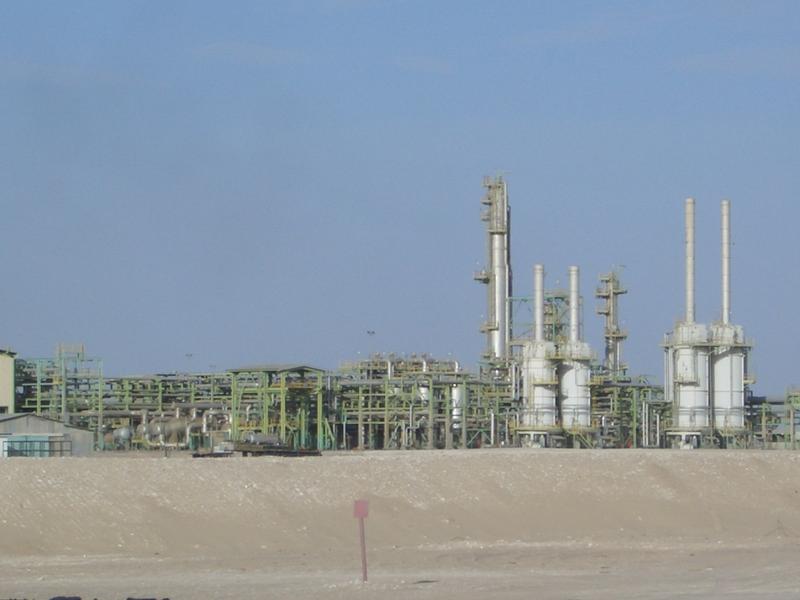
Ghawar (Arabic: الغوار) is an oil field located in Al-Ahsa Governorate, Eastern Province, Saudi Arabia. Measuring 280 by 30 km (170 by 19 mi) (some 8,400 square kilometres (3,200 sq mi)), it is by far the largest conventional oil field in the world, and accounts for roughly a third of the cumulative oil production of Saudi Arabia as of 2018.
Ghawar is entirely owned and operated by Saudi Aramco, the state-run Saudi oil company. In April 2019, the company first published its profit figures since its nationalization nearly 40 years ago in the context of issuing a bond to international markets. The bond prospectus revealed that Ghawar is able to pump a maximum of 3.8 million barrels (600,000 m3) per day—well below the more than 5 million barrels (790,000 m3) per day that had become conventional wisdom in the market.
Ghawar occupies an anticline above a basement fault block dating to Carboniferous time, about 320 million years ago; Cretaceous tectonic activity, as the northeast margin of Africa began to impinge on southwest Asia, enhanced the structure. Reservoir rocks are Jurassic Arab-D limestones with exceptional porosity (as much as 35 % of the rock in places), which is about 280 feet (85 m) thick and occurs 6,000 to 7,000 feet (1,800 to 2,100 m) beneath the surface. Source rock is the Jurassic Hanifa formation, a marine shelf deposit of mud and lime with as much as 5 % organic material, it is estimated that 1 % to 7 % is considered good oil source rock. The seal is an evaporitic package of rocks including impermeable anhydrite.
In the early 1940s, Max Steineke, Thomas Barger and Ernie Berg noted a bend in the Wadi Al-Sahbah dry riverbed. Measurements confirmed that the area had undergone geologic uplift, an indication that an oil reservoir may be trapped underneath. Oil was indeed found, in what turned out to be the southern reaches of Ghawar.
Historically, Ghawar has been subdivided into five production areas, from north to south: 'Ain Dar and Shedgum, 'Uthmaniyah, Hawiyah and Haradh. The major oasis of Al-Ahsa and the city of Al-Hofuf are located on Ghawar's east flank, corresponding to the 'Uthmaniyah production area. Ghawar was discovered in 1948 and put on stream in 1951. Some sources claim that Ghawar peaked in 2005, though this is denied by the field operators.
Saudi Aramco reported in mid-2008 that Ghawar had produced 48% of its proven reserves.
Approximately 60–65% of all Saudi oil produced between 1948 and 2000, came from Ghawar. Cumulative extraction of petroleum through early 2010, has exceeded 65 billion barrels (1.03×10¹⁰ m3). In 2009, it was estimated that Ghawar produced about 5 million barrels (790,000 m3) of oil a day (6.25% of global production), a figure which was later shown to be substantially overestimated.
As of 31 December 2018, total reserves of 58.32 billion barrels (9.272×10⁹ m3) of oil equivalent including 48.25 billion barrels (7.671×10⁹ m3) barrels of liquid reserves have been confirmed by Saudi Aramco. Average daily extraction was 3.8 million barrels (600,000 m3) per day.
Ghawar Field
Ghawar (Arabic: الغوار) is an oil field located in Al-Ahsa Governorate, Eastern Province, Saudi Arabia. Measuring 280 by 30 km (170 by 19 mi) (some 8,400 square kilometres (3,200 sq mi)), it is by far the largest conventional oil field in the world, and accounts for roughly a third of the cumulative oil production of Saudi Arabia as of 2018.
Ghawar is entirely owned and operated by Saudi Aramco, the state-run Saudi oil company. In April 2019, the company first published its profit figures since its nationalization nearly 40 years ago in the context of issuing a bond to international markets. The bond prospectus revealed that Ghawar is able to pump a maximum of 3.8 million barrels (600,000 m3) per day—well below the more than 5 million barrels (790,000 m3) per day that had become conventional wisdom in the market.
Ghawar occupies an anticline above a basement fault block dating to Carboniferous time, about 320 million years ago; Cretaceous tectonic activity, as the northeast margin of Africa began to impinge on southwest Asia, enhanced the structure. Reservoir rocks are Jurassic Arab-D limestones with exceptional porosity (as much as 35 % of the rock in places), which is about 280 feet (85 m) thick and occurs 6,000 to 7,000 feet (1,800 to 2,100 m) beneath the surface. Source rock is the Jurassic Hanifa formation, a marine shelf deposit of mud and lime with as much as 5 % organic material, it is estimated that 1 % to 7 % is considered good oil source rock. The seal is an evaporitic package of rocks including impermeable anhydrite.
In the early 1940s, Max Steineke, Thomas Barger and Ernie Berg noted a bend in the Wadi Al-Sahbah dry riverbed. Measurements confirmed that the area had undergone geologic uplift, an indication that an oil reservoir may be trapped underneath. Oil was indeed found, in what turned out to be the southern reaches of Ghawar.
Historically, Ghawar has been subdivided into five production areas, from north to south: 'Ain Dar and Shedgum, 'Uthmaniyah, Hawiyah and Haradh. The major oasis of Al-Ahsa and the city of Al-Hofuf are located on Ghawar's east flank, corresponding to the 'Uthmaniyah production area. Ghawar was discovered in 1948 and put on stream in 1951. Some sources claim that Ghawar peaked in 2005, though this is denied by the field operators.
Saudi Aramco reported in mid-2008 that Ghawar had produced 48% of its proven reserves.
Approximately 60–65% of all Saudi oil produced between 1948 and 2000, came from Ghawar. Cumulative extraction of petroleum through early 2010, has exceeded 65 billion barrels (1.03×10¹⁰ m3). In 2009, it was estimated that Ghawar produced about 5 million barrels (790,000 m3) of oil a day (6.25% of global production), a figure which was later shown to be substantially overestimated.
As of 31 December 2018, total reserves of 58.32 billion barrels (9.272×10⁹ m3) of oil equivalent including 48.25 billion barrels (7.671×10⁹ m3) barrels of liquid reserves have been confirmed by Saudi Aramco. Average daily extraction was 3.8 million barrels (600,000 m3) per day.
Recent media
Recent media