



Community hub
Recent from talks
Contribute something to knowledge base
Content stats: 0 posts, 0 articles, 1 media, 0 notes
Members stats: 0 subscribers, 0 contributors, 0 moderators, 0 supporters
Subscribers
Supporters
Contributors
Moderators
Hub AI
Giant cell arteritis AI simulator
(@Giant cell arteritis_simulator)
Hub AI
Giant cell arteritis AI simulator
(@Giant cell arteritis_simulator)
Giant cell arteritis
Giant cell arteritis (GCA), also called temporal arteritis, is an inflammatory autoimmune disease of large blood vessels. Symptoms may include headache, pain over the temples, flu-like symptoms, double vision, and difficulty opening the mouth. Complications can include blockage of the artery to the eye with resulting blindness, as well as aortic dissection, and aortic aneurysm. GCA is frequently associated with polymyalgia rheumatica.
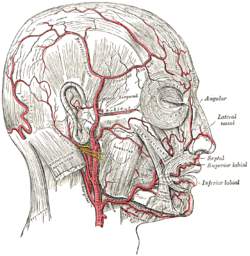
The cause is unknown. The underlying mechanism involves inflammation of the small blood vessels that supply the walls of larger arteries. This mainly affects arteries around the head and neck, though some in the chest may also be affected. Diagnosis is suspected based on symptoms, blood tests, and medical imaging, and confirmed by biopsy of the temporal artery. However, in about 10% of people the temporal artery is normal.
Treatment is typical with high doses of steroids such as prednisone or prednisolone. Once symptoms have resolved, the dose is decreased by about 15% per month. Once a low dose is reached, the taper is slowed further over the subsequent year. Other medications that may be recommended include bisphosphonates to prevent bone loss and a proton-pump inhibitor to prevent stomach problems.
It affects about 1 in 15,000 people over the age of 50 per year. The condition mostly occurs in those over the age of 50, being most common among those in their 70s. Females are more often affected than males. Those of northern European descent are more commonly affected. Life expectancy is typically normal. The first description of the condition occurred in 1890.
Common symptoms of giant cell arteritis include:
The inflammation may affect blood supply to the eye; blurred vision or sudden blindness may occur. In 76% of cases involving the eye, the ophthalmic artery is involved, causing arteritic anterior ischemic optic neuropathy.
Giant cell arteritis may present with atypical or overlapping features. Early and accurate diagnosis is important to prevent ischemic vision loss. Therefore, this condition is considered a medical emergency.
While studies vary as to the exact relapse rate of giant cell arteritis, relapse of this condition can occur. It most often happens at low doses of prednisone (<20 mg/day), during the first year of treatment, and the most common signs of relapse are headache and polymyalgia rheumatica.
Giant cell arteritis
Giant cell arteritis (GCA), also called temporal arteritis, is an inflammatory autoimmune disease of large blood vessels. Symptoms may include headache, pain over the temples, flu-like symptoms, double vision, and difficulty opening the mouth. Complications can include blockage of the artery to the eye with resulting blindness, as well as aortic dissection, and aortic aneurysm. GCA is frequently associated with polymyalgia rheumatica.
The cause is unknown. The underlying mechanism involves inflammation of the small blood vessels that supply the walls of larger arteries. This mainly affects arteries around the head and neck, though some in the chest may also be affected. Diagnosis is suspected based on symptoms, blood tests, and medical imaging, and confirmed by biopsy of the temporal artery. However, in about 10% of people the temporal artery is normal.
Treatment is typical with high doses of steroids such as prednisone or prednisolone. Once symptoms have resolved, the dose is decreased by about 15% per month. Once a low dose is reached, the taper is slowed further over the subsequent year. Other medications that may be recommended include bisphosphonates to prevent bone loss and a proton-pump inhibitor to prevent stomach problems.
It affects about 1 in 15,000 people over the age of 50 per year. The condition mostly occurs in those over the age of 50, being most common among those in their 70s. Females are more often affected than males. Those of northern European descent are more commonly affected. Life expectancy is typically normal. The first description of the condition occurred in 1890.
Common symptoms of giant cell arteritis include:
The inflammation may affect blood supply to the eye; blurred vision or sudden blindness may occur. In 76% of cases involving the eye, the ophthalmic artery is involved, causing arteritic anterior ischemic optic neuropathy.
Giant cell arteritis may present with atypical or overlapping features. Early and accurate diagnosis is important to prevent ischemic vision loss. Therefore, this condition is considered a medical emergency.
While studies vary as to the exact relapse rate of giant cell arteritis, relapse of this condition can occur. It most often happens at low doses of prednisone (<20 mg/day), during the first year of treatment, and the most common signs of relapse are headache and polymyalgia rheumatica.
Recent media
Recent media