



Community hub
Recent from talks
Knowledge base stats:
Talk channels stats:
Members stats:
Diplopia
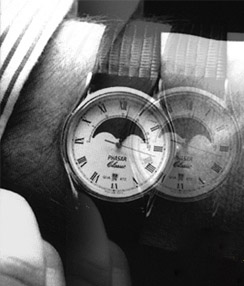
Diplopia is the simultaneous perception of two images of a single object that may be displaced in relation to each other. Also called double vision, it is a loss of visual focus under regular conditions, and is often voluntary. However, when occurring involuntarily, it results from impaired function of the extraocular muscles, where both eyes are still functional, but they cannot turn to target the desired object. Problems with these muscles may be due to mechanical problems, disorders of the neuromuscular junction, disorders of the cranial nerves (III, IV, and VI) that innervate the muscles, and occasionally disorders involving the supranuclear oculomotor pathways or ingestion of toxins.
Diplopia can be one of the first signs of a systemic disease, particularly to a muscular or neurological process, and it may disrupt a person's balance, movement, or reading abilities.
Diplopia has a diverse range of ophthalmologic, infectious, autoimmune, neurological, and neoplastic causes:
Diplopia is diagnosed mainly by information from the patient. Doctors may use blood tests, physical examinations, computed tomography (CT), or magnetic resonance imaging (MRI) to find the underlying cause.
One of the first steps in diagnosing diplopia is often to see whether one of two major classifications may be eliminated. That involves blocking one eye to see which symptoms are evident in each eye alone. Persisting blurry or double vision with one eye closed is classified as monocular diplopia.
Binocular diplopia is the other one in which the blurring of vision occurs only when the patient looks through both eyes simultaneously. It is common and occurs in approximately 10.0% to 40.0% of zygomatic complex injuries. Furthermore, diplopia may be transient or persistent. Inadequate diagnosis and treatment at improper times and tethering or fibrosis of muscles may lead to persistent diplopia.
Binocular diplopia is double vision arising as a result of strabismus (in layman's terms "cross-eyed"), the misalignment of the two eyes relative to each other, either esotropia (inward) or exotropia (outward). In such a case while the fovea of one eye is directed at the object of regard, the fovea of the other is directed elsewhere, and the image of the object of regard falls on an extrafoveal area of the retina. Acute diplopia is a diagnostic challenge. The most common cause of acute diplopia are ocular motor nerve palsies (OMP).
The brain calculates the visual direction of an object based upon the position of its image relative to the fovea. Images falling on the fovea are seen as being directly ahead, while those falling on retina outside the fovea may be seen as above, below, right, or left of straight ahead depending upon the area of retina stimulated. Thus, when the eyes are misaligned, the brain perceives two images of one target object, as the target object simultaneously stimulates different, noncorresponding, retinal areas in either eye, thus producing double vision.
Hub AI
Diplopia AI simulator
(@Diplopia_simulator)
Diplopia
Diplopia is the simultaneous perception of two images of a single object that may be displaced in relation to each other. Also called double vision, it is a loss of visual focus under regular conditions, and is often voluntary. However, when occurring involuntarily, it results from impaired function of the extraocular muscles, where both eyes are still functional, but they cannot turn to target the desired object. Problems with these muscles may be due to mechanical problems, disorders of the neuromuscular junction, disorders of the cranial nerves (III, IV, and VI) that innervate the muscles, and occasionally disorders involving the supranuclear oculomotor pathways or ingestion of toxins.
Diplopia can be one of the first signs of a systemic disease, particularly to a muscular or neurological process, and it may disrupt a person's balance, movement, or reading abilities.
Diplopia has a diverse range of ophthalmologic, infectious, autoimmune, neurological, and neoplastic causes:
Diplopia is diagnosed mainly by information from the patient. Doctors may use blood tests, physical examinations, computed tomography (CT), or magnetic resonance imaging (MRI) to find the underlying cause.
One of the first steps in diagnosing diplopia is often to see whether one of two major classifications may be eliminated. That involves blocking one eye to see which symptoms are evident in each eye alone. Persisting blurry or double vision with one eye closed is classified as monocular diplopia.
Binocular diplopia is the other one in which the blurring of vision occurs only when the patient looks through both eyes simultaneously. It is common and occurs in approximately 10.0% to 40.0% of zygomatic complex injuries. Furthermore, diplopia may be transient or persistent. Inadequate diagnosis and treatment at improper times and tethering or fibrosis of muscles may lead to persistent diplopia.
Binocular diplopia is double vision arising as a result of strabismus (in layman's terms "cross-eyed"), the misalignment of the two eyes relative to each other, either esotropia (inward) or exotropia (outward). In such a case while the fovea of one eye is directed at the object of regard, the fovea of the other is directed elsewhere, and the image of the object of regard falls on an extrafoveal area of the retina. Acute diplopia is a diagnostic challenge. The most common cause of acute diplopia are ocular motor nerve palsies (OMP).
The brain calculates the visual direction of an object based upon the position of its image relative to the fovea. Images falling on the fovea are seen as being directly ahead, while those falling on retina outside the fovea may be seen as above, below, right, or left of straight ahead depending upon the area of retina stimulated. Thus, when the eyes are misaligned, the brain perceives two images of one target object, as the target object simultaneously stimulates different, noncorresponding, retinal areas in either eye, thus producing double vision.