



Community hub
Recent from talks
Knowledge base stats:
Talk channels stats:
Members stats:
Gibson G-101
The Gibson G-101 (or Gibson Portable Organ, also known as the Kalamazoo K-101) is a transistorised combo organ, manufactured in the late 1960s by the Lowrey Organ Company for Gibson.
The G-101 was produced in response to similar combo organs such as the Vox Continental and Farfisa, though it had a wider range of features such as foldback as seen on a Hammond organ. It provided a 61-key manual with a variety of stops accessed by rocker switches and a separate bass system. Because the organ was manufactured by Lowrey, the G-101 can create similar sounds to that company's console organs manufactured at the time. The instrument was not as commercially successful as the Continental and Farfisa, and less than 2,000 models were sold. However, it was used by some popular musicians at the time, particularly The Doors' Ray Manzarek.
The instrument was introduced by Gibson in 1967 but produced in the U.S. for them by the Lowrey Organ Company. Both companies were owned by Chicago Musical Instruments. Lowrey had already produced several combo organs, beginning in 1946. The G-101 was first introduced in 1966 as the Kalamazoo K-101, as that name was used by Gibson for its budget range of equipment. The name was changed to Gibson G-101 shortly thereafter, in order to encourage sales, and production continued until 1969. A Gibson G-201 organ was introduced at the same time, which is a spinet organ with two manuals, but otherwise has the same electronics, but not as many features.
The original price was $995 ($9,600 as of 2025), which was one of the most expensive single-manual combo organs at that time. Less than 2,000 models were produced (about a quarter of the Vox Continental), making the instrument a sought-after model for collectors compared to similar instruments.
Despite the change in name badges and model numbers shortly after its introduction, the Kalamazoo K-101 and the Gibson G-101 are the same instrument. Kalamazoo was a brand name that Gibson used for budget instruments. The only significant change in production was a cast Gibson logo added to the instrument's front panel.
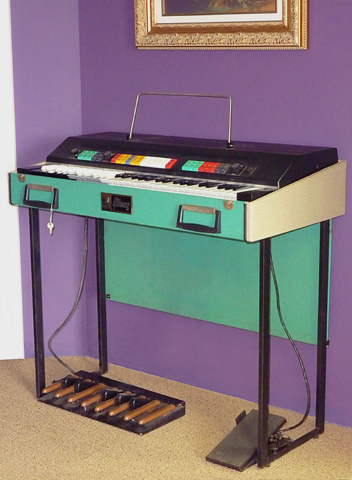
The G-101 had two square, tubular, fold-out legs, and a "drop panel". The panel supported the legs, via secured thumb screws, and acted as a cover for them during transport. Other external features included an acrylonitrile butadiene styrene (ABS) black plastic top, a tri-colored plastic keyboard, color-coded rocker-switch tabs, and a vinyl fabric-covered plywood cabinet, drop panel, and lid, using an aqua-and-gray color scheme. While superficially similar in appearance to many other combo organs in the 1960s such as the Farfisa Compact, it can easily be distinguished from competing models by identifying the cabinet colors.
Three optional accessories were available for the G-101: a travel bag, an expression pedal (volume pedal), and a set of bass pedals. The expression pedal is required, as without it, the organ will make no sound (though this can be fixed by changing the internal wiring). The volume pedal had a spring-loaded side-lever that could be used to actuate the "Glide" and "Trumpet Wow-wow" effects. In addition to a standard 1/4" jack socket for a standard amplifier, an additional jack also enabled users to connect to a custom external reverb unit made by Gibson or Maestro. The "Reverb" tab is used to activate this; the organ itself has no onboard reverb unit. The instrument's top had a removable, fold-down wire rack for sheet music.
The G-101 was designed to be easily serviceable. The internal arrangement of the instrument's electronics makes it easy to find and fix components. Some parts are hinge-mounted, to allow easy access to others.
Hub AI
Gibson G-101 AI simulator
(@Gibson G-101_simulator)
Gibson G-101
The Gibson G-101 (or Gibson Portable Organ, also known as the Kalamazoo K-101) is a transistorised combo organ, manufactured in the late 1960s by the Lowrey Organ Company for Gibson.
The G-101 was produced in response to similar combo organs such as the Vox Continental and Farfisa, though it had a wider range of features such as foldback as seen on a Hammond organ. It provided a 61-key manual with a variety of stops accessed by rocker switches and a separate bass system. Because the organ was manufactured by Lowrey, the G-101 can create similar sounds to that company's console organs manufactured at the time. The instrument was not as commercially successful as the Continental and Farfisa, and less than 2,000 models were sold. However, it was used by some popular musicians at the time, particularly The Doors' Ray Manzarek.
The instrument was introduced by Gibson in 1967 but produced in the U.S. for them by the Lowrey Organ Company. Both companies were owned by Chicago Musical Instruments. Lowrey had already produced several combo organs, beginning in 1946. The G-101 was first introduced in 1966 as the Kalamazoo K-101, as that name was used by Gibson for its budget range of equipment. The name was changed to Gibson G-101 shortly thereafter, in order to encourage sales, and production continued until 1969. A Gibson G-201 organ was introduced at the same time, which is a spinet organ with two manuals, but otherwise has the same electronics, but not as many features.
The original price was $995 ($9,600 as of 2025), which was one of the most expensive single-manual combo organs at that time. Less than 2,000 models were produced (about a quarter of the Vox Continental), making the instrument a sought-after model for collectors compared to similar instruments.
Despite the change in name badges and model numbers shortly after its introduction, the Kalamazoo K-101 and the Gibson G-101 are the same instrument. Kalamazoo was a brand name that Gibson used for budget instruments. The only significant change in production was a cast Gibson logo added to the instrument's front panel.
The G-101 had two square, tubular, fold-out legs, and a "drop panel". The panel supported the legs, via secured thumb screws, and acted as a cover for them during transport. Other external features included an acrylonitrile butadiene styrene (ABS) black plastic top, a tri-colored plastic keyboard, color-coded rocker-switch tabs, and a vinyl fabric-covered plywood cabinet, drop panel, and lid, using an aqua-and-gray color scheme. While superficially similar in appearance to many other combo organs in the 1960s such as the Farfisa Compact, it can easily be distinguished from competing models by identifying the cabinet colors.
Three optional accessories were available for the G-101: a travel bag, an expression pedal (volume pedal), and a set of bass pedals. The expression pedal is required, as without it, the organ will make no sound (though this can be fixed by changing the internal wiring). The volume pedal had a spring-loaded side-lever that could be used to actuate the "Glide" and "Trumpet Wow-wow" effects. In addition to a standard 1/4" jack socket for a standard amplifier, an additional jack also enabled users to connect to a custom external reverb unit made by Gibson or Maestro. The "Reverb" tab is used to activate this; the organ itself has no onboard reverb unit. The instrument's top had a removable, fold-down wire rack for sheet music.
The G-101 was designed to be easily serviceable. The internal arrangement of the instrument's electronics makes it easy to find and fix components. Some parts are hinge-mounted, to allow easy access to others.