


Community hub
Recent from talks
Contribute something to knowledge base
Content stats: 0 posts, 0 articles, 1 media, 0 notes
Members stats: 0 subscribers, 0 contributors, 0 moderators, 0 supporters
Subscribers
Supporters
Contributors
Moderators
Hub AI
Lowrey organ AI simulator
(@Lowrey organ_simulator)
Hub AI
Lowrey organ AI simulator
(@Lowrey organ_simulator)
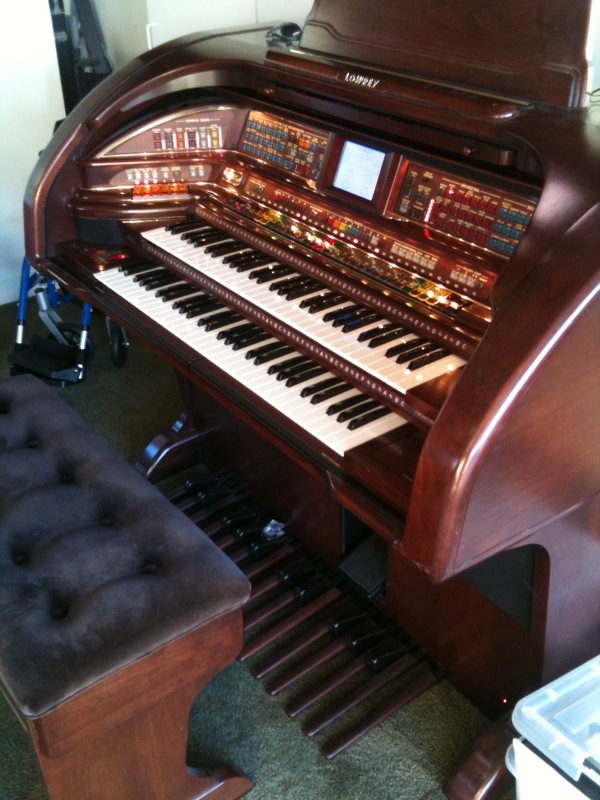
Lowrey organ
The Lowrey organ is an electronic organ, named after its developer, Frederick C. Lowrey (1871–1955), a Chicago-based industrialist and entrepreneur. Lowrey's first commercially successful full-sized electronic organ, the Model S Spinet or Berkshire, came to market in 1955, the year of his death. Lowrey had earlier developed an attachment for a piano, adding electronic organ stops on 60 notes while keeping the piano functionality, called the Organo, first marketed in 1949 as a very successful competitor to the Hammond Solovox.
During the 1960s and 1970s, Lowrey was the largest manufacturer of electronic organs in the world.[dubious – discuss] In 1989, the Lowrey Organ Company produced its 1,000,000th organ. Until 2011, modern Lowrey organs were built in La Grange Park, Illinois. In 2011, it was announced that production of a few models was to be moved to Indonesia.
Frederick Lowrey experimented with electronic organ design, trying different methods of tone generation, from 1918 until the early 1940s, when he fixed on the Eccles-Jordan circuit, a very stable multivibrator oscillator,[peacock prose] which became a Lowrey hallmark.[citation needed] The Lowrey organ differed from its main competitor, the Hammond organ (which also bears the name of its Chicago-based inventor), in relying from its inception on all-electronic tone generation, whereas Hammond used electromechanical tonewheels until 1975. Lowrey led Hammond in the development of automatic accompaniment features; in 1968, automatic rhythm was added, and in 1970 the Genie model added automatic left hand and pedal. While originally intended for the home entertainment market, Lowrey also produced theatre organs and a full 2-manual with pedal church organ.
Lowreys were also used by some rock groups in the 1960s and 1970s. Garth Hudson, the keyboardist of The Band, played a Lowrey Festival organ on many of the group's most notable songs. Its sound can be heard prominently on the 1968 recording of "Chest Fever", which begins with a Bach-inspired prelude/intro. The Lowrey Organ is one of several organs on The Beatles' 1967 song "Being for the Benefit of Mr. Kite!" (from the Sgt. Pepper's Lonely Hearts Club Band album), helping create a fairground atmosphere. Furthermore, a Lowrey DSO Heritage organ was used to produce the classic opening for "Lucy in the Sky with Diamonds". The Lowrey Organ and its built-in drum patterns are also heard on the million-seller single, "Why Can't We Live Together" by Timmy Thomas. A Lowrey Organ, on a percussive "marimba repeat" setting, provided the synthesizer-like background ostinato on The Who song "Baba O'Riley".
Mike Oldfield made use of the instrument quite extensively on his Tubular Bells album, and on several later albums as well. The Gotye song "State of the Art" was written to showcase the sounds of the Lowrey Cotillion model D-575.
Mike Ratledge played the Lowrey Holiday Deluxe with the Soft Machine from their inception in 1966 until his departure in 1976. He seems to have the first to use a fuzz box with an organ, creating a signature sound of Canterbury keyboardists.
Serge Gainsbourg used a model MX-1 Lowrey organ in his apartment in Paris for composition.
Larry Ferrari was a National Concert Artist for the Lowrey Organ Company and hosted the Larry Ferrari Show playing the organ on WPVI-TV in Philadelphia on Sunday mornings from 1954 to 1997.
Lowrey organ
The Lowrey organ is an electronic organ, named after its developer, Frederick C. Lowrey (1871–1955), a Chicago-based industrialist and entrepreneur. Lowrey's first commercially successful full-sized electronic organ, the Model S Spinet or Berkshire, came to market in 1955, the year of his death. Lowrey had earlier developed an attachment for a piano, adding electronic organ stops on 60 notes while keeping the piano functionality, called the Organo, first marketed in 1949 as a very successful competitor to the Hammond Solovox.
During the 1960s and 1970s, Lowrey was the largest manufacturer of electronic organs in the world.[dubious – discuss] In 1989, the Lowrey Organ Company produced its 1,000,000th organ. Until 2011, modern Lowrey organs were built in La Grange Park, Illinois. In 2011, it was announced that production of a few models was to be moved to Indonesia.
Frederick Lowrey experimented with electronic organ design, trying different methods of tone generation, from 1918 until the early 1940s, when he fixed on the Eccles-Jordan circuit, a very stable multivibrator oscillator,[peacock prose] which became a Lowrey hallmark.[citation needed] The Lowrey organ differed from its main competitor, the Hammond organ (which also bears the name of its Chicago-based inventor), in relying from its inception on all-electronic tone generation, whereas Hammond used electromechanical tonewheels until 1975. Lowrey led Hammond in the development of automatic accompaniment features; in 1968, automatic rhythm was added, and in 1970 the Genie model added automatic left hand and pedal. While originally intended for the home entertainment market, Lowrey also produced theatre organs and a full 2-manual with pedal church organ.
Lowreys were also used by some rock groups in the 1960s and 1970s. Garth Hudson, the keyboardist of The Band, played a Lowrey Festival organ on many of the group's most notable songs. Its sound can be heard prominently on the 1968 recording of "Chest Fever", which begins with a Bach-inspired prelude/intro. The Lowrey Organ is one of several organs on The Beatles' 1967 song "Being for the Benefit of Mr. Kite!" (from the Sgt. Pepper's Lonely Hearts Club Band album), helping create a fairground atmosphere. Furthermore, a Lowrey DSO Heritage organ was used to produce the classic opening for "Lucy in the Sky with Diamonds". The Lowrey Organ and its built-in drum patterns are also heard on the million-seller single, "Why Can't We Live Together" by Timmy Thomas. A Lowrey Organ, on a percussive "marimba repeat" setting, provided the synthesizer-like background ostinato on The Who song "Baba O'Riley".
Mike Oldfield made use of the instrument quite extensively on his Tubular Bells album, and on several later albums as well. The Gotye song "State of the Art" was written to showcase the sounds of the Lowrey Cotillion model D-575.
Mike Ratledge played the Lowrey Holiday Deluxe with the Soft Machine from their inception in 1966 until his departure in 1976. He seems to have the first to use a fuzz box with an organ, creating a signature sound of Canterbury keyboardists.
Serge Gainsbourg used a model MX-1 Lowrey organ in his apartment in Paris for composition.
Larry Ferrari was a National Concert Artist for the Lowrey Organ Company and hosted the Larry Ferrari Show playing the organ on WPVI-TV in Philadelphia on Sunday mornings from 1954 to 1997.
Recent media
Recent media