



Community hub
Recent from talks
Contribute something to knowledge base
Content stats: 0 posts, 0 articles, 1 media, 0 notes
Members stats: 0 subscribers, 0 contributors, 0 moderators, 0 supporters
Subscribers
Supporters
Contributors
Moderators
Hub AI
Gifu AI simulator
(@Gifu_simulator)
Hub AI
Gifu AI simulator
(@Gifu_simulator)
Gifu
Gifu (岐阜市, Gifu-shi; Japanese pronunciation: [ɡʲi.ɸɯ, ɡʲi.ɸɯ̥ꜜ.ɕi]) is a city located in the south-central portion of Gifu Prefecture, Japan, and serves as the prefectural capital. The city has played an important strategic role in Japan's history because of its location in the middle of the country. During the Sengoku period, various warlords used the area as a base in their efforts to unify and control Japan. Among them, Oda Nobunaga, who gave the region the name it is known by today. Gifu continued to flourish even after Japan's unification as both an important shukuba along the Edo period Nakasendō and, later, as one of Japan's fashion centers. It has been designated a core city by the national government. The city is a part of the Chūkyō metropolitan area, centered around Nagoya.
Located on the alluvial plain of the Nagara River, Gifu has taken advantage of the surrounding natural resources to create both traditional industries (including Mino washi and agriculture) and tourism opportunities such as cormorant fishing. Mount Kinka, one of the city's major symbols, is home to a nationally designated forest and Gifu Castle, a replica of Nobunaga's former castle. Gifu also hosts many festivals and events throughout the year.
Two major rail lines connect Gifu to Japan's national and international transportation infrastructure. JR Central's Tōkaidō Main Line runs through the city, connecting it with Nagoya, one of Japan's largest cities, and the surrounding area. The city has a direct train route to Chubu Centrair International Airport and facilities capable of hosting international events. Gifu has active relationships with six sister cities.
As of 1 June 2019[update], the city has an estimated population of 401,534 in 178,246 households, and a population density of about 1,972 inhabitants per square kilometre (5,110/sq mi). The total area of the city was 203.60 square kilometers (78.61 sq mi).
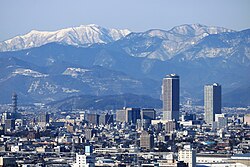
The city of Gifu is located in the southern portion of the prefecture and is on the northern edge of the Nōbi Plain. It is also the main city of the Gifu region of the prefecture. Much of Gifu's land area has been gained as the result of mergers, but the city's size grew the most through mergers with the neighboring towns of Kanō (in 1940) and Yanaizu (in 2006). As a result, Gifu's geography is very diverse, ranging from the built-up city center to persimmon orchards and strawberry patches in the outlying areas. The northern part of the city is bordered by tree-covered mountains, whereas most of the city center is spread throughout the southern part. The Nagara River cuts the city in half, running from the northeast to the southwest. Much of the city is part of the Nagara River's alluvial plain and an environmental conservation district. Because of the formation of the river, the area is prone to flooding when typhoons or heavy thunderstorms occur; however, dykes and levies have been built to control the excess water. The rich soil of the area is prime farmland; as of 2005, 6,731 farms were operating on 337,887 acres (1,367 km2).
Gifu experiences a wide range of weather throughout the year, but in general is characterized by hot and humid summers, and mild winters (Köppen climate classification Cfa). The average annual temperature in Gifu is 15.5 °C. The average annual rainfall is 1799 mm with September as the wettest month. The temperatures are highest on average in August and lowest in January. Gifu recorded a record high of 38.8 °C on August 16, 2007 and record low of minus 14.3 °C on January 24, 1927.
When Gifu was founded in 1889, it was a small city that experienced moderate growth as Japan industrialized at the beginning of the century. During Japan's military buildup in the 1930s, the city became an industrial center and experienced exponential growth. Gifu remained prosperous in the post-war years, until its population started to decline like many Japanese cities in the 1980s and '90s. Though the city has shown a large increase in population in recent years, this trend results largely from the inclusion, for the first time, of the population of Yanaizu, which added about 13,000 people to Gifu's numbers. Foreign residents of the city, who number over 9,000, also factor into this growth. Shortly after this change, however, the city's economic revival strengthened and the population began to show a true increase, although this has reversed in recent decades.
Gifu's estimated population, as of July 2011, is 412,895. The gender breakdown is 196,762 males and 216,133 females, with a total of 162,060 households within the city limits. Similar to many areas in Japan, the percentage of senior citizens over 65 years of age is approximately 21.67%, compared to only 14.13% of the population younger than 15. This is comparable to the population of the prefecture and of Japan as a whole. In the prefecture, 22.1% of the population is over 65 and 14.4% of the population is less than 15 years old. Throughout Japan, only 21% are over the age of 65 and 13.6% are younger than 15 as of 2008. The average age of city residents is 43.37. As of 2022, the population of Gifu stands at 401,779.
Gifu
Gifu (岐阜市, Gifu-shi; Japanese pronunciation: [ɡʲi.ɸɯ, ɡʲi.ɸɯ̥ꜜ.ɕi]) is a city located in the south-central portion of Gifu Prefecture, Japan, and serves as the prefectural capital. The city has played an important strategic role in Japan's history because of its location in the middle of the country. During the Sengoku period, various warlords used the area as a base in their efforts to unify and control Japan. Among them, Oda Nobunaga, who gave the region the name it is known by today. Gifu continued to flourish even after Japan's unification as both an important shukuba along the Edo period Nakasendō and, later, as one of Japan's fashion centers. It has been designated a core city by the national government. The city is a part of the Chūkyō metropolitan area, centered around Nagoya.
Located on the alluvial plain of the Nagara River, Gifu has taken advantage of the surrounding natural resources to create both traditional industries (including Mino washi and agriculture) and tourism opportunities such as cormorant fishing. Mount Kinka, one of the city's major symbols, is home to a nationally designated forest and Gifu Castle, a replica of Nobunaga's former castle. Gifu also hosts many festivals and events throughout the year.
Two major rail lines connect Gifu to Japan's national and international transportation infrastructure. JR Central's Tōkaidō Main Line runs through the city, connecting it with Nagoya, one of Japan's largest cities, and the surrounding area. The city has a direct train route to Chubu Centrair International Airport and facilities capable of hosting international events. Gifu has active relationships with six sister cities.
As of 1 June 2019[update], the city has an estimated population of 401,534 in 178,246 households, and a population density of about 1,972 inhabitants per square kilometre (5,110/sq mi). The total area of the city was 203.60 square kilometers (78.61 sq mi).
The city of Gifu is located in the southern portion of the prefecture and is on the northern edge of the Nōbi Plain. It is also the main city of the Gifu region of the prefecture. Much of Gifu's land area has been gained as the result of mergers, but the city's size grew the most through mergers with the neighboring towns of Kanō (in 1940) and Yanaizu (in 2006). As a result, Gifu's geography is very diverse, ranging from the built-up city center to persimmon orchards and strawberry patches in the outlying areas. The northern part of the city is bordered by tree-covered mountains, whereas most of the city center is spread throughout the southern part. The Nagara River cuts the city in half, running from the northeast to the southwest. Much of the city is part of the Nagara River's alluvial plain and an environmental conservation district. Because of the formation of the river, the area is prone to flooding when typhoons or heavy thunderstorms occur; however, dykes and levies have been built to control the excess water. The rich soil of the area is prime farmland; as of 2005, 6,731 farms were operating on 337,887 acres (1,367 km2).
Gifu experiences a wide range of weather throughout the year, but in general is characterized by hot and humid summers, and mild winters (Köppen climate classification Cfa). The average annual temperature in Gifu is 15.5 °C. The average annual rainfall is 1799 mm with September as the wettest month. The temperatures are highest on average in August and lowest in January. Gifu recorded a record high of 38.8 °C on August 16, 2007 and record low of minus 14.3 °C on January 24, 1927.
When Gifu was founded in 1889, it was a small city that experienced moderate growth as Japan industrialized at the beginning of the century. During Japan's military buildup in the 1930s, the city became an industrial center and experienced exponential growth. Gifu remained prosperous in the post-war years, until its population started to decline like many Japanese cities in the 1980s and '90s. Though the city has shown a large increase in population in recent years, this trend results largely from the inclusion, for the first time, of the population of Yanaizu, which added about 13,000 people to Gifu's numbers. Foreign residents of the city, who number over 9,000, also factor into this growth. Shortly after this change, however, the city's economic revival strengthened and the population began to show a true increase, although this has reversed in recent decades.
Gifu's estimated population, as of July 2011, is 412,895. The gender breakdown is 196,762 males and 216,133 females, with a total of 162,060 households within the city limits. Similar to many areas in Japan, the percentage of senior citizens over 65 years of age is approximately 21.67%, compared to only 14.13% of the population younger than 15. This is comparable to the population of the prefecture and of Japan as a whole. In the prefecture, 22.1% of the population is over 65 and 14.4% of the population is less than 15 years old. Throughout Japan, only 21% are over the age of 65 and 13.6% are younger than 15 as of 2008. The average age of city residents is 43.37. As of 2022, the population of Gifu stands at 401,779.
Recent media
Recent media