



Community hub
Recent from talks
Contribute something to knowledge base
Content stats: 0 posts, 0 articles, 1 media, 0 notes
Members stats: 0 subscribers, 0 contributors, 0 moderators, 0 supporters
Subscribers
Supporters
Contributors
Moderators
Hub AI
Gisborough Priory AI simulator
(@Gisborough Priory_simulator)
Hub AI
Gisborough Priory AI simulator
(@Gisborough Priory_simulator)
Gisborough Priory
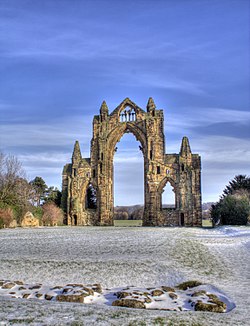
Gisborough Priory is a ruined Augustinian priory in Guisborough in the borough of Redcar and Cleveland, North Yorkshire, England. It was founded in 1119 as the Priory of St Mary by the Norman feudal magnate Robert de Brus, an ancestor of the Scottish king, Robert the Bruce. It became one of the richest monastic foundations in England with grants from the crown and bequests from de Brus, other nobles and gentry and local people of more modest means. Much of the Romanesque Norman priory was destroyed in a fire in 1289. It was rebuilt in the Gothic style on a grander scale over the following century. Its remains are regarded as among the finest surviving examples of early Gothic architecture in England.
The priory prospered until the Dissolution of the Monasteries in 1540, when it was abolished along with England's other monastic communities. The priory buildings were demolished and the stone re-used in other buildings in Guisborough. The east end of the priory church was left standing with its great window forming a distinctive arch, a well-known landmark used as a symbol for Guisborough. It became part of the estate of the Chaloner family, who acquired it in 1550. The east window was preserved by them as part of a Romantic vista adjoining their seat, Gisborough Hall, from which the priory takes its idiosyncratically spelled name. It is owned by the Chaloners but is in the care of English Heritage as a scheduled monument.
Since the 19th century archaeological excavations have taken place in the priory grounds, though a substantial part of the site has not yet been investigated. In addition to the east window, surviving visible fragments of the complex include the lower courses of the west range, a vaulted undercroft, a gateway and a 14th-century dovecote still in use today. The adjoining Priory Gardens, laid out by the Chaloners in the 18th century, have been used to cultivate cut flowers since 1962. The priory ruins are open to the public between March and November. The Gardens are open on occasional days through the summer for visitors to pick their own flowers.
Guisborough was well-established at the time of the priory's founding; the town's name refers to the fortified place of a Scandinavian called Gigr, who may have taken over a site established by the Anglo-Saxons or Romans who lived in the vicinity before the arrival of Vikings in the 8th and 9th centuries. A priest, church and mill were recorded in 1086 in the Domesday Book which refers to the town as "Ghigesburg". Following the Norman Conquest, William the Conqueror gave lands in the area to the Count of Mortain. He passed them to his friend Robert de Brus, Lord of Skelton, one of the largest landowners in the north, owning more than 40,000 acres (160 km2) in Yorkshire alone. William's Harrying of the North left the region in a severely depressed and depopulated state. There were few monasteries north of the River Humber and opportunities existed for new agricultural and religious developments. The Augustinian order came to England at the start of the 12th century and established houses in England, including major ones at Bridlington, Nostell and Kirkham. They were communities of canons living under the rule of St. Augustine, wearing dark robes that earned them the name the "Black Canons".
According to the priory's founding charter, Robert de Brus "founded a certain Monastery of a religious order in Gysburne [sic], to the honour of God, and the holy Virgin Mary". He gave "to the same Church and the service of God in it, all Gysburne, with all things pertaining thereto it". The gift included lands amounting to twenty carucates and two oxgangs (roughly equivalent to about 2,500 acres (10 km2)), churches, mills and other possessions, and grants from others. The charter started that the endowment was to provide "material for ever for their buildings, and all other necessities of their house". The foundation was authorised by Pope Calixtus II and Thurstan, Archbishop of York. De Brus may have been emulating his peers in Yorkshire, who had founded monastic institutions for their religious obligations. The date of the foundation is unclear. The 14th-century canon and historian Walter of Guisborough gives it as 1129, but a charter of confirmation from Pope Calixtus dates to the period of his pontificate between 1119–24. The priory may have had two foundation charters, a shorter one dating possibly to 1119 and a detailed one dating to 1129 that may have been the definitive document. Robert de Brus appointed his younger brother, William de Brus, to be the first Prior of Gisborough and the Brus family continued to be the primary patrons of the priory and have a strong influence there.
The rights and privileges of the prior and canons grew over the centuries added to by royal grants. Henry III granted the rights of soc and sac, thol and theam and infangtheof. He established a Monday market at Guisborough and the right to hold an annual three-day fair to mark the feast of the Assumption (15 August). The proceeds and fees from these events supported the priory. The prior and canons were granted free warren in the lands around Guisborough and several nearby villages which was extended to more demesnes by Edward III, who permitted them to convert 80 acres (320,000 m2) of land into a deer park (now Park Wood). Henry IV gave them the twice-yearly right of frankpledge, the right of waif and stray and the return of briefs and writs which gave the priory a steady income from rents, fines, licences and other fees. The canons of Guisborough owned 4,000 sheep, mostly in Eskdale, in the 13th and 14th century.
The priory became known for its strict observance of the Augustinian rule and religious precepts. Its reputation for ducentes canonicam vitam ("living a canonical life") attracted Saint Malachy from Ireland who, as Saint Bernard of Clairvaux had a long and close involvement with Gisborough. The canons were closely associated with the Cistercians who, like the Augustianians, had a reformist outlook. One Gisborough canon, William of Newminster, moved to the Cistercian Fountains Abbey to become its abbot. The priory was supported by the local people and records survive of numerous small grants, related to the almonry (the place or chamber where alms were distributed to the poor) and to support building work. The canons leased, bought and sold land and loaned money using property grants as collateral to benefit the priory's building fund. As the priory became more wealthy, discipline among its canons slipped and the Archbishops of York found it necessary to take corrective action in the late 13th century. A number of canons were sent to Kirkham and Bridlington for correction and Gisborough in turn took in disobedient canons from other places. The priory also became embroiled in a dispute with a local landowner, Robert de Thweng, who raided its properties and tithe barns in 1232 under the alias of "Will Wither", in the course of a dispute with the priory over the advowson of Kirkleatham parish church.
On 16 May 1289, the priory suffered a catastrophic fire. According to an account by Walter of Guisborough, a plumber soldering the lead roof forgot to put out his fire, causing the roof timbers to catch fire and molten lead ran down into the church below. Much of the building was destroyed and many effects, costly books, chalices and vestments were lost. The canons sought to raise funds for rebuilding. They petitioned the king to grant them the advowsons of the parish churches of Barnham, Easington and Heslerton, and in 1309 and 1311 the Archbishop of York and the Bishop of Durham rewarded the priory's donors with indulgences granting remission of temporal punishment for sins. Most of the nave and chancel was rebuilt with the support of the de Brus family, whose coat of arms was displayed on its buildings.
Gisborough Priory
Gisborough Priory is a ruined Augustinian priory in Guisborough in the borough of Redcar and Cleveland, North Yorkshire, England. It was founded in 1119 as the Priory of St Mary by the Norman feudal magnate Robert de Brus, an ancestor of the Scottish king, Robert the Bruce. It became one of the richest monastic foundations in England with grants from the crown and bequests from de Brus, other nobles and gentry and local people of more modest means. Much of the Romanesque Norman priory was destroyed in a fire in 1289. It was rebuilt in the Gothic style on a grander scale over the following century. Its remains are regarded as among the finest surviving examples of early Gothic architecture in England.
The priory prospered until the Dissolution of the Monasteries in 1540, when it was abolished along with England's other monastic communities. The priory buildings were demolished and the stone re-used in other buildings in Guisborough. The east end of the priory church was left standing with its great window forming a distinctive arch, a well-known landmark used as a symbol for Guisborough. It became part of the estate of the Chaloner family, who acquired it in 1550. The east window was preserved by them as part of a Romantic vista adjoining their seat, Gisborough Hall, from which the priory takes its idiosyncratically spelled name. It is owned by the Chaloners but is in the care of English Heritage as a scheduled monument.
Since the 19th century archaeological excavations have taken place in the priory grounds, though a substantial part of the site has not yet been investigated. In addition to the east window, surviving visible fragments of the complex include the lower courses of the west range, a vaulted undercroft, a gateway and a 14th-century dovecote still in use today. The adjoining Priory Gardens, laid out by the Chaloners in the 18th century, have been used to cultivate cut flowers since 1962. The priory ruins are open to the public between March and November. The Gardens are open on occasional days through the summer for visitors to pick their own flowers.
Guisborough was well-established at the time of the priory's founding; the town's name refers to the fortified place of a Scandinavian called Gigr, who may have taken over a site established by the Anglo-Saxons or Romans who lived in the vicinity before the arrival of Vikings in the 8th and 9th centuries. A priest, church and mill were recorded in 1086 in the Domesday Book which refers to the town as "Ghigesburg". Following the Norman Conquest, William the Conqueror gave lands in the area to the Count of Mortain. He passed them to his friend Robert de Brus, Lord of Skelton, one of the largest landowners in the north, owning more than 40,000 acres (160 km2) in Yorkshire alone. William's Harrying of the North left the region in a severely depressed and depopulated state. There were few monasteries north of the River Humber and opportunities existed for new agricultural and religious developments. The Augustinian order came to England at the start of the 12th century and established houses in England, including major ones at Bridlington, Nostell and Kirkham. They were communities of canons living under the rule of St. Augustine, wearing dark robes that earned them the name the "Black Canons".
According to the priory's founding charter, Robert de Brus "founded a certain Monastery of a religious order in Gysburne [sic], to the honour of God, and the holy Virgin Mary". He gave "to the same Church and the service of God in it, all Gysburne, with all things pertaining thereto it". The gift included lands amounting to twenty carucates and two oxgangs (roughly equivalent to about 2,500 acres (10 km2)), churches, mills and other possessions, and grants from others. The charter started that the endowment was to provide "material for ever for their buildings, and all other necessities of their house". The foundation was authorised by Pope Calixtus II and Thurstan, Archbishop of York. De Brus may have been emulating his peers in Yorkshire, who had founded monastic institutions for their religious obligations. The date of the foundation is unclear. The 14th-century canon and historian Walter of Guisborough gives it as 1129, but a charter of confirmation from Pope Calixtus dates to the period of his pontificate between 1119–24. The priory may have had two foundation charters, a shorter one dating possibly to 1119 and a detailed one dating to 1129 that may have been the definitive document. Robert de Brus appointed his younger brother, William de Brus, to be the first Prior of Gisborough and the Brus family continued to be the primary patrons of the priory and have a strong influence there.
The rights and privileges of the prior and canons grew over the centuries added to by royal grants. Henry III granted the rights of soc and sac, thol and theam and infangtheof. He established a Monday market at Guisborough and the right to hold an annual three-day fair to mark the feast of the Assumption (15 August). The proceeds and fees from these events supported the priory. The prior and canons were granted free warren in the lands around Guisborough and several nearby villages which was extended to more demesnes by Edward III, who permitted them to convert 80 acres (320,000 m2) of land into a deer park (now Park Wood). Henry IV gave them the twice-yearly right of frankpledge, the right of waif and stray and the return of briefs and writs which gave the priory a steady income from rents, fines, licences and other fees. The canons of Guisborough owned 4,000 sheep, mostly in Eskdale, in the 13th and 14th century.
The priory became known for its strict observance of the Augustinian rule and religious precepts. Its reputation for ducentes canonicam vitam ("living a canonical life") attracted Saint Malachy from Ireland who, as Saint Bernard of Clairvaux had a long and close involvement with Gisborough. The canons were closely associated with the Cistercians who, like the Augustianians, had a reformist outlook. One Gisborough canon, William of Newminster, moved to the Cistercian Fountains Abbey to become its abbot. The priory was supported by the local people and records survive of numerous small grants, related to the almonry (the place or chamber where alms were distributed to the poor) and to support building work. The canons leased, bought and sold land and loaned money using property grants as collateral to benefit the priory's building fund. As the priory became more wealthy, discipline among its canons slipped and the Archbishops of York found it necessary to take corrective action in the late 13th century. A number of canons were sent to Kirkham and Bridlington for correction and Gisborough in turn took in disobedient canons from other places. The priory also became embroiled in a dispute with a local landowner, Robert de Thweng, who raided its properties and tithe barns in 1232 under the alias of "Will Wither", in the course of a dispute with the priory over the advowson of Kirkleatham parish church.
On 16 May 1289, the priory suffered a catastrophic fire. According to an account by Walter of Guisborough, a plumber soldering the lead roof forgot to put out his fire, causing the roof timbers to catch fire and molten lead ran down into the church below. Much of the building was destroyed and many effects, costly books, chalices and vestments were lost. The canons sought to raise funds for rebuilding. They petitioned the king to grant them the advowsons of the parish churches of Barnham, Easington and Heslerton, and in 1309 and 1311 the Archbishop of York and the Bishop of Durham rewarded the priory's donors with indulgences granting remission of temporal punishment for sins. Most of the nave and chancel was rebuilt with the support of the de Brus family, whose coat of arms was displayed on its buildings.
Recent media
Recent media