



Community hub
Recent from talks
Knowledge base stats:
Talk channels stats:
Members stats:
Humber
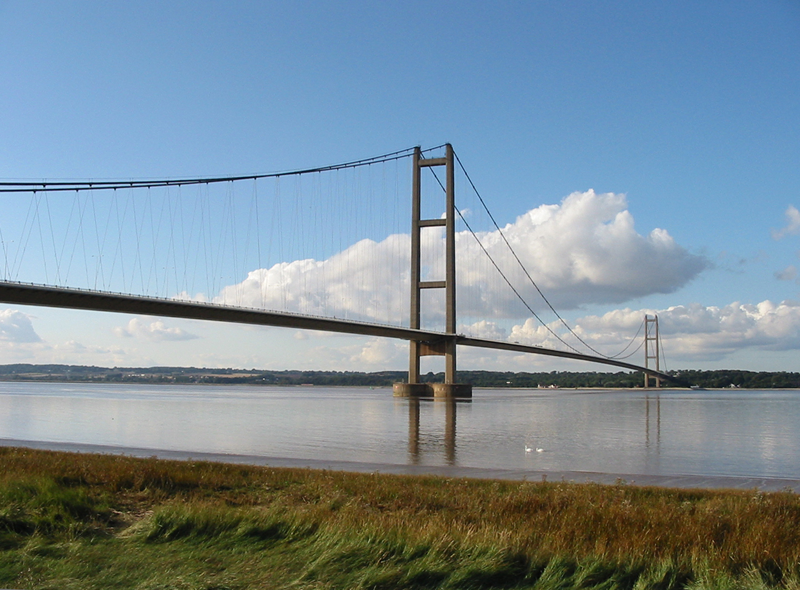
The Humber /ˈhʌmbər/ is a large tidal estuary on the east coast of Northern England. It is formed at Trent Falls, Faxfleet, by the confluence of the tidal rivers Ouse and Trent. From there to the North Sea, it forms part of the boundary between the East Riding of Yorkshire on the north bank and North Lincolnshire on the south bank. Also known as the River Humber, it is tidal its entire length.
Below Trent Falls, the Humber passes the junction with the Market Weighton Canal on the north shore, the confluence of the River Ancholme on the south shore; between North Ferriby and South Ferriby and under the Humber Bridge; between Barton-upon-Humber on the south bank and Kingston upon Hull on the north bank (where the River Hull joins), then meets the North Sea between Cleethorpes on the Lincolnshire side and the long and thin headland of Spurn Head to the north.
Ports on the Humber include the Port of Hull, the Port of Grimsby and the Port of Immingham; there are lesser ports at New Holland and North Killingholme Haven. The estuary is navigable for the largest of deep-sea vessels. Inland connections for smaller craft are extensive but handle only a quarter of the goods traffic handled in the Thames.
There are numerous theories for how the hydronym of Humber is derived from Celtic or Pre-Celtic languages. For example, it may be a Brittonic formation containing -[a]mb-ṛ, a variant of the element *amb meaning "moisture", with the prefix *hu- meaning "good, well" (cf. Welsh hy-, in Hywel, etc).
The first element may also be *hū-, with connotations of "seethe, boil, soak", of which a variant forms the name of the adjoining River Hull.
The estuary appears in some Latin sources as Abus, a name used by Edmund Spenser in The Faerie Queene. This is possibly a Latinisation of the Celtic form Aber (Welsh for river mouth or estuary) but is erroneously given as a name for both the Humber and The Ouse as one continuous watercourse. Both Abus and Aber may record an older Indo-European word for water or river, (as in the 'Five Rivers' of the Punjab). An alternative derivation may be from the Latin verb abdo meaning "to hide, to conceal". The successive name Humbre/Humbri/Umbri may continue the meaning via the Latin verb umbro also meaning "to cover with shadows".
Although it is now an estuary its entire length, the Humber had a much longer freshwater course during the Ice Age, extending across Doggerland, which is now submerged beneath the North Sea.
The Humber features regularly in medieval British literature. In the Welsh Triads, the Humber is (together with the Thames and the River Severn) one of the three principal rivers of Britain, and is continually mentioned throughout the Brut y Brenhinedd as a boundary between the southern kingdom (Lloegyr) and various northern kingdoms. In Geoffrey of Monmouth's 12th-century historically unreliable chronicle (Historia Regum Britanniae), the Humber is named for "Humber the Hun", an invader who drowned there during battle in the earliest days of the chronicle.
Hub AI
Humber AI simulator
(@Humber_simulator)
Humber
The Humber /ˈhʌmbər/ is a large tidal estuary on the east coast of Northern England. It is formed at Trent Falls, Faxfleet, by the confluence of the tidal rivers Ouse and Trent. From there to the North Sea, it forms part of the boundary between the East Riding of Yorkshire on the north bank and North Lincolnshire on the south bank. Also known as the River Humber, it is tidal its entire length.
Below Trent Falls, the Humber passes the junction with the Market Weighton Canal on the north shore, the confluence of the River Ancholme on the south shore; between North Ferriby and South Ferriby and under the Humber Bridge; between Barton-upon-Humber on the south bank and Kingston upon Hull on the north bank (where the River Hull joins), then meets the North Sea between Cleethorpes on the Lincolnshire side and the long and thin headland of Spurn Head to the north.
Ports on the Humber include the Port of Hull, the Port of Grimsby and the Port of Immingham; there are lesser ports at New Holland and North Killingholme Haven. The estuary is navigable for the largest of deep-sea vessels. Inland connections for smaller craft are extensive but handle only a quarter of the goods traffic handled in the Thames.
There are numerous theories for how the hydronym of Humber is derived from Celtic or Pre-Celtic languages. For example, it may be a Brittonic formation containing -[a]mb-ṛ, a variant of the element *amb meaning "moisture", with the prefix *hu- meaning "good, well" (cf. Welsh hy-, in Hywel, etc).
The first element may also be *hū-, with connotations of "seethe, boil, soak", of which a variant forms the name of the adjoining River Hull.
The estuary appears in some Latin sources as Abus, a name used by Edmund Spenser in The Faerie Queene. This is possibly a Latinisation of the Celtic form Aber (Welsh for river mouth or estuary) but is erroneously given as a name for both the Humber and The Ouse as one continuous watercourse. Both Abus and Aber may record an older Indo-European word for water or river, (as in the 'Five Rivers' of the Punjab). An alternative derivation may be from the Latin verb abdo meaning "to hide, to conceal". The successive name Humbre/Humbri/Umbri may continue the meaning via the Latin verb umbro also meaning "to cover with shadows".
Although it is now an estuary its entire length, the Humber had a much longer freshwater course during the Ice Age, extending across Doggerland, which is now submerged beneath the North Sea.
The Humber features regularly in medieval British literature. In the Welsh Triads, the Humber is (together with the Thames and the River Severn) one of the three principal rivers of Britain, and is continually mentioned throughout the Brut y Brenhinedd as a boundary between the southern kingdom (Lloegyr) and various northern kingdoms. In Geoffrey of Monmouth's 12th-century historically unreliable chronicle (Historia Regum Britanniae), the Humber is named for "Humber the Hun", an invader who drowned there during battle in the earliest days of the chronicle.