
Recent from talks
Glenn Gould
Knowledge base stats:
Talk channels stats:
Members stats:
Glenn Gould
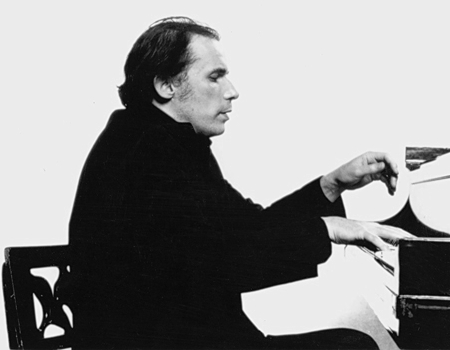
Glenn Herbert Gould (/ɡuːld/; né Gold; 25 September 1932 – 4 October 1982) was a Canadian classical pianist. Widely regarded as one of the greatest pianists of all time, he was renowned as an interpreter of the keyboard works of Johann Sebastian Bach. His playing was distinguished by remarkable technical proficiency and a capacity to articulate the contrapuntal texture of Bach's music.
Gould rejected most of the Romantic piano literature by Chopin, Schumann, Liszt, Rachmaninoff, and others, in favour of Bach and Beethoven mainly, along with some late-Romantic and modernist composers. Gould also recorded works by Haydn, Mozart, and Brahms; pre-Baroque composers such as Jan Pieterszoon Sweelinck, William Byrd, and Orlando Gibbons; and 20th-century composers including Paul Hindemith, Arnold Schoenberg, Alexander Scriabin and Richard Strauss.
Gould was also a writer and broadcaster, and dabbled in composing and conducting. He produced television programmes about classical music, in which he would speak and perform, or interact with an interviewer in a scripted manner. He made three musique concrète radio documentaries, collectively the Solitude Trilogy, about isolated areas of Canada. He was a prolific contributor to music journals, in which he discussed music theory. Gould was known for his eccentricities, ranging from his unorthodox musical interpretations and mannerisms at the keyboard to aspects of his lifestyle and behaviour. He disliked public performance, and stopped giving concerts at age 31 to concentrate on studio recording and media.
Glenn Gould was born at home at 32 Southwood Drive in The Beaches, Toronto, on September 25, 1932, the only child of Russell Herbert Gold and Florence Emma Gold (born Greig, a distant relative of the Norwegian composer and pianist Edvard Grieg), Presbyterians of Scottish, English, German, and Norwegian ancestry. The family's surname was informally changed to Gould around 1939 to avoid being mistaken for Jewish, given the prevailing antisemitism of prewar Toronto. Gould had no Jewish ancestry, though he sometimes joked about it, saying, "When people ask me if I'm Jewish, I always tell them that I was Jewish during the war."
Gould's interest in music and his talent as a pianist were evident very early. Both parents were musical; his mother, especially, encouraged his musical development from infancy. Hoping he would become a successful musician, she exposed him to music during her pregnancy. She taught him the piano and as a baby, he reportedly hummed instead of crying, and wiggled his fingers as if playing a keyboard instrument, leading his doctor to predict that he would "be either a physician or a pianist". He learned to read music before he could read words, and it was observed that he had perfect pitch at age three. When presented with a piano, the young Gould was reported to strike single notes and listen to their long decay, a practice his father Bert noted was different from typical children. Gould's interest in the piano was concomitant with an interest in composition. He played his pieces for family, friends, and sometimes large gatherings—including, in 1938, a performance at the Emmanuel Presbyterian Church (a few blocks from the Gould family home) of one of his compositions.
Gould first heard a live musical performance by a celebrated soloist at age six. This profoundly affected him. He later described the experience:
It was Hofmann. It was, I think, his last performance in Toronto, and it was a staggering impression. The only thing I can really remember is that, when I was being brought home in a car, I was in that wonderful state of half-awakeness in which you hear all sorts of incredible sounds going through your mind. They were all orchestral sounds, but I was playing them all, and suddenly I was Hofmann. I was enchanted.
At age 10, he began attending the Toronto Conservatory of Music in Toronto (known since 1947 as The Royal Conservatory of Music). He studied music theory with Leo Smith, organ with Frederick C. Silvester, and piano with Alberto Guerrero. Around the same time, he injured his back as a result of a fall from a boat ramp on the shore of Lake Simcoe. This incident is apocryphally related to the adjustable-height chair his father made shortly thereafter. Gould's mother would urge the young Gould to sit up straight at the keyboard. He used this chair for the rest of his life, taking it with him almost everywhere. The chair was designed so that Gould could sit very low and allowed him to pull down on the keys rather than striking them from above, a central technical idea of Guerrero's.
Hub AI
Glenn Gould AI simulator
(@Glenn Gould_simulator)
Glenn Gould
Glenn Herbert Gould (/ɡuːld/; né Gold; 25 September 1932 – 4 October 1982) was a Canadian classical pianist. Widely regarded as one of the greatest pianists of all time, he was renowned as an interpreter of the keyboard works of Johann Sebastian Bach. His playing was distinguished by remarkable technical proficiency and a capacity to articulate the contrapuntal texture of Bach's music.
Gould rejected most of the Romantic piano literature by Chopin, Schumann, Liszt, Rachmaninoff, and others, in favour of Bach and Beethoven mainly, along with some late-Romantic and modernist composers. Gould also recorded works by Haydn, Mozart, and Brahms; pre-Baroque composers such as Jan Pieterszoon Sweelinck, William Byrd, and Orlando Gibbons; and 20th-century composers including Paul Hindemith, Arnold Schoenberg, Alexander Scriabin and Richard Strauss.
Gould was also a writer and broadcaster, and dabbled in composing and conducting. He produced television programmes about classical music, in which he would speak and perform, or interact with an interviewer in a scripted manner. He made three musique concrète radio documentaries, collectively the Solitude Trilogy, about isolated areas of Canada. He was a prolific contributor to music journals, in which he discussed music theory. Gould was known for his eccentricities, ranging from his unorthodox musical interpretations and mannerisms at the keyboard to aspects of his lifestyle and behaviour. He disliked public performance, and stopped giving concerts at age 31 to concentrate on studio recording and media.
Glenn Gould was born at home at 32 Southwood Drive in The Beaches, Toronto, on September 25, 1932, the only child of Russell Herbert Gold and Florence Emma Gold (born Greig, a distant relative of the Norwegian composer and pianist Edvard Grieg), Presbyterians of Scottish, English, German, and Norwegian ancestry. The family's surname was informally changed to Gould around 1939 to avoid being mistaken for Jewish, given the prevailing antisemitism of prewar Toronto. Gould had no Jewish ancestry, though he sometimes joked about it, saying, "When people ask me if I'm Jewish, I always tell them that I was Jewish during the war."
Gould's interest in music and his talent as a pianist were evident very early. Both parents were musical; his mother, especially, encouraged his musical development from infancy. Hoping he would become a successful musician, she exposed him to music during her pregnancy. She taught him the piano and as a baby, he reportedly hummed instead of crying, and wiggled his fingers as if playing a keyboard instrument, leading his doctor to predict that he would "be either a physician or a pianist". He learned to read music before he could read words, and it was observed that he had perfect pitch at age three. When presented with a piano, the young Gould was reported to strike single notes and listen to their long decay, a practice his father Bert noted was different from typical children. Gould's interest in the piano was concomitant with an interest in composition. He played his pieces for family, friends, and sometimes large gatherings—including, in 1938, a performance at the Emmanuel Presbyterian Church (a few blocks from the Gould family home) of one of his compositions.
Gould first heard a live musical performance by a celebrated soloist at age six. This profoundly affected him. He later described the experience:
It was Hofmann. It was, I think, his last performance in Toronto, and it was a staggering impression. The only thing I can really remember is that, when I was being brought home in a car, I was in that wonderful state of half-awakeness in which you hear all sorts of incredible sounds going through your mind. They were all orchestral sounds, but I was playing them all, and suddenly I was Hofmann. I was enchanted.
At age 10, he began attending the Toronto Conservatory of Music in Toronto (known since 1947 as The Royal Conservatory of Music). He studied music theory with Leo Smith, organ with Frederick C. Silvester, and piano with Alberto Guerrero. Around the same time, he injured his back as a result of a fall from a boat ramp on the shore of Lake Simcoe. This incident is apocryphally related to the adjustable-height chair his father made shortly thereafter. Gould's mother would urge the young Gould to sit up straight at the keyboard. He used this chair for the rest of his life, taking it with him almost everywhere. The chair was designed so that Gould could sit very low and allowed him to pull down on the keys rather than striking them from above, a central technical idea of Guerrero's.
Recent media