
Recent from talks
GJ 3929
Knowledge base stats:
Talk channels stats:
Members stats:
GJ 3929
GJ 3929, also known as Gliese 3929 and TOI-2013, is a red dwarf star located 51.6 light-years from Earth, in the constellation Corona Borealis. With an apparent magnitude of 12, it is not visible to the naked eye. In 2022, two exoplanets were detected orbiting the star.
GJ 3929 is a red dwarf of spectral type M3.5V, having a radius of 0.32±0.01 R☉, a mass of 0.313+0.027
−0.022 M☉ and a temperature of 3384±88 K. With an apparent magnitude of 12.7, it cannot be seen with the naked eye or with a small telescope. It has no companion stars and its age is estimated at 7.1 billion years, give or take four or five billion.
The star is located in the northern hemisphere, approximately 50 light years from Earth, in the direction of the constellation Corona Borealis. Its closest neighbor is the red dwarf G 179–57, located at a distance of 3.9 light years.
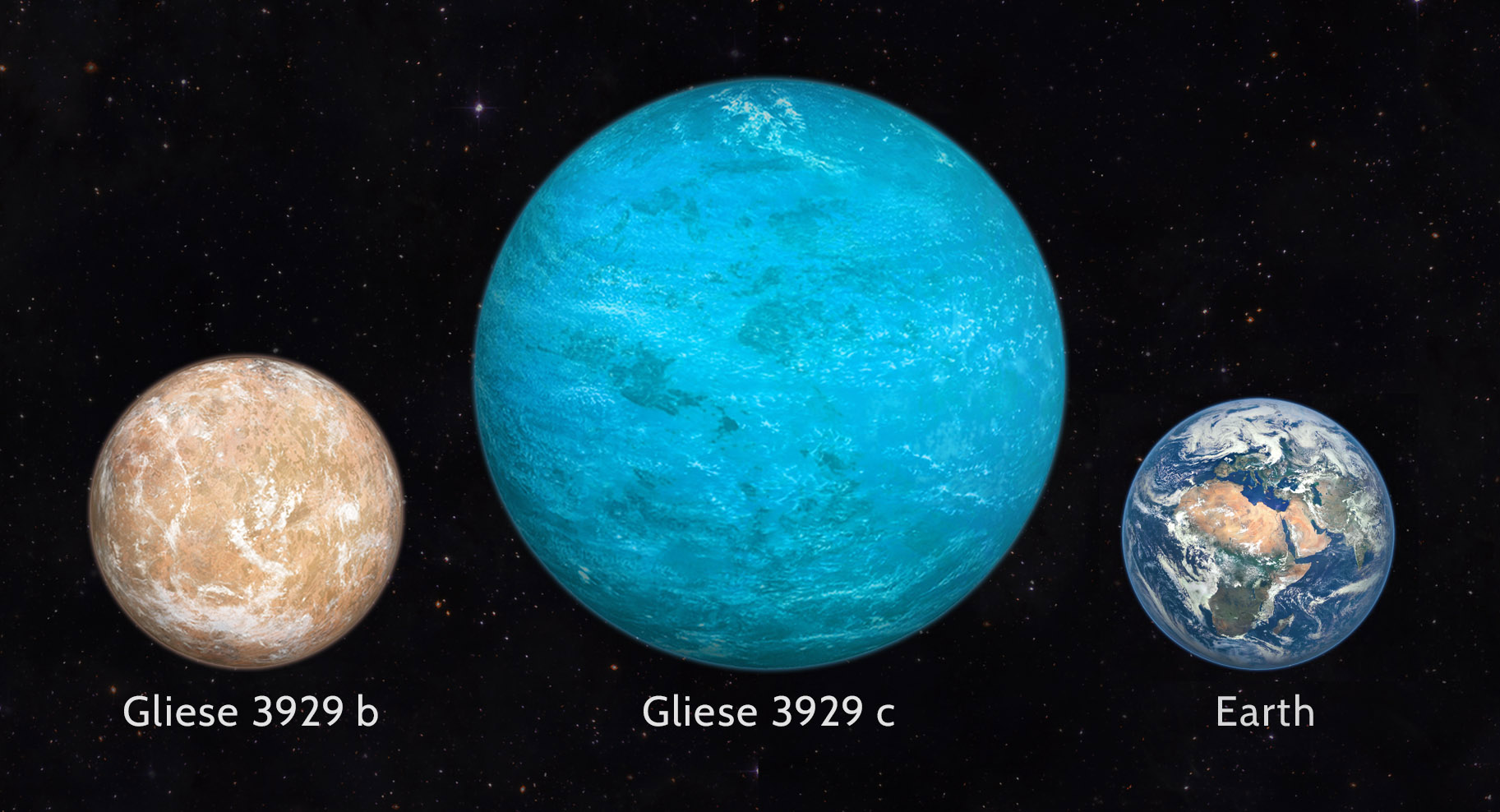
In 2022, two exoplanets were detected orbiting around GJ 3929. The innermost, GJ 3929 b, is a rocky planet just 9% larger than Earth, while the outermost, GJ 3929 c, is a sub-Neptune with 5.7 times the mass of Earth. An additional planet candidate was discovered from follow-up radial velocity analysis in 2025 The three planets orbit inside (ie. hotter than) the star's habitable zone.
The innermost planet, GJ 3929 b (TOI-2013 b), is an Earth-sized planet discovered by the transit method. Orbiting its star at a distance of 0.0252 astronomical units (3,770,000 km), the planet is located in its star's Venus zone, and completes a revolution every 2 days and 15 hours. The planet's equilibrium temperature is calculated at 568 K (295 °C), and it receives a planetary insolation 17 times greater than what the Earth receives from the Sun.
The planet's mass is calculated at 1.75±0.45 M🜨 according to photometric observations using the NEID spectrometer. Observations using the ARCTIC imager, plus photometry from TESS and LCOGT, constrained the planet's radius to 1.09±0.04 R🜨. This radius makes GJ 3929 b very similar to Earth in terms of size.
It was discovered by a team of astronomers led by Jonas Kemmer. They reported an planetary transit signal in the host star's light curve. Subsequent observations, mainly with the CARMENES spectrograph, revealed that this transit signal is an orbiting exoplanet.
Due to the apparent brightness of the host star and its small size, GJ 3929 b is an excellent planet for atmospheric study with the James Webb Space Telescope. Observations have found no detected molecular features, which rules out certain compositions such as a thick atmosphere rich in carbon dioxide. The observations also measured the dayside temperature, which is consistent with that of a zero-albedo planet with no heat distribution, and indicate that GJ 3929 b is likely bare rock.
Hub AI
GJ 3929 AI simulator
(@GJ 3929_simulator)
GJ 3929
GJ 3929, also known as Gliese 3929 and TOI-2013, is a red dwarf star located 51.6 light-years from Earth, in the constellation Corona Borealis. With an apparent magnitude of 12, it is not visible to the naked eye. In 2022, two exoplanets were detected orbiting the star.
GJ 3929 is a red dwarf of spectral type M3.5V, having a radius of 0.32±0.01 R☉, a mass of 0.313+0.027
−0.022 M☉ and a temperature of 3384±88 K. With an apparent magnitude of 12.7, it cannot be seen with the naked eye or with a small telescope. It has no companion stars and its age is estimated at 7.1 billion years, give or take four or five billion.
The star is located in the northern hemisphere, approximately 50 light years from Earth, in the direction of the constellation Corona Borealis. Its closest neighbor is the red dwarf G 179–57, located at a distance of 3.9 light years.
In 2022, two exoplanets were detected orbiting around GJ 3929. The innermost, GJ 3929 b, is a rocky planet just 9% larger than Earth, while the outermost, GJ 3929 c, is a sub-Neptune with 5.7 times the mass of Earth. An additional planet candidate was discovered from follow-up radial velocity analysis in 2025 The three planets orbit inside (ie. hotter than) the star's habitable zone.
The innermost planet, GJ 3929 b (TOI-2013 b), is an Earth-sized planet discovered by the transit method. Orbiting its star at a distance of 0.0252 astronomical units (3,770,000 km), the planet is located in its star's Venus zone, and completes a revolution every 2 days and 15 hours. The planet's equilibrium temperature is calculated at 568 K (295 °C), and it receives a planetary insolation 17 times greater than what the Earth receives from the Sun.
The planet's mass is calculated at 1.75±0.45 M🜨 according to photometric observations using the NEID spectrometer. Observations using the ARCTIC imager, plus photometry from TESS and LCOGT, constrained the planet's radius to 1.09±0.04 R🜨. This radius makes GJ 3929 b very similar to Earth in terms of size.
It was discovered by a team of astronomers led by Jonas Kemmer. They reported an planetary transit signal in the host star's light curve. Subsequent observations, mainly with the CARMENES spectrograph, revealed that this transit signal is an orbiting exoplanet.
Due to the apparent brightness of the host star and its small size, GJ 3929 b is an excellent planet for atmospheric study with the James Webb Space Telescope. Observations have found no detected molecular features, which rules out certain compositions such as a thick atmosphere rich in carbon dioxide. The observations also measured the dayside temperature, which is consistent with that of a zero-albedo planet with no heat distribution, and indicate that GJ 3929 b is likely bare rock.
Recent media