



Community hub
Recent from talks
Contribute something to knowledge base
Content stats: 0 posts, 0 articles, 1 media, 0 notes
Members stats: 0 subscribers, 0 contributors, 0 moderators, 0 supporters
Subscribers
Supporters
Contributors
Moderators
Hub AI
Corona Borealis AI simulator
(@Corona Borealis_simulator)
Hub AI
Corona Borealis AI simulator
(@Corona Borealis_simulator)
Corona Borealis
Corona Borealis is a small constellation in the Northern Celestial Hemisphere. It is one of the 48 constellations listed by the 2nd-century astronomer Ptolemy, and remains one of the 88 modern constellations. Its brightest stars form a semicircular arc. Its Latin name, inspired by its shape, means "northern crown". In classical mythology Corona Borealis generally represented the crown given by the god Dionysus to the Cretan princess Ariadne and set by her in the heavens. Other cultures likened the pattern to a circle of elders, an eagle's nest, a bear's den or a smokehole. Ptolemy also listed a southern counterpart, Corona Australis, with a similar pattern.
The brightest star is the magnitude 2.2 Alpha Coronae Borealis. The yellow supergiant R Coronae Borealis is the prototype of a rare class of giant stars—the R Coronae Borealis variables—that are extremely hydrogen deficient, and thought to result from the merger of two white dwarfs. T Coronae Borealis, also known as the Blaze Star, is another unusual type of variable star known as a recurrent nova. Normally of magnitude 10, it last flared up to magnitude 2 in 1946, and is predicted to do the same in 2025. ADS 9731 and Sigma Coronae Borealis are multiple star systems with six and five components respectively. Five stars in the constellation host Jupiter-sized exoplanets. Abell 2065 is a highly concentrated galaxy cluster one billion light-years from the Solar System containing more than 400 members, and is itself part of the larger Corona Borealis Supercluster.
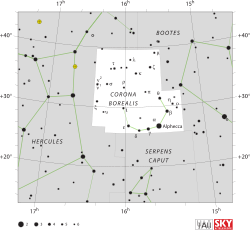
Covering 179 square degrees and hence 0.433% of the sky, Corona Borealis ranks 73rd of the IAU designated constellations by area. Its position in the Northern Celestial Hemisphere means that the whole constellation is visible to observers north of 50°S. It is bordered by Boötes to the north and west, Serpens Caput to the south, and Hercules to the east. The three-letter abbreviation for the constellation, as adopted by the International Astronomical Union in 1922, is "CrB". The official constellation boundaries, as set by Belgian astronomer Eugène Delporte in 1930, are defined by a polygon of eight segments (illustrated in infobox). In the equatorial coordinate system, the right ascension coordinates of these borders lie between 15h 16.0m and 16h 25.1m , while the declination coordinates are between 39.71° and 25.54°. It has a counterpart—Corona Australis—in the Southern Celestial Hemisphere.
The seven stars that make up the constellation's distinctive crown-shaped pattern are all 4th-magnitude stars except for the brightest of them, Alpha Coronae Borealis. The other six stars are Theta, Beta, Gamma, Delta, Epsilon and Iota Coronae Borealis. The German cartographer Johann Bayer gave twenty stars in Corona Borealis Bayer designations from Alpha to Upsilon in his 1603 star atlas Uranometria. Zeta Coronae Borealis was noted to be a double star by later astronomers and its components designated Zeta1 and Zeta2. John Flamsteed did likewise with Nu Coronae Borealis; classed by Bayer as a single star, it was noted to be two close stars by Flamsteed. He named them 20 and 21 Coronae Borealis in his catalogue, alongside the designations Nu1 and Nu2 respectively. Chinese astronomers deemed nine stars to make up the asterism, adding Pi and Rho Coronae Borealis. Within the constellation's borders, there are 37 stars brighter than or equal to apparent magnitude 6.5.
Alpha Coronae Borealis (officially named Alphecca by the IAU, but sometimes also known as Gemma) appears as a blue-white star of magnitude 2.2. In fact, it is an Algol-type eclipsing binary that varies by 0.1 magnitude with a period of 17.4 days. The primary is a white main-sequence star of spectral type A0V that is 2.91 times the mass of the Sun (M☉) and 57 times as luminous (L☉), and is surrounded by a debris disk out to a radius of around 60 astronomical units (AU). The secondary companion is a yellow main-sequence star of spectral type G5V that is a little smaller (0.9 times) the diameter of the Sun. Lying 75±0.5 light-years from Earth, Alphecca is believed to be a member of the Ursa Major Moving Group of stars that have a common motion through space.
Located 112±3 light-years away, Beta Coronae Borealis or Nusakan is a spectroscopic binary system whose two components are separated by 10 AU and orbit each other every 10.5 years. The brighter component is a rapidly oscillating Ap star, pulsating with a period of 16.2 minutes. Of spectral type A5V with a surface temperature of around 7980 K, it has around 2.1 M☉, 2.6 solar radii (R☉), and 25.3 L☉. The smaller star is of spectral type F2V with a surface temperature of around 6750 K, and has around 1.4 M☉, 1.56 R☉, and between 4 and 5 L☉. Near Nusakan is Theta Coronae Borealis, a binary system that shines with a combined magnitude of 4.13 located 380±20 light-years distant. The brighter component, Theta Coronae Borealis A, is a blue-white star that spins extremely rapidly—at a rate of around 393 km per second. A Be star, it is surrounded by a debris disk.
Flanking Alpha to the east is Gamma Coronae Borealis, yet another binary star system, whose components orbit each other every 92.94 years and are roughly as far apart from each other as the Sun and Neptune. The brighter component has been classed as a Delta Scuti variable star, though this view is not universal. The components are main sequence stars of spectral types B9V and A3V. Located 170±2 light-years away, 4.06-magnitude Delta Coronae Borealis is a yellow giant star of spectral type G3.5III that is around 2.4 M☉ and has swollen to 7.4 R☉. It has a surface temperature of 5180 K. For most of its existence, Delta Coronae Borealis was a blue-white main-sequence star of spectral type B before it ran out of hydrogen fuel in its core. Its luminosity and spectrum suggest it has just crossed the Hertzsprung gap, having finished burning core hydrogen and just begun burning hydrogen in a shell that surrounds the core.
Zeta Coronae Borealis is a double star with two blue-white components 6.3 arcseconds apart that can be readily separated at 100x magnification. The primary is of magnitude 5.1 and the secondary is of magnitude 6.0. Nu Coronae Borealis is an optical double, whose components are a similar distance from Earth but have different radial velocities, hence are assumed to be unrelated. The primary, Nu1 Coronae Borealis, is a red giant of spectral type M2III and magnitude 5.2, lying 640±30 light-years distant, and the secondary, Nu2 Coronae Borealis, is an orange-hued giant star of spectral type K5III and magnitude 5.4, estimated to be 590±30 light-years away. Sigma Coronae Borealis, on the other hand, is a true multiple star system divisible by small amateur telescopes. It is actually a complex system composed of two stars around as massive as the Sun that orbit each other every 1.14 days, orbited by a third Sun-like star every 726 years. The fourth and fifth components are a binary red dwarf system that is 14,000 AU distant from the other three stars. ADS 9731 is an even rarer multiple system in the constellation, composed of six stars, two of which are spectroscopic binaries.
Corona Borealis
Corona Borealis is a small constellation in the Northern Celestial Hemisphere. It is one of the 48 constellations listed by the 2nd-century astronomer Ptolemy, and remains one of the 88 modern constellations. Its brightest stars form a semicircular arc. Its Latin name, inspired by its shape, means "northern crown". In classical mythology Corona Borealis generally represented the crown given by the god Dionysus to the Cretan princess Ariadne and set by her in the heavens. Other cultures likened the pattern to a circle of elders, an eagle's nest, a bear's den or a smokehole. Ptolemy also listed a southern counterpart, Corona Australis, with a similar pattern.
The brightest star is the magnitude 2.2 Alpha Coronae Borealis. The yellow supergiant R Coronae Borealis is the prototype of a rare class of giant stars—the R Coronae Borealis variables—that are extremely hydrogen deficient, and thought to result from the merger of two white dwarfs. T Coronae Borealis, also known as the Blaze Star, is another unusual type of variable star known as a recurrent nova. Normally of magnitude 10, it last flared up to magnitude 2 in 1946, and is predicted to do the same in 2025. ADS 9731 and Sigma Coronae Borealis are multiple star systems with six and five components respectively. Five stars in the constellation host Jupiter-sized exoplanets. Abell 2065 is a highly concentrated galaxy cluster one billion light-years from the Solar System containing more than 400 members, and is itself part of the larger Corona Borealis Supercluster.
Covering 179 square degrees and hence 0.433% of the sky, Corona Borealis ranks 73rd of the IAU designated constellations by area. Its position in the Northern Celestial Hemisphere means that the whole constellation is visible to observers north of 50°S. It is bordered by Boötes to the north and west, Serpens Caput to the south, and Hercules to the east. The three-letter abbreviation for the constellation, as adopted by the International Astronomical Union in 1922, is "CrB". The official constellation boundaries, as set by Belgian astronomer Eugène Delporte in 1930, are defined by a polygon of eight segments (illustrated in infobox). In the equatorial coordinate system, the right ascension coordinates of these borders lie between 15h 16.0m and 16h 25.1m , while the declination coordinates are between 39.71° and 25.54°. It has a counterpart—Corona Australis—in the Southern Celestial Hemisphere.
The seven stars that make up the constellation's distinctive crown-shaped pattern are all 4th-magnitude stars except for the brightest of them, Alpha Coronae Borealis. The other six stars are Theta, Beta, Gamma, Delta, Epsilon and Iota Coronae Borealis. The German cartographer Johann Bayer gave twenty stars in Corona Borealis Bayer designations from Alpha to Upsilon in his 1603 star atlas Uranometria. Zeta Coronae Borealis was noted to be a double star by later astronomers and its components designated Zeta1 and Zeta2. John Flamsteed did likewise with Nu Coronae Borealis; classed by Bayer as a single star, it was noted to be two close stars by Flamsteed. He named them 20 and 21 Coronae Borealis in his catalogue, alongside the designations Nu1 and Nu2 respectively. Chinese astronomers deemed nine stars to make up the asterism, adding Pi and Rho Coronae Borealis. Within the constellation's borders, there are 37 stars brighter than or equal to apparent magnitude 6.5.
Alpha Coronae Borealis (officially named Alphecca by the IAU, but sometimes also known as Gemma) appears as a blue-white star of magnitude 2.2. In fact, it is an Algol-type eclipsing binary that varies by 0.1 magnitude with a period of 17.4 days. The primary is a white main-sequence star of spectral type A0V that is 2.91 times the mass of the Sun (M☉) and 57 times as luminous (L☉), and is surrounded by a debris disk out to a radius of around 60 astronomical units (AU). The secondary companion is a yellow main-sequence star of spectral type G5V that is a little smaller (0.9 times) the diameter of the Sun. Lying 75±0.5 light-years from Earth, Alphecca is believed to be a member of the Ursa Major Moving Group of stars that have a common motion through space.
Located 112±3 light-years away, Beta Coronae Borealis or Nusakan is a spectroscopic binary system whose two components are separated by 10 AU and orbit each other every 10.5 years. The brighter component is a rapidly oscillating Ap star, pulsating with a period of 16.2 minutes. Of spectral type A5V with a surface temperature of around 7980 K, it has around 2.1 M☉, 2.6 solar radii (R☉), and 25.3 L☉. The smaller star is of spectral type F2V with a surface temperature of around 6750 K, and has around 1.4 M☉, 1.56 R☉, and between 4 and 5 L☉. Near Nusakan is Theta Coronae Borealis, a binary system that shines with a combined magnitude of 4.13 located 380±20 light-years distant. The brighter component, Theta Coronae Borealis A, is a blue-white star that spins extremely rapidly—at a rate of around 393 km per second. A Be star, it is surrounded by a debris disk.
Flanking Alpha to the east is Gamma Coronae Borealis, yet another binary star system, whose components orbit each other every 92.94 years and are roughly as far apart from each other as the Sun and Neptune. The brighter component has been classed as a Delta Scuti variable star, though this view is not universal. The components are main sequence stars of spectral types B9V and A3V. Located 170±2 light-years away, 4.06-magnitude Delta Coronae Borealis is a yellow giant star of spectral type G3.5III that is around 2.4 M☉ and has swollen to 7.4 R☉. It has a surface temperature of 5180 K. For most of its existence, Delta Coronae Borealis was a blue-white main-sequence star of spectral type B before it ran out of hydrogen fuel in its core. Its luminosity and spectrum suggest it has just crossed the Hertzsprung gap, having finished burning core hydrogen and just begun burning hydrogen in a shell that surrounds the core.
Zeta Coronae Borealis is a double star with two blue-white components 6.3 arcseconds apart that can be readily separated at 100x magnification. The primary is of magnitude 5.1 and the secondary is of magnitude 6.0. Nu Coronae Borealis is an optical double, whose components are a similar distance from Earth but have different radial velocities, hence are assumed to be unrelated. The primary, Nu1 Coronae Borealis, is a red giant of spectral type M2III and magnitude 5.2, lying 640±30 light-years distant, and the secondary, Nu2 Coronae Borealis, is an orange-hued giant star of spectral type K5III and magnitude 5.4, estimated to be 590±30 light-years away. Sigma Coronae Borealis, on the other hand, is a true multiple star system divisible by small amateur telescopes. It is actually a complex system composed of two stars around as massive as the Sun that orbit each other every 1.14 days, orbited by a third Sun-like star every 726 years. The fourth and fifth components are a binary red dwarf system that is 14,000 AU distant from the other three stars. ADS 9731 is an even rarer multiple system in the constellation, composed of six stars, two of which are spectroscopic binaries.
Recent media
Recent media