



Community hub
Recent from talks
Knowledge base stats:
Talk channels stats:
Members stats:
Gliese 581g
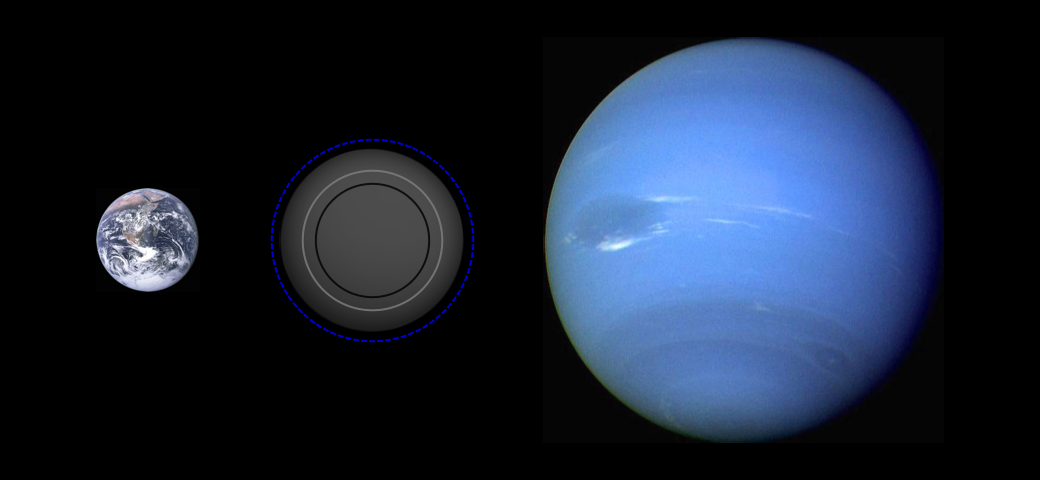
Gliese 581g /ˈɡliːzə/ was a candidate exoplanet postulated to orbit within the Gliese 581 system, twenty light-years from Earth. It was discovered by the Lick–Carnegie Exoplanet Survey, and was the sixth planet claimed to orbit the star; however, its existence could not be confirmed by the European Southern Observatory (ESO) / High Accuracy Radial Velocity Planet Searcher (HARPS) survey team, and was ultimately refuted. It was thought to be near the middle of the habitable zone of its star, meaning it could sustain liquid water—a necessity for all known life—on its surface, if there are favorable atmospheric conditions on the planet.
Gliese 581g was claimed to be detected by astronomers of the Lick–Carnegie Exoplanet Survey. The authors stated that data sets from both the High Resolution Echelle Spectrometer (HIRES) and HARPS were needed to sense the planet; however, the ESO/HARPS survey team could not confirm its existence. The planet remained unconfirmed as consensus for its existence could not be reached. Additional reanalysis only found evidence for four planets, but the discoverer, Steven S. Vogt, did not agree with those conclusions. In 2012, a reanalysis by Vogt supported its existence. A new study in 2014 concluded that it was a false positive, a conclusion which has been further confirmed by subsequent studies. The planet was thought to be tidally locked to its star. If the planet has a dense atmosphere, it may be able to circulate heat. The actual habitability of the planet depends on the composition of its surface and the atmosphere. It was thought to have temperatures around −37 to −11 °C (−35 to 12 °F). By comparison, Earth has an average surface temperature of 15 °C (59 °F)—while Mars has an average surface temperature of about −63 °C (−81 °F). The planet was said by Vogt to have a "100%" chance of supporting life. The supposed detection of Gliese 581g was said to foreshadow what Vogt called "a second Age of Discovery".
The planet's discovery was claimed in September 2010, to have been detected by astronomers in the Lick–Carnegie Exoplanet Survey, led by principal investigator Steven Vogt, professor of astronomy and astrophysics at the University of California, Santa Cruz, and co-investigator R. Paul Butler of the Carnegie Institution of Washington. The discovery was made using radial velocity measurements, combining 122 observations obtained over 11 years from the HIRES instrument of the W. M. Keck Observatory with 119 measurements obtained over 4.3 years from the HARPS instrument of the ESO 3.6 m Telescope at La Silla Observatory. In addition, brightness measurements of the star were confirmed with a robotic telescope from Tennessee State University.
After subtracting the signals of the previously known Gliese 581 planets, b, c, d and e, the signals of two additional planets were apparent: a 445-day signal from a newly recognized outermost planet designated f, and the 37-day signal from Gliese 581g. The probability that the detection of the latter was spurious was estimated at only 2.7 in a million. The authors stated that while the 37-day signal is "clearly visible in the HIRES data set alone", "the HARPS data set alone is not able to reliably sense this planet" and concluded, "It is really necessary to combine both data sets to sense all these planets reliably". The Lick–Carnegie team explained the results of their research in a paper published in the Astrophysical Journal, which were also made available in preprint version on arXiv. Although not sanctioned by the IAU's naming conventions, Vogt's team informally referred to the planet as "Zarmina's World" after his wife, and in some cases simply as Zarmina.
During a press release announcing the discovery, Vogt et al. acknowledged that the "Gliese 581 system has a somewhat checkered history of habitable planet claims," as two previously discovered planets in the same system, Gliese 581c and d, were also regarded as potentially habitable, but later evaluated as being outside the conservatively defined habitable zone.
Two weeks after the announcement of the discovery of Gliese 581g, another team—led by Michael Mayor of the Geneva Observatory—reported that in a new analysis of 179 measurements taken by the HARPS spectrograph over 6.5 years, neither planet g nor planet f was detectable. An astronomer who works on HARPS data at the Geneva Observatory, Francesco Pepe, said in an email for an Astrobiology Magazine article republished on Space.com, "The reason for that is that, despite the extreme accuracy of the instrument and the many data points, the signal amplitude of this potential fifth planet is very low and basically at the level of the measurement noise". The Geneva team had also published their paper on arXiv, but it appeared to not have been accepted for publication[why?].
Vogt responded to the latest concerns by saying, "I am not overly surprised by this as these are very weak signals, and adding 60 points onto 119 does not necessarily translate to big gains in sensitivity." More recently, Vogt added, "I feel confident that we have accurately and honestly reported our uncertainties and done a thorough and responsible job extracting what information this data set has to offer. I feel confident that anyone independently analyzing this data set will come to the same conclusions."
Differences in the two groups' results may involve the planetary orbital characteristics assumed in calculations. According to Massachusetts Institute of Technology astronomer Sara Seager, Vogt postulated the planets around Gliese 581 had perfectly circular orbits whereas the Swiss group thought the orbits were more eccentric. This difference in approach may be the reason for the disagreement, according to Alan Boss. Butler remarked that with additional observations, "I would expect that on the time scale of a year or two this should be settled." Other astronomers also supported a deliberate evaluation: Seager stated, "We will have consensus at some point; I don't think we need to vote right now." Ray Jayawardhana noted, "Given the extremely interesting implications of such a discovery, it's important to have independent confirmation." Gliese 581g is listed as "retracted" in the Extrasolar Planets Encyclopaedia.
Hub AI
Gliese 581g AI simulator
(@Gliese 581g_simulator)
Gliese 581g
Gliese 581g /ˈɡliːzə/ was a candidate exoplanet postulated to orbit within the Gliese 581 system, twenty light-years from Earth. It was discovered by the Lick–Carnegie Exoplanet Survey, and was the sixth planet claimed to orbit the star; however, its existence could not be confirmed by the European Southern Observatory (ESO) / High Accuracy Radial Velocity Planet Searcher (HARPS) survey team, and was ultimately refuted. It was thought to be near the middle of the habitable zone of its star, meaning it could sustain liquid water—a necessity for all known life—on its surface, if there are favorable atmospheric conditions on the planet.
Gliese 581g was claimed to be detected by astronomers of the Lick–Carnegie Exoplanet Survey. The authors stated that data sets from both the High Resolution Echelle Spectrometer (HIRES) and HARPS were needed to sense the planet; however, the ESO/HARPS survey team could not confirm its existence. The planet remained unconfirmed as consensus for its existence could not be reached. Additional reanalysis only found evidence for four planets, but the discoverer, Steven S. Vogt, did not agree with those conclusions. In 2012, a reanalysis by Vogt supported its existence. A new study in 2014 concluded that it was a false positive, a conclusion which has been further confirmed by subsequent studies. The planet was thought to be tidally locked to its star. If the planet has a dense atmosphere, it may be able to circulate heat. The actual habitability of the planet depends on the composition of its surface and the atmosphere. It was thought to have temperatures around −37 to −11 °C (−35 to 12 °F). By comparison, Earth has an average surface temperature of 15 °C (59 °F)—while Mars has an average surface temperature of about −63 °C (−81 °F). The planet was said by Vogt to have a "100%" chance of supporting life. The supposed detection of Gliese 581g was said to foreshadow what Vogt called "a second Age of Discovery".
The planet's discovery was claimed in September 2010, to have been detected by astronomers in the Lick–Carnegie Exoplanet Survey, led by principal investigator Steven Vogt, professor of astronomy and astrophysics at the University of California, Santa Cruz, and co-investigator R. Paul Butler of the Carnegie Institution of Washington. The discovery was made using radial velocity measurements, combining 122 observations obtained over 11 years from the HIRES instrument of the W. M. Keck Observatory with 119 measurements obtained over 4.3 years from the HARPS instrument of the ESO 3.6 m Telescope at La Silla Observatory. In addition, brightness measurements of the star were confirmed with a robotic telescope from Tennessee State University.
After subtracting the signals of the previously known Gliese 581 planets, b, c, d and e, the signals of two additional planets were apparent: a 445-day signal from a newly recognized outermost planet designated f, and the 37-day signal from Gliese 581g. The probability that the detection of the latter was spurious was estimated at only 2.7 in a million. The authors stated that while the 37-day signal is "clearly visible in the HIRES data set alone", "the HARPS data set alone is not able to reliably sense this planet" and concluded, "It is really necessary to combine both data sets to sense all these planets reliably". The Lick–Carnegie team explained the results of their research in a paper published in the Astrophysical Journal, which were also made available in preprint version on arXiv. Although not sanctioned by the IAU's naming conventions, Vogt's team informally referred to the planet as "Zarmina's World" after his wife, and in some cases simply as Zarmina.
During a press release announcing the discovery, Vogt et al. acknowledged that the "Gliese 581 system has a somewhat checkered history of habitable planet claims," as two previously discovered planets in the same system, Gliese 581c and d, were also regarded as potentially habitable, but later evaluated as being outside the conservatively defined habitable zone.
Two weeks after the announcement of the discovery of Gliese 581g, another team—led by Michael Mayor of the Geneva Observatory—reported that in a new analysis of 179 measurements taken by the HARPS spectrograph over 6.5 years, neither planet g nor planet f was detectable. An astronomer who works on HARPS data at the Geneva Observatory, Francesco Pepe, said in an email for an Astrobiology Magazine article republished on Space.com, "The reason for that is that, despite the extreme accuracy of the instrument and the many data points, the signal amplitude of this potential fifth planet is very low and basically at the level of the measurement noise". The Geneva team had also published their paper on arXiv, but it appeared to not have been accepted for publication[why?].
Vogt responded to the latest concerns by saying, "I am not overly surprised by this as these are very weak signals, and adding 60 points onto 119 does not necessarily translate to big gains in sensitivity." More recently, Vogt added, "I feel confident that we have accurately and honestly reported our uncertainties and done a thorough and responsible job extracting what information this data set has to offer. I feel confident that anyone independently analyzing this data set will come to the same conclusions."
Differences in the two groups' results may involve the planetary orbital characteristics assumed in calculations. According to Massachusetts Institute of Technology astronomer Sara Seager, Vogt postulated the planets around Gliese 581 had perfectly circular orbits whereas the Swiss group thought the orbits were more eccentric. This difference in approach may be the reason for the disagreement, according to Alan Boss. Butler remarked that with additional observations, "I would expect that on the time scale of a year or two this should be settled." Other astronomers also supported a deliberate evaluation: Seager stated, "We will have consensus at some point; I don't think we need to vote right now." Ray Jayawardhana noted, "Given the extremely interesting implications of such a discovery, it's important to have independent confirmation." Gliese 581g is listed as "retracted" in the Extrasolar Planets Encyclopaedia.