Hubbry Logo
Tidal lockingTidal lockingMain
Open search
Tidal locking
Community hub
Tidal locking
logo
8 pages, 0 posts
0 subscribers
Be the first to start a discussion here.
Tidal locking
Tidal locking
from Wikipedia
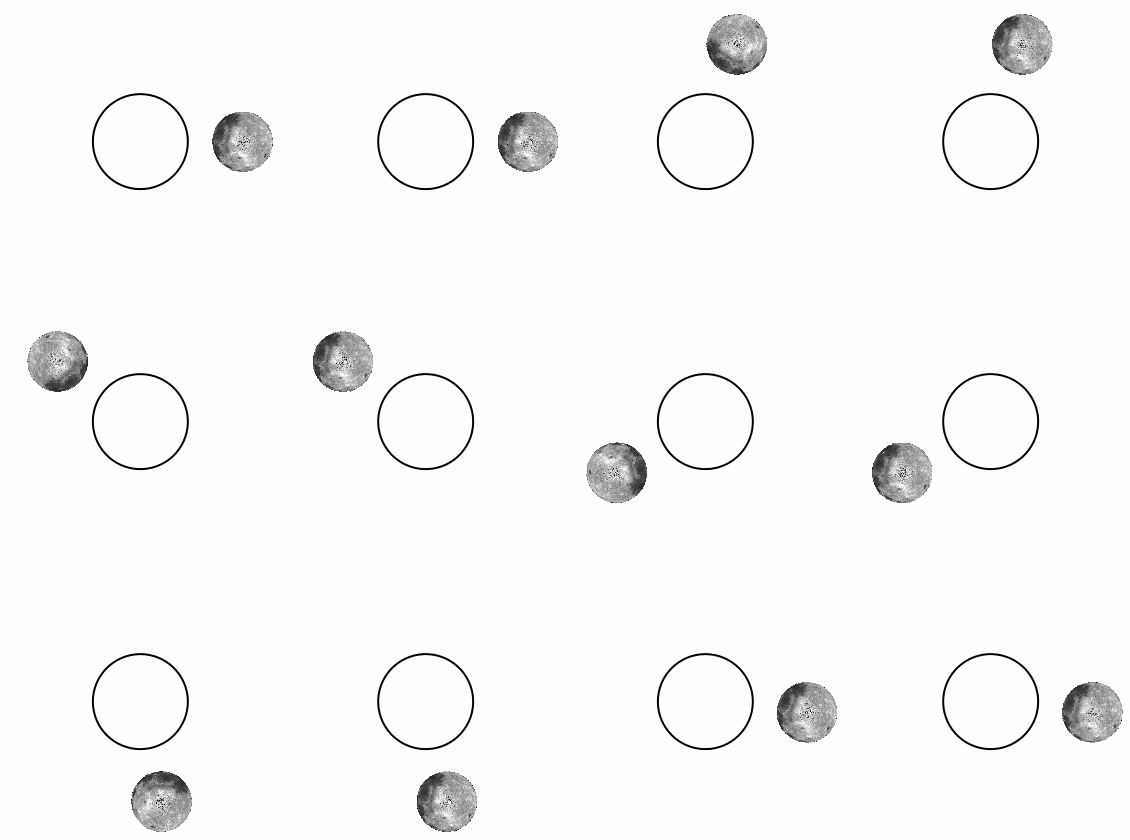
At left, the Moon rotates at the same rate it orbits the Earth, keeping the same face toward the planet. At right, if the Moon did not rotate then the face would change over the course of an orbit. Viewed from above; not to scale.
A side view of the Pluto–Charon system. Pluto and Charon are tidally locked to each other.

Tidal locking between a pair of co-orbiting astronomical bodies occurs when one of the objects reaches a state where there is no longer any net change in its rotation rate over the course of a complete orbit. In the case where a tidally locked body possesses synchronous rotation, the object takes just as long to rotate around its own axis as it does to revolve around its partner. For example, the same side of the Moon always faces Earth, although there is some variability because the Moon's orbit is not perfectly circular. Usually, only the satellite is tidally locked to the larger body.[1] However, if both the difference in mass between the two bodies and the distance between them are relatively small, each may be tidally locked to the other; this is the case for Pluto and Charon, and for Eris and Dysnomia. Alternative names for the tidal locking process are gravitational locking,[2] captured rotation, and spin–orbit locking.

The effect arises between two bodies when their gravitational interaction slows a body's rotation until it becomes tidally locked. Over many millions of years, the interaction forces changes to their orbits and rotation rates as a result of energy exchange and heat dissipation. When one of the bodies reaches a state where there is no longer any net change in its rotation rate over the course of a complete orbit, it is said to be tidally locked.[3] The object tends to stay in this state because leaving it would require adding energy back into the system. The object's orbit may migrate over time so as to undo the tidal lock, for example, if a giant planet perturbs the object.

There is ambiguity in the use of the terms 'tidally locked' and 'tidal locking', in that some scientific sources use it to refer exclusively to 1:1 synchronous rotation (e.g. the Moon), while others include non-synchronous orbital resonances in which there is no further transfer of angular momentum over the course of one orbit (e.g. Mercury).[4] In Mercury's case, the planet completes three rotations for every two revolutions around the Sun, a 3:2 spin–orbit resonance. In the special case where an orbit is nearly circular and the body's rotation axis is not significantly tilted, such as the Moon, tidal locking results in the same hemisphere of the revolving object constantly facing its partner.[3][4][5] Regardless of which definition of tidal locking is used, the hemisphere that is visible changes slightly due to variations in the locked body's orbital velocity and the inclination of its rotation axis over time.

Mechanism

[edit]
Here, the body's tidal bulges (green) are misaligned with the direction of the attracting force (red). The local tidal forces (blue) exert a net torque that twists the body back toward realignment.

Consider a pair of co-orbiting objects, A and B. The change in rotation rate necessary to tidally lock body B to the larger body A is caused by the torque applied by A's gravity on bulges it has induced on B by tidal forces.[6]

The gravitational force from object A upon B will vary with distance, being greatest at the nearest surface to A and least at the most distant. This creates a gravitational gradient across object B that will distort its equilibrium shape slightly. The body of object B will become elongated along the axis oriented toward A, and conversely, slightly reduced in dimension in directions orthogonal to this axis. The elongated distortions are known as tidal bulges. (For the solid Earth, these bulges can reach displacements of up to around 0.4 m or 1 ft 4 in.[7]) When B is not yet tidally locked, the bulges travel over its surface due to orbital motions, with one of the two "high" tidal bulges traveling close to the point where body A is overhead. For large astronomical bodies that are nearly spherical due to self-gravitation, the tidal distortion produces a slightly prolate spheroid, i.e. an axially symmetric ellipsoid that is elongated along its major axis. Smaller bodies also experience distortion, but this distortion is less regular.

The material of B exerts resistance to this periodic reshaping caused by the tidal force. In effect, some time is required to reshape B to the gravitational equilibrium shape, by which time the forming bulges have already been carried some distance away from the A–B axis by B's rotation. Seen from a vantage point in space, the points of maximum bulge extension are displaced from the axis oriented toward A. If B's rotation period is shorter than its orbital period, the bulges are carried forward of the axis oriented toward A in the direction of rotation, whereas if B's rotation period is longer, the bulges instead lag behind.

Because the bulges are now displaced from the A–B axis, A's gravitational pull on the mass in them exerts a torque on B. The torque on the A-facing bulge acts to bring B's rotation in line with its orbital period, whereas the "back" bulge, which faces away from A, acts in the opposite sense. However, the bulge on the A-facing side is closer to A than the back bulge by a distance of approximately B's diameter, and so experiences a slightly stronger gravitational force and torque. The net resulting torque from both bulges, then, is always in the direction that acts to synchronize B's rotation with its orbital period, leading eventually to tidal locking.

Orbital changes

[edit]
In (1), a satellite orbits in the same direction as (but slower than) its parent body's rotation. The nearer tidal bulge (red) attracts the satellite more than the farther bulge (blue), slowing the parent's rotation while imparting a net positive force (dotted arrows showing forces resolved into their components) in the direction of orbit, lifting it into a higher orbit (tidal acceleration).
In (2) with the rotation reversed, the net force opposes the satellite's direction of orbit, lowering it (tidal deceleration).
Tidal Locking
If rotational frequency is larger than orbital frequency, a small torque counteracting the rotation arises, eventually locking the frequencies (situation depicted in green)

The angular momentum of the whole A–B system is conserved in this process, so that when B slows down and loses rotational angular momentum, its orbital angular momentum is boosted by a similar amount (there are also some smaller effects on A's rotation). This results in a raising of B's orbit about A in tandem with its rotational slowdown. For the other case where B starts off rotating too slowly, tidal locking both speeds up its rotation, and lowers its orbit.

Locking of the larger body

[edit]

The tidal locking effect is also experienced by the larger body A, but at a slower rate because B's gravitational effect is weaker due to B's smaller mass. For example, Earth's rotation is gradually being slowed by the Moon, by an amount that becomes noticeable over geological time as revealed in the fossil record.[8] Current estimations are that this (together with the tidal influence of the Sun) has helped lengthen the Earth day from about 6 hours to the current 24 hours (over about 4.5 billion years). Currently, atomic clocks show that Earth's day lengthens, on average, by about 2.3 milliseconds per century.[9] Given enough time, this would create a mutual tidal locking between Earth and the Moon. The length of Earth's day would increase and the length of a lunar month would also increase. Earth's sidereal day would eventually have the same length as the Moon's orbital period, about 47 times the length of the Earth day at present. However, Earth is not expected to become tidally locked to the Moon before the Sun becomes a red giant and engulfs both.[10][11]

For bodies of similar size the effect may be of comparable size for both, and both may become tidally locked to each other on a much shorter timescale. An example is the dwarf planet Pluto and its satellite Charon. They have already reached a state where Charon is visible from only one hemisphere of Pluto and vice versa.[12]

Eccentric orbits

[edit]

A widely spread misapprehension is that a tidally locked body permanently turns one side to its host.

— Heller et al. (2011)[4]

For orbits that do not have an eccentricity close to zero, the rotation rate tends to become locked with the orbital speed when the body is at periapsis, which is the point of strongest tidal interaction between the two objects. If the orbiting object has a companion, this third body can cause the rotation rate of the parent object to vary in an oscillatory manner. This interaction can also drive an increase in orbital eccentricity of the orbiting object around the primary – an effect known as eccentricity pumping.[13]

In some cases where the orbit is eccentric and the tidal effect is relatively weak, the smaller body may end up in a so-called spin–orbit resonance, rather than being tidally locked. Here, the ratio of the rotation period of a body to its own orbital period is some simple fraction different from 1:1. A well known case is the rotation of Mercury, which is locked to its own orbit around the Sun in a 3:2 resonance.[2] This results in the rotation speed roughly matching the orbital speed around perihelion.[14]

Many exoplanets (especially the close-in ones) are expected to be in spin–orbit resonances higher than 1:1. A Mercury-like terrestrial planet can, for example, become captured in a 3:2, 2:1, or 5:2 spin–orbit resonance, with the probability of each being dependent on the orbital eccentricity.[15]

Occurrence

[edit]

Moons

[edit]
Due to tidal locking, the inhabitants of the central body will never be able to see the satellite's green area.

All twenty known moons in the Solar System that are large enough to be round are tidally locked with their primaries, because they orbit very closely and tidal force increases rapidly (as a cubic function) with decreasing distance.[16] On the other hand, most of the irregular outer satellites of the giant planets (e.g. Phoebe), which orbit much farther away than the large well-known moons, are not tidally locked.[citation needed]

Pluto and Charon are an extreme example of a tidal lock. Charon is a relatively large moon in comparison to its primary and also has a very close orbit. This results in Pluto and Charon being mutually tidally locked. Pluto's other moons are not tidally locked; Styx, Nix, Kerberos, and Hydra all rotate chaotically due to the influence of Charon.[17] Similarly, Eris and Dysnomia are mutually tidally locked.[18] Orcus and Vanth might also be mutually tidally locked, but the data is not conclusive.[19]

The tidal locking situation for asteroid moons is largely unknown, but closely orbiting binaries are expected to be tidally locked,[citation needed] as well as contact binaries.

Earth's Moon

[edit]
This simulation shows the variability in the portion of the Moon visible from Earth due to libration over the course of an orbit. Lighting phases from the Sun are not included.

Earth's Moon's rotation and orbital periods are tidally locked with each other, so no matter when the Moon is observed from Earth, the same hemisphere of the Moon is always seen. Most of the far side of the Moon was not seen until 1959, when photographs of most of the far side were transmitted from the Soviet spacecraft Luna 3.[20]

When Earth is observed from the Moon, Earth does not appear to move across the sky. It remains in the same place while showing nearly all its surface as it rotates on its axis.[21]

Despite the Moon's rotational and orbital periods being exactly locked, about 59 percent of the Moon's total surface may be seen with repeated observations from Earth, due to the phenomena of libration and parallax. Librations are primarily caused by the Moon's varying orbital speed due to the eccentricity of its orbit: this allows up to about 6° more along its perimeter to be seen from Earth. Parallax is a geometric effect: at the surface of Earth observers are offset from the line through the centers of Earth and Moon; this accounts for about a 1° difference in the Moon's surface which can be seen around the sides of the Moon when comparing observations made during moonrise and moonset.[22]

Planets

[edit]

It was thought for some time that Mercury was in synchronous rotation with the Sun. This was because whenever Mercury was best placed for observation, the same side faced inward. Radar observations in 1965 demonstrated instead that Mercury has a 3:2 spin–orbit resonance, rotating three times for every two revolutions around the Sun, which results in the same positioning at those observation points. Modeling has demonstrated that Mercury was captured into the 3:2 spin–orbit state very early in its history, probably within 10–20 million years after its formation.[23]

The 583.92-day interval between successive close approaches of Venus to Earth is equal to 5.001444 Venusian solar days, making approximately the same face visible from Earth at each close approach. Whether this relationship arose by chance or is the result of some kind of tidal locking with Earth is unknown.[24]

The exoplanet Proxima Centauri b discovered in 2016 which orbits around Proxima Centauri, is almost certainly tidally locked, expressing either synchronized rotation or a 3:2 spin–orbit resonance like that of Mercury.[25]

One form of hypothetical tidally locked exoplanets are eyeball planets, which in turn are divided into "hot" and "cold" eyeball planets.[26][27]

Stars

[edit]

Close binary stars throughout the universe are expected to be tidally locked with each other, and extrasolar planets that have been found to orbit their primaries extremely closely are also thought to be tidally locked to them. An unusual example, confirmed by MOST, may be Tau Boötis, a star that is probably tidally locked by its planet Tau Boötis b.[28] If so, the tidal locking is almost certainly mutual.[29][30]

Timescale

[edit]

An estimate of the time for a body to become tidally locked can be obtained using the following formula:[31]

where

  • is the initial spin rate expressed in radians per second,
  • is the semi-major axis of the motion of the satellite around the planet (given by the average of the periapsis and apoapsis distances),
  • is the moment of inertia of the satellite, where is the mass of the satellite and is the mean radius of the satellite,
  • is the dissipation function of the satellite,
  • is the gravitational constant,
  • is the mass of the planet (i.e., the object being orbited), and
  • is the tidal Love number of the satellite.

and are generally very poorly known except for the Moon, which has . For a really rough estimate it is common to take (perhaps conservatively, giving overestimated locking times), and

where

  • is the density of the satellite
  • is the surface gravity of the satellite
  • is the rigidity of the satellite. This can be roughly taken as 3×10¹⁰ N/m2 for rocky objects and 4×10⁹ N/m2 for icy ones.

Even knowing the size and density of the satellite leaves many parameters that must be estimated (especially ω, Q, and μ), so that any calculated locking times obtained are expected to be inaccurate, even to factors of ten. Further, during the tidal locking phase the semi-major axis may have been significantly different from that observed nowadays due to subsequent tidal acceleration, and the locking time is extremely sensitive to this value.

Because the uncertainty is so high, the above formulas can be simplified to give a somewhat less cumbersome one. By assuming that the satellite is spherical, , and it is sensible to guess one revolution every 12 hours in the initial non-locked state (most asteroids have rotational periods between about 2 hours and about 2 days)

[32]

with masses in kilograms, distances in meters, and in newtons per meter squared; can be roughly taken as 3×10¹⁰ N/m2 for rocky objects and 4×10⁹ N/m2 for icy ones.

There is an extremely strong dependence on semi-major axis .

For the locking of a primary body to its satellite as in the case of Pluto, the satellite and primary body parameters can be swapped.

One conclusion is that, other things being equal (such as and ), a large moon will lock faster than a smaller moon at the same orbital distance from the planet because grows as the cube of the satellite radius . A possible example of this is in the Saturn system, where Hyperion is not tidally locked, whereas the larger Iapetus, which orbits at a greater distance, is. However, this is not clear cut because Hyperion also experiences strong driving from the nearby Titan, which forces its rotation to be chaotic.

The above formulae for the timescale of locking may be off by orders of magnitude, because they ignore the frequency dependence of . More importantly, they may be inapplicable to viscous binaries (double stars, or double asteroids that are rubble), because the spin–orbit dynamics of such bodies is defined mainly by their viscosity, not rigidity.[33]

List of known tidally locked bodies

[edit]

Solar System

[edit]

All the bodies below are tidally locked, and all but Mercury are moreover in synchronous rotation. (Mercury is tidally locked, but not in synchronous rotation.)

Parent body Tidally-locked satellites[34]
Sun Mercury[35][36][23] (3:2 spin–orbit resonance)
Earth Moon[37]
Mars Phobos[38] · Deimos[39]
Jupiter Metis[40] · Adrastea · Amalthea[40] · Thebe[40] · Io · Europa · Ganymede · Callisto
Saturn Pan · Atlas · Prometheus · Pandora · Epimetheus · Janus · Mimas · Enceladus[41] · Telesto · Tethys[41] · Calypso · Dione[41] · Rhea[41] · Titan · Iapetus[41]
Uranus Miranda · Ariel · Umbriel · Titania · Oberon[42]
Neptune Proteus[43] · Triton[38]
Pluto Charon (mutually locked)[12]
Eris Dysnomia (mutually locked)[18]

Extra-solar

[edit]
  • The most successful detection methods of exoplanets (transits and radial velocities) suffer from a clear observational bias favoring the detection of planets near the star; thus, 85% of the exoplanets detected are inside the tidal locking zone, which makes it difficult to estimate the true incidence of this phenomenon.[44] Tau Boötis is known to be locked to the close-orbiting giant planet Tau Boötis b.[28]

Bodies likely to be locked

[edit]

Solar System

[edit]

Based on comparison between the likely time needed to lock a body to its primary, and the time it has been in its present orbit (comparable with the age of the Solar System for most planetary moons), a number of moons are thought to be locked. However their rotations are not known or not known enough. These are:

Probably locked to Saturn

[edit]

Probably locked to Uranus

[edit]

Probably locked to Neptune

[edit]

Probably mutually tidally locked

[edit]

Extrasolar

[edit]

See also

[edit]

References

[edit]
Revisions and contributorsEdit on WikipediaRead on Wikipedia
from Grokipedia
Tidal locking, also known as synchronous rotation, is a gravitational phenomenon where the rotation period of a celestial body becomes synchronized with its orbital period around a larger partner, causing one side of the body to consistently face the partner. This synchronization arises from tidal forces that distort the smaller body's shape into bulges, with friction from these deforming bulges dissipating rotational energy as heat, gradually slowing the rotation until it matches the orbital rate. In the Solar System, all large moons, such as Earth's Moon and the major satellites of Jupiter and Saturn, are tidally locked to their parent planets, a process that typically occurs early in their formation, often within hundreds of thousands of years for larger bodies. Notable exceptions include mutual tidal locking, as seen in the Pluto-Charon system, where both bodies face each other perpetually. This effect extends beyond moons to some exoplanets orbiting close to their stars and certain binary star systems, influencing planetary climates, geological activity, and potential habitability by stabilizing or altering rotational dynamics. For Earth's Moon, tidal locking means that it rotates continuously on its axis once approximately every 27.3 days, matching its sidereal orbital period around Earth due to gravitational interactions over billions of years. This synchronous rotation ensures that the same side always faces Earth, countering the common misconception that the Moon does not rotate. Nevertheless, the Moon has its own day-night cycle relative to the Sun, with approximately half its surface illuminated at any time and the illuminated portion changing as it rotates. Tidal locking resulted from the Moon's initial rapid rotation following its formation from a massive collision, with ongoing tidal interactions causing it to recede from Earth at about 4 centimeters per year. Over billions of years, such forces may eventually lead to Earth becoming tidally locked to the Moon as well.

Fundamentals

Definition and Principles

Tidal locking occurs in a gravitationally bound system when the rotation period of a smaller body matches its orbital period around a larger primary body, ensuring that one hemisphere of the smaller body consistently faces the primary. This synchronization results from long-term gravitational interactions that stabilize the rotational state over time. Key characteristics of tidal locking include synchronous rotation, where the smaller body's spin aligns precisely with its orbital motion, establishing a 1:1 spin-orbit resonance. This resonance leads to a permanent division of the smaller body's surface into a dayside perpetually illuminated by the primary and a nightside in constant shadow, with transitional regions experiencing prolonged twilight. Such configurations are common among natural satellites and close-orbiting planets due to the stabilizing influence of gravitational torques. The term "tidal locking" derives from the tidal forces generated by the gravitational gradient between the bodies, which drive the rotational synchronization. This effect was first systematically described by astronomer Giovanni Domenico Cassini in 1693 through observations of the Moon, where he formulated laws including its synchronous rotation relative to Earth. A simple illustration of tidal locking typically depicts a moon orbiting a planet with the same facial features—such as craters or markings—always oriented toward the planet, emphasizing the fixed orientation.

Physical Basis

Tidal locking arises from the interaction between gravitational forces and the rotational dynamics of celestial bodies, where tides serve as the primary mechanism driving the synchronization of rotation and orbital motion. The physical foundation lies in the gravitational gradient, which refers to the variation in gravitational acceleration across an extended body due to a nearby massive object. This differential pull stretches the body into a prolate spheroid shape, elongating it along the line connecting the centers of the two bodies. For instance, the Moon's gravity creates such a gradient on Earth, leading to ocean bulges, while on solid bodies like planets, it deforms the crust and mantle. The magnitude of the tidal force responsible for this deformation is given by the approximation FGMmrd3F \propto \frac{G M m r}{d^3}, where GG is the gravitational constant, MM is the mass of the perturbing body, mm is the mass of the test particle within the deformed body, rr is the distance from the center of the deformed body to the particle, and dd is the separation between the centers of the two bodies. This force arises from the difference in gravitational attraction on points at slightly different distances from the perturber, resulting in a tidal acceleration that scales inversely with the cube of the distance dd. The r/d3r/d^3 dependence highlights how the effect is strongest near the perturber and diminishes rapidly with distance, making it significant only for close-orbiting bodies. In the absence of rotation, the body assumes an equilibrium tide configuration, where the deformation matches the instantaneous gravitational potential of the perturber, forming static bulges aligned with the line of centers. However, when the body rotates, these bulges become dynamic tides, oscillating and potentially lagging or leading the equilibrium position due to the body's inertia, elasticity, and internal friction. This distinction is crucial, as dynamic tides introduce time-varying stresses that facilitate energy dissipation and angular momentum transfer. The process of tidal locking involves spin-orbit coupling, governed by the conservation of total angular momentum in the system, which includes both the orbital angular momentum and the spin angular momentum of the bodies. As tides transfer angular momentum from the body's rotation to its orbit (or vice versa), the total remains constant, leading to a gradual alignment of the rotation period with the orbital period. This conservation principle underpins the long-term evolution toward synchronization observed in many binary systems.

Mechanism

Tidal Bulge Formation

Tidal forces arise from the differential gravitational attraction exerted by a primary body on a satellite, causing the satellite to deform into an elongated shape. This deformation manifests as two tidal bulges: the near-side bulge, where the satellite's material is pulled toward the primary by the stronger gravitational field on the closer side, and the far-side bulge, resulting from the weaker pull on the distant side combined with the centrifugal force due to the satellite's orbital motion around the system's center of mass. The equilibrium shape for a fluid body would align these bulges perfectly along the line connecting the centers of the two bodies, but real bodies exhibit partial rigidity that limits the deformation. When the satellite's rotation rate differs from its orbital angular velocity, the tidal bulges do not remain aligned with this line of centers. Instead, internal material response delays the bulges, creating a misalignment that generates a gravitational torque. This torque acts on the satellite's rotation and the primary's orbit, with the magnitude depending on the offset angle between the bulges and the line of centers. The degree of deformation is quantified by the second-degree tidal Love number k2k_2, which measures the ratio of the body's tidal potential perturbation to the perturbing tidal potential and reflects its rigidity; values of k2k_2 range from 1.5 for fluid bodies to much smaller for highly rigid ones. Energy dissipation during deformation is characterized by the tidal quality factor QQ, which indicates the ratio of stored to dissipated energy in the tidal response, with higher QQ implying less friction. The resulting bulge lag angle δθ\delta \theta, which drives the torque, arises from internal friction within the satellite, modeled as a viscoelastic material response, where deformational energy is converted to heat through hysteresis in the material's strain cycle. The dissipation rate is proportional to k2/Qk_2 / Q, highlighting how both rigidity and frictional properties influence the efficiency of energy loss.

Synchronization Process

The synchronization process in tidal locking arises from tidal torques generated by the gravitational interaction between two bodies, where friction within the tidally deformed body causes a lag in the alignment of the tidal bulge relative to the line connecting the centers of mass. This misalignment results in a net torque as the primary body gravitationally pulls on the lagged bulge, transferring angular momentum from the body's rotational kinetic energy to its orbital motion (or vice versa, depending on the initial configuration). The direction of the torque opposes the relative motion between the rotation and orbit, driving the system toward equilibrium where the rotational period matches the orbital period. For a satellite in prograde rotation initially faster than its orbital rate around a more massive primary, the tidal torque systematically decelerates the spin, reducing the rotation rate until synchronization is achieved, at which point the torque vanishes and the bulge aligns perfectly with the primary. This process conserves total angular momentum while dissipating rotational energy as heat through internal friction. In systems where the masses of the two bodies are comparable, tidal torques act on both, potentially leading to mutual locking where both rotations synchronize with the orbital period. The rate of change of the rotation rate Ω\Omega for the tidally deformed body in such equilibrium evolution is given by Ω˙=3GM2k2R5QIα6,\dot{\Omega} = -\frac{3 G M^2 k_2 R^5}{Q I \alpha^6}, where GG is the gravitational constant, MM the mass of the primary, k2k_2 the second-degree tidal Love number, RR the radius of the deformed body, QQ the tidal dissipation factor, II the moment of inertia of the deformed body, and α\alpha the orbital separation. In the case of eccentric orbits, full synchronization to the mean orbital period may not occur; instead, a pseudo-synchronous rotation state can emerge, where the average tidal torque over one orbit is zero, typically resulting in a rotation rate slightly faster than the mean motion to balance the varying gravitational forces. This equilibrium minimizes energy dissipation while maintaining a stable configuration distinct from true synchronous locking.

Orbital Modifications

Tidal interactions in a two-body system generate torques that transfer angular momentum between the rotational states of the bodies and their mutual orbit. When dissipation occurs primarily in the more massive primary, the torque accelerates the primary's rotation or transfers angular momentum from its spin to the orbit, leading to orbital expansion. Conversely, if the mass ratio favors significant dissipation in the less massive secondary, the torque can extract angular momentum from the orbit, causing contraction. This behavior depends on the relative strengths of tidal dissipation in each body, with the direction of migration reversing based on which component dominates the energy loss. A key orbital modification is the damping of eccentricity due to tidal friction, which circularizes the orbit over time. The rate of eccentricity change is described by the relation dedte(1e2)13/2\frac{de}{dt} \propto -\frac{e}{(1 - e^2)^{13/2}}, where ee is the orbital eccentricity; this form arises from the equilibrium tide model and highlights how damping accelerates for higher initial eccentricities until the orbit approaches circularity. The net migration of the secondary depends on the locus of dissipation: outward migration occurs when the primary's tides dominate, as angular momentum is added to the orbit, while inward migration results if the secondary's internal friction prevails, drawing angular momentum from the orbit to spin up the secondary. This dichotomy explains diverse evolutionary paths in planetary systems, such as the outward drift of Jupiter's Galilean satellites driven by Jupiter's dissipation. In certain scenarios, particularly for bodies with specific mass ratios or initial conditions, full 1:1 tidal locking may not be achieved; instead, the system can stabilize in a 2:1 spin-orbit resonance, where the secondary completes two rotations per orbital period, serving as an alternative equilibrium state.

Timescales

Influencing Factors

The rate of tidal dissipation within a satellite fundamentally governs the speed of tidal locking, as it determines how quickly angular momentum is transferred between the satellite's rotation and orbit. This dissipation is quantified by the tidal quality factor QQ, defined as the ratio of the peak stored tidal energy to the energy dissipated per radian of oscillation; lower QQ values indicate more efficient energy loss as heat, accelerating synchronization. For instance, QQ typically ranges from 10 to 100 near material melting points, where viscoelastic relaxation enhances friction. The satellite's composition and internal structure further modulate QQ: rocky bodies generally exhibit higher QQ (around 100–280, reflecting greater rigidity) compared to icy bodies, which have lower QQ (often 10–100) due to the more dissipative nature of ice under tidal straining. In layered structures, such as those with a fluid core or mantle, dissipation concentrates in deformable interfaces, potentially lowering effective QQ by orders of magnitude. The strength of the tidal torque, which drives the locking process, scales strongly with the mass ratio between primary and satellite, as well as their separation. Specifically, the torque Γ\Gamma is proportional to Mp2Rs5a6\frac{M_p^2 R_s^5}{a^6}, where MpM_p is the primary's mass, RsR_s the satellite's radius, and aa the semi-major axis; thus, more massive primaries and closer orbits (smaller aa) produce stronger torques, hastening locking. This dependence arises because tidal forces, varying as Mp/a3M_p / a^3, raise larger bulges on bigger satellites (RsR_s), amplifying the gravitational misalignment that generates torque. Satellites orbiting massive stars or gas giants, like those around Jupiter, therefore lock more rapidly than those around less massive hosts. Initial rotational and orbital conditions also shape the locking outcome and timescale. A satellite starting with rapid spin (e.g., near breakup speed from formation) requires longer to despin to synchrony, as the initial angular momentum deficit is greater, though the torque remains constant. Orbital eccentricity influences the equilibrium state: low-eccentricity orbits favor 1:1 spin-orbit resonance, while higher eccentricity can trap the satellite in non-synchronous resonances (e.g., 3:2), altering the final rotational period. Environmental features like atmospheres or subsurface oceans can boost dissipation beyond solid-body contributions. Dense atmospheres generate thermal tides, where solar heating creates pressure waves that interact with planetary rotation, adding frictional losses and effectively reducing QQ. Similarly, subsurface oceans in icy satellites enhance tidal response by decoupling the rigid ice shell from the core, allowing greater bulge deformation and resonance-enhanced energy dissipation in the fluid layer. These effects are pronounced in ocean worlds like Europa, where ocean tides contribute significantly to total heating.

Estimation Techniques

Estimation of tidal locking timescales relies on balancing the tidal torque with the angular momentum of the body's rotation. The analytical timescale τ\tau for synchronization is derived by equating the rate of change of rotational angular momentum to the tidal torque, yielding τ2QIΩ3GMp2k2Rs5a6\tau \approx \frac{2 Q I \Omega}{3 G M_p^2 k_2 R_s^5} a^6, where QQ is the tidal quality factor, II is the moment of inertia, Ω\Omega is the initial rotation rate, GG is the gravitational constant, MpM_p is the primary's mass, k2k_2 is the tidal Love number, RsR_s is the satellite's radius, and aa is the semi-major axis. This formula assumes constant dissipation and provides order-of-magnitude estimates for systems where tidal forces dominate. Numerical simulations extend these analytical models by incorporating variable dissipation and complex orbital dynamics using N-body integrators. Early foundations trace to George Darwin's 19th-century viscous sphere theory, which modeled tidal bulges and friction but assumed constant viscosity. Modern updates integrate realistic rheology models, such as viscoelastic responses in icy or rocky bodies, allowing for frequency-dependent QQ values that vary with rotation and orbital periods. Tools like RheoVolution employ these in N-body frameworks to simulate long-term evolution, capturing non-linear effects like resonance capture that analytical approximations overlook. Approaches differ in handling the phase lag between tidal bulges and the perturbing body: constant-phase-lag (CPL) models assume a fixed lag angle, simplifying to a constant QQ for quick estimates but ignoring material-dependent dissipation. In contrast, constant-time-lag (CTL) or time-dependent phase lag models account for realistic varying dissipation by incorporating frequency dependence, better suiting bodies with complex interiors like planets with oceans or partial melts. These are essential for accurate predictions in systems with evolving eccentricities. Recent advancements incorporate machine learning to accelerate predictions of tidal locking in exoplanet systems, training on simulation outputs to estimate timescales from orbital parameters without full N-body runs. Post-2020 studies apply neural networks to model tidal evolution in star-planet interactions, enabling rapid assessment for large catalogs of close-in exoplanets. This approach enhances efficiency for habitability assessments by forecasting locking probabilities under uncertain dissipation parameters.

Occurrence

In the Solar System

In the Solar System, tidal locking is a common phenomenon among the major regular satellites of the outer planets, where gravitational interactions with their parent bodies have synchronized their rotations to match their orbital periods. All large moons of Jupiter, Saturn, Uranus, and Neptune exhibit this synchronous rotation, always keeping the same hemisphere facing their planet. This includes Jupiter's Galilean moons—Io, Europa, Ganymede, and Callisto—which orbit close enough for tidal forces to enforce locking over billions of years. Similarly, Saturn's major inner moons, such as Mimas, Enceladus, Tethys, Dione, Rhea, and especially Titan, are tidally locked, as are Uranus's five principal moons (Miranda, Ariel, Umbriel, Titania, and Oberon) and Neptune's Triton, the latter despite its captured origin from the Kuiper Belt. A striking example of mutual tidal locking involves the Pluto-Charon binary system, where both the dwarf planet Pluto and its large moon Charon are synchronously rotated relative to each other, orbiting a common barycenter outside Pluto's radius. This configuration results from strong tidal interactions that have circularized their orbit and aligned their rotations. Data from NASA's New Horizons flyby in July 2015 provided detailed confirmation of this mutual locking, revealing consistent surface features on the facing hemispheres and supporting models of their tidal evolution. The innermost planet, Mercury, demonstrates a stable but non-synchronous form of tidal locking known as a 3:2 spin-orbit resonance, in which it rotates three times on its axis for every two revolutions around the Sun. This resonance arose from chaotic early orbital dynamics influenced by Venus and Jupiter, capturing Mercury into this configuration approximately 3-4 billion years ago and preventing full 1:1 locking due to its greater distance from the Sun compared to typical locked moons. Irregular satellites, such as the distant, retrograde outer moons of Jupiter, Saturn, Uranus, and Neptune (e.g., Phoebe around Saturn), are generally not tidally locked because their wide, eccentric, and inclined orbits result in weaker and more variable tidal torques, insufficient for synchronization over the Solar System's age. NASA's observations indicate that while all gravitationally rounded large moons are locked, these smaller, captured bodies often retain asynchronous rotations due to their dynamical instability. Potential tidal locking has also been inferred for some small Kuiper Belt objects, particularly in binary pairs, where close separations enable rapid tidal evolution toward synchrony, as modeled in systems like those observed by New Horizons.

In Extrasolar Systems

Hot Jupiters, massive gas giant exoplanets orbiting very close to their host stars with periods typically under 3 days, experience strong tidal forces that lead to near-universal tidal locking, where the planet's rotation period matches its orbital period. This synchronization occurs on timescales of less than a billion years, far shorter than the age of most systems, making it a standard outcome for these planets. For instance, HD 189733 b, a prototypical hot Jupiter with an orbital period of 2.2 days, shows a rotation period consistent with synchronous locking based on high-resolution spectroscopy measurements. Analyses of data from the Kepler and TESS missions support this, with theoretical models indicating that nearly all hot Jupiters with periods shorter than 3 days are tidally locked, as the tidal locking timescale is much shorter than the typical age of their host stars. Earth-sized rocky exoplanets in the habitable zones of cool M-dwarf stars are also prone to tidal locking owing to their proximity to the host star, which places them within the regime where tidal torques dominate over billions of years. The TRAPPIST-1 system, discovered in 2017, exemplifies this phenomenon: its seven terrestrial planets, with orbital periods from 1.5 to 19 days, are all likely tidally locked, resulting in permanent daysides and nightsides that influence their climates and potential atmospheres. Such configurations are common for small planets around low-mass stars, as tidal equilibrium is reached efficiently due to the stars' weak magnetic braking and the planets' close-in orbits. In binary star systems beyond the Solar System, tidal locking manifests as synchronized rotations between the components, particularly in close pairs where gravitational interactions are intense. Contact binaries, in which the stars' Roche lobes overflow and they share a common convective envelope, routinely exhibit rotational periods equal to their orbital periods, a direct result of tidal friction dissipating angular momentum differences. RS CVn-type binaries, characterized by chromospheric activity and evolved components, similarly show tidal synchronization, with rotation periods matching orbital ones in short-period systems (typically under 20 days), enhancing their magnetic dynamo activity. Brown dwarfs in wide binaries or circumbinary configurations can also achieve locking, as seen in systems where their rotation aligns with orbital motion over gigayear timescales. Recent Hubble Space Telescope (HST) observations have illuminated tidal locking in white dwarf binary systems, revealing synchronized dynamics in post-main-sequence pairs. For example, in eclipsing white dwarf-brown dwarf binaries like WD 0137-349B, the secondary is inferred to be tidally locked, with its rotation period equaling the ~2-hour orbital period, as deduced from photometric and spectroscopic data showing stable light curves consistent with synchronous rotation. These findings highlight how tidal forces maintain locking even in degenerate remnants, influencing mass transfer and evolutionary paths. Tidal locking in extrasolar systems is detected indirectly through methods that probe rotational and orbital dynamics. Radial velocity (RV) measurements, often combined with the Rossiter-McLaughlin effect during transits, can indicate spin-orbit alignment, a hallmark of locking by revealing low stellar obliquities in systems with close-in planets. Transit timing variations (TTVs), observed in multi-planet setups like those from Kepler and TESS, signal gravitational perturbations that arise from tidal resonances, indirectly supporting spin synchronization by demonstrating orbital stability influenced by tidal dissipation. These techniques have confirmed locking in select cases, such as resonant chains where TTVs align with expected tidal equilibria.

Implications

Dynamical Effects

Tidal locking contributes to the orbital stability of locked bodies by minimizing tidal torques that could otherwise drive perturbations in spin and orbit. In such configurations, the synchronous rotation aligns the body's rotational bulge with the line connecting it to the primary, reducing dissipative forces and making the system more resistant to external gravitational disturbances from nearby bodies. This stability is particularly evident in hierarchical systems, where the locked state helps maintain long-term orbital coherence. In multi-moon systems around a planet, tidal interactions often drive the alignment of satellite orbits with the Laplace plane, an invariant plane determined by the balance of the planet's equatorial bulge and the central star's perturbation. This alignment enhances overall dynamical stability by confining orbital inclinations and preventing chaotic scattering among the moons. For instance, during the Laplace plane transition, tidal dissipation can reorient orbits toward this stable plane, avoiding instabilities that might otherwise lead to moon loss or collisions. Cassini states represent equilibrium configurations in tidally locked systems where the spin axis, orbital pole, and the primary's equatorial pole align in a specific geometry, balancing precessional torques. These states arise from the interplay of tidal friction and orbital perturbations, resulting in a fixed obliquity θ\theta relative to the orbital inclination II. For the primary Cassini state (state 1), the equilibrium condition is given by sin(Iθ)sinθ=32CACcosI,\frac{\sin(I - \theta)}{\sin \theta} = -\frac{3}{2} \frac{C - A}{C} \cos I, where CC and AA are the body's polar and equatorial moments of inertia, respectively. This equation, derived from averaged Hamiltonian dynamics, describes how the obliquity adjusts to maintain the alignment, with the spin axis precessing at the same rate as the orbit. Such equilibria are common in locked satellites like the Moon, ensuring long-term axial stability despite secular perturbations. In binary systems exhibiting mutual tidal locking, such as Pluto and Charon, both bodies synchronize their rotations to the mutual orbital period, which circularizes and expands the orbit while stabilizing the configuration against perturbations. This dual locking transfers angular momentum efficiently from spins to the orbit, damping eccentricities and inclinations over timescales of 1–10 million years, thereby preventing close encounters that could destabilize the system. The resulting near-circular orbit resists further tidal evolution, maintaining a robust equilibrium. However, tidally locked systems with high orbital eccentricities face significant disruption risks, as varying tidal forces can induce chaotic spin evolution or orbital instabilities. Elevated eccentricity amplifies tidal dissipation episodically during periastron passages, potentially exciting resonances that lead to tumbling or mode instabilities in the locked body. In extreme cases, this chaos can culminate in ejection from the system or tidal disruption if the orbit decays sufficiently, particularly in multi-body environments where perturbations exacerbate the eccentricity.

Observational and Habitability Impacts

Tidal locking produces distinctive observational signatures that aid in characterizing exoplanets. Thermal phase curves, observed through broadband photometry or spectroscopy, exhibit a pronounced day-night contrast, with peak emission from the permanently illuminated substellar hemisphere and minimal output from the darkside, reflecting limited heat redistribution in thin atmospheres. Transmission spectroscopy during transits primarily samples the terminator zones—the twilight boundaries between day and night—revealing atmospheric compositions and potential haze layers that differ from dayside or nightside profiles. These features enable differentiation of tidally locked worlds from non-synchronous rotators, as the fixed orientation amplifies hemispheric asymmetries in emitted flux. On tidally locked planets, extreme climates often manifest as the "eyeball" effect, where intense stellar heating confines liquid water to a circular region around the substellar point, while the surrounding land freezes and the antistellar hemisphere becomes uninhabitable. Atmospheric circulation, driven by day-night temperature gradients, can partially mitigate this by transporting heat equatorward and toward the nightside via winds, potentially expanding the liquid water zone beyond the substellar area. For Proxima Centauri b, 2016 general circulation models demonstrated that efficient heat transport in a thick atmosphere could sustain global habitability, with surface temperatures averaging 250–300 K even under modest greenhouse effects. Habitability faces significant challenges from the asynchronous exposure to stellar radiation on M-dwarf planets, where the dayside endures elevated UV fluxes from frequent flares, risking atmospheric erosion, ozone depletion, and DNA damage to surface life. Global oceans, however, offer a counterbalance by enabling efficient meridional and longitudinal heat redistribution through currents, which can homogenize temperatures and support subsurface or polar habitats less affected by irradiation. This oceanic transport broadens the effective habitable zone, allowing liquid water stability across larger fractions of the surface compared to land-dominated worlds. Simulations from 2022–2025 highlight mechanisms enhancing habitability in locked systems, such as tidally induced volcanic activity that drives plate tectonics and the carbon-silicate cycle, maintaining long-term liquid water via CO₂ regulation. Models of ocean-bearing planets show substellar "lone seas"—isolated water bodies at the dayside center—fostering nutrient upwelling and microbial ecosystems, with sporadic rotation episodes further promoting circulation to avert full freeze-overs. Additionally, 2025 studies on mantle convection reveal that perpetual stellar forcing sustains internal heating, potentially fueling cryovolcanism on icy ocean worlds and expanding subsurface habitability. Recent 2024–2025 research further indicates that while stellar winds may erode atmospheres on tidally locked exoplanets orbiting active stars, night-side regions could maintain stable liquid water, potentially extending habitability beyond the substellar point. These findings underscore how geological and hydrological feedbacks can transform tidal locking from a barrier into an enabler for life.

References

Add your contribution
Related Hubs
User Avatar
No comments yet.