


Community hub
Recent from talks
Contribute something
Nothing was collected or created yet.
W. M. Keck Observatory
View on Wikipedia
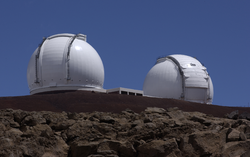
The W. M. Keck Observatory is an astronomical observatory with two telescopes at an elevation of 4,145 meters (13,600 ft) near the summit of Mauna Kea in the U.S. state of Hawaii. Both telescopes have 10 m (33 ft) aperture primary mirrors, and, when completed in 1993 (Keck I) and 1996 (Keck II), they were the largest optical reflecting telescopes in the world. They have been the third and fourth largest since 2006.
Key Information


Overview
[edit]With a concept first proposed in 1977, telescope designers Terry Mast, of the University of California, Berkeley, and Jerry Nelson of Lawrence Berkeley Laboratory had been developing the technology necessary to build a large, ground-based telescope.[1] In 1985, Howard B. Keck of the W. M. Keck Foundation gave $70 million to fund the construction of the Keck I telescope, which began in September 1985. First light occurred on November 24, 1990, using 9 of the eventual 36 segments. When construction of the first telescope was well advanced, further donations allowed the construction of a second telescope starting in 1991. The Keck I telescope began science observations in May 1993, while first light for Keck II occurred on April 27, 1996.

The key advance that allowed the construction of the Keck telescopes was the use of active optics to operate smaller mirror segments as a single, contiguous mirror. A mirror of similar size cast of a single piece of glass could not be made rigid enough to hold its shape precisely; it would sag microscopically under its own weight as it was turned to different positions, causing aberrations in the optical path. In the Keck telescopes, each primary mirror is made of 36 hexagonal segments that work together as a unit. Each segment is 1.8 meters wide and 7.5 centimeters thick and weighs half a ton.[2] The mirrors were made in Lexington, Massachusetts by Itek Optical Systems from Zerodur glass-ceramic by the German company Schott AG.[3][4] On the telescope, each segment is kept stable by a system of active optics, which uses extremely rigid support structures in combination with three actuators under each segment. During observation, the computer-controlled system of sensors and actuators dynamically adjusts each segment's position relative to its neighbors, keeping a surface shape accuracy of four nanometers. As the telescope moves, this twice-per-second adjustment counters the effects of gravity and other environmental and structural effects that can affect mirror shape.
Each Keck telescope sits on an altazimuth mount. Most current 8–10 m class telescopes use altazimuth designs for their reduced structural requirements compared to older equatorial designs. Altazimuth mounting provides the greatest strength and stiffness with the least amount of steel, which, for Keck Observatory, totals about 270 tons per telescope, bringing each telescope's total weight to more than 300 tons. Two proposed designs for the next generation 30 and 40 m telescopes use the same basic technology pioneered at Keck Observatory: a hexagonal mirror array coupled with an altazimuth mounting.
Each of the two telescopes has a primary mirror with an equivalent diameter of 10 meters (32.8 ft or 394 in), slightly smaller than the Gran Telescopio Canarias whose primary mirror has an equivalent diameter of 10.4 meters.
The telescopes are equipped with a suite of cameras and spectrometers that allow observations across much of the visible and near-infrared spectrum.
Management
[edit]The Keck Observatory is managed by the California Association for Research in Astronomy, a non-profit 501(c)(3) organization whose board of directors includes representatives from Caltech and the University of California. Construction of the telescopes was made possible through private grants of over $140 million from the W.M. Keck Foundation. The National Aeronautics and Space Administration (NASA) joined the partnership in October 1996 when Keck II commenced observations.
Telescope time is allocated by the partner institutions. Caltech, the University of Hawaii System, and the University of California accept proposals from their own researchers; NASA accepts proposals from researchers based in the United States.
Jerry Nelson, Keck Telescope project scientist, contributed to later multi-mirror projects until his death in June 2017. He conceived one of the Kecks' innovations, a reflecting surface of multiple thin segments acting as one mirror.[5]
Instruments
[edit]

Current instrument suite:
- MOSFIRE
- MOSFIRE (Multi-Object Spectrometer for Infra-Red Exploration),[6] a third-generation instrument, was delivered to Keck Observatory on February 8, 2012; first light was obtained on the Kecks I telescope on April 4, 2012. A multi-object spectrograph wide-field camera for the near-infrared (0.97 to 2.41 μm), its special feature is its cryogenic Configurable Slit Unit (CSU) that is reconfigurable by remote control in under six minutes without any thermal cycling. Bars move in from each side to form up to 46 short slits. When the bars are removed, MOSFIRE becomes a wide-field imager. It was developed by teams from the University of California, Los Angeles (UCLA), the California Institute of Technology (Caltech) and the University of California, Santa Cruz, (UCSC). Its co-principal investigators are Ian S. McLean (UCLA) and Charles C. Steidel (Caltech), and the project was managed by WMKO Instrument Program Manager Sean Adkins. MOSFIRE was funded in part by the Telescope System Instrumentation Program (TSIP), operated by AURA and funded by the National Science Foundation; and by a private donation to WMKO by Gordon and Betty Moore.[7]
- DEIMOS
- The Deep Extragalactic Imaging Multi-Object Spectrograph is capable of gathering spectra from 130 galaxies or more in a single exposure. In "Mega Mask" mode, DEIMOS can take spectra of more than 1,200 objects at once, using a special narrow-band filter.
- HIRES
- The largest and most mechanically complex of the Keck Observatory's main instruments,[citation needed] the High Resolution Echelle Spectrometer breaks up incoming light into its component colors to measure the precise intensity of each of thousands of color channels. Its spectral capabilities have resulted in many breakthrough discoveries, such as the detection of planets outside the Solar System and direct evidence for a model of the Big Bang theory. The radial velocity precision is up to one meter per second (1.0 m/s).[8] The instrument detection limit at 1 AU is 0.2 MJ.[9]
- KCWI
- The Keck Cosmic Web Imager[10] is an integral field spectrograph originally operating at wavelengths between 350 and 560 nm. More recently, the Keck Cosmic Reionization Mapper (KCRM) was added, extending long wavelength coverage from 560 to 1050 nm.
- LRIS
- The Low Resolution Imaging Spectrograph is a faint-light instrument capable of taking spectra and images of the most distant known objects in the universe. The instrument is equipped with a red arm and a blue arm to explore stellar populations of distant galaxies, active galactic nuclei, galactic clusters, and quasars.
- NIRC-2
- The second generation Near Infrared Camera works with the Keck Adaptive Optics system to produce the highest-resolution ground-based images and spectroscopy in the 1–5 micrometers (μm) range. Typical programs include mapping surface features on Solar System bodies, searching for planets around other stars, and analyzing the morphology of remote galaxies.
- NIRES
- The Near-Infrared Echellette Spectrometer is a spectrograph that provides simultaneous coverage of wavelengths from 0.94 to 2.45 microns.
- NIRSPEC
- The Near Infrared Spectrometer studies very high redshift radio galaxies, the motions and types of stars located near the Galactic Center, the nature of brown dwarfs, the nuclear regions of dusty starburst galaxies, active galactic nuclei, interstellar chemistry, stellar physics, and Solar System science.
- OSIRIS
- The OH-Suppressing Infrared Imaging Spectrograph is a near-infrared spectrograph for use with the Keck I adaptive optics system. OSIRIS takes spectra in a small field of view to provide a series of images at different wavelengths. The instrument allows astronomers to ignore wavelengths at which the Earth's atmosphere shines brightly from emissions of OH (hydroxyl) molecules, thus allowing the detection of objects 10 times fainter than previously available. Originally installed on Keck II, in January 2012 OSIRIS was moved to the Keck I telescope.
- ESI
- The Echellette Spectrograph and Imager[11] is a high-resolution spectrograph for optical wavelengths, also featuring imaging capabilities.
- KPF
- The Keck Planet Finder[12] is the newest instrument on Keck, which achieved first light in 2022. It is an extremely stable, high-resolution spectrograph designed to identify exoplanets via the radial velocity method.
Former instruments:
- NIRC
- The Near Infrared Camera for the Keck I telescope is so sensitive it could detect the equivalent of a single candle flame on the Moon. This sensitivity makes it ideal for ultra-deep studies of galactic formation and evolution, the search for proto-galaxies and images of quasar environments. It has provided ground-breaking studies of the Galactic Center, and is also used to study protoplanetary disks, and high-mass star-forming regions. NIRC was retired from science observations in 2010.
- LWS
- The Long Wavelength Spectrometer for the Keck I telescope is an imaging, grating spectrometer working in the wavelength range of 3-25 microns. Like NIRC, the LWS was a forward-CASS instrument, and was used for studying cometary, planetary, and extragalactic objects. The LWS is now retired from science observations.
- Keck Interferometer
- The Interferometer allowed the light from both Keck telescopes to be combined into an 85-metre-baseline (279 ft), near-infrared, optical interferometer. This long baseline gave the interferometer an effective angular resolution of 5 milliarcseconds (mas) at 2.2 μm, and 24 mas at 10 μm. Several back-end instruments allowed the interferometer to operate in a variety of modes, operating in H, K, and L-band near infrared, as well as nulling interferometry. As of mid-2012 the Keck Interferometer has been discontinued for lack of funding.
Both Keck Observatory telescopes are equipped with laser guide star adaptive optics, which compensate for the blurring from atmospheric turbulence. The equipment is the first AO system operational on a large telescope and has been constantly upgraded to expand its capability.


Middle: The night sky and Keck Observatory laser for adaptive optics. Right: W. M. Keck Observatory at sunset
See also
[edit]
References
[edit]- ^ "In Memoriam: Terry Mast (1943 - 2016)". UC Santa Cruz News. Retrieved July 28, 2019.
- ^ Lynn Yarris (1992). "Keck Revolution in Telescope Design Pioneered at Lawrence Berkeley Lab". Retrieved October 7, 2016.
- ^ Mast, T. S.; Nelson, J. E. (1988). Ulrich, Marie-Helene (ed.). "Keck Telescope Primary Mirror Segments: Fabrication and Support". Very Large Telescopes and Their Instrumentation, ESO Conference and Workshop Proceedings, Proceedings of a ESO Conference on Very Large Telescopes and Their Instrumentation. 30. Garching, Germany: European Southern Observatory (ESO): 411. Bibcode:1988ESOC...30..411M.
- ^ Hans F. Morian; Peter Hartmann; Ralf Jedamzik; Hartmut W. Höneß. "ZERODUR for Large Segmented Telescopes" (PDF). SCHOTT Glas. Archived from the original (PDF) on July 31, 2009. Retrieved April 17, 2009.
- ^ Lewis, Hilton. "In Memoriam: Jerry Nelson, Legendary Telescope Designer". Scientific American Blog Network. Retrieved June 16, 2017.
- ^ "MOSFIRE science based capabilities".
- ^ "MOSFIRE, the Multi-Object Spectrometer For Infra-Red Exploration at the Keck Observatory" (PDF). irlab.astro.ucla.edu. Archived from the original (PDF) on March 23, 2015. Retrieved November 13, 2019.
- ^ NASA. "Kepler Discoveries - About Follow-up Observations". NASA. Archived from the original on July 21, 2011.
- ^ "The NASA-UC Eta-Earth Survey At Keck Observatory". Chinese Academy of Sciences. October 16, 2010. Archived from the original on July 4, 2011. Retrieved February 21, 2015.
- ^ Morrissey, Patrick; Matuszewski, Matuesz; Martin, D. Christopher; Neill, James D.; Epps, Harland; Fucik, Jason; Weber, Bob; Darvish, Behnam; Adkins, Sean; Allen, Steve; Bartos, Randy; Belicki, Justin; Cabak, Jerry; Callahan, Shawn; Cowley, Dave; Crabill, Marty; Deich, Willian; Delecroix, Alex; Doppman, Greg; Hilyard, David; James, Ean; Kaye, Steve; Kokorowski, Michael; Kwok, Shui; Lanclos, Kyle; Milner, Steve; Moore, Anna; O’Sullivan, Donal; Parihar, Prachi; Park, Sam; Phillips, Andrew; Rizzi, Luca; Rockosi, Constance; Rodriguez, Hector; Salaun, Yves; Seaman, Kirk; Sheikh, David; Weiss, Jason; Zarzaca, Ray (September 1, 2018). "The Keck Cosmic Web Imager Integral Field Spectrograph". The Astrophysical Journal. 864 (1): 93. arXiv:1807.10356. Bibcode:2018ApJ...864...93M. doi:10.3847/1538-4357/aad597.
- ^ Sheinis, A. I.; Bolte, M.; Epps, H. W.; Kibrick, R. I.; Miller, J. S.; Radovan, M. V.; Bigelow, B. C.; Sutin, B. M. (August 2002). "ESI, a New Keck Observatory Echellette Spectrograph and Imager". Publications of the Astronomical Society of the Pacific. 114 (798): 851–865. arXiv:astro-ph/0204297. Bibcode:2002PASP..114..851S. doi:10.1086/341706.
- ^ Gibson, Steven R.; Howard, Andrew W.; Rider, Kodi; Halverson, Samuel P.; Roy, Arpita; Baker, Ashley D.; Edelstein, Jerry; Smith, Christopher; Fulton, Benjamin; Walawender, Josh; Brodheim, Max; Brown, Matthew; Chan, Dwight; Dai, Fei; Deich, William; Gottschalk, Colby; Grillo, Jason; Hale, David; Hill, Grant; Holden, Bradford P.; Householder, Aaron; Isaacson, Howard; Ishikawa, Yuzo; Jelinsky, Sharon; Kassis, Marc F.; Kaye, Stephen; Laher, Russ; Lanclos, Kyle; Lee, Chien-Hsiu; Lilley, Scott; McCarney, Benjamin; Miller, Tim; Payne, Joel; Petigura, Erik; Poppett, Claire; Raffanti, Mike; Rubenzahl, Ryan; Sandford, Dale; Schwab, Christian; Shaum, Abby P.; Sirk, Martin M.; Smith, Roger; Thorne, Jim; Valliant, John; Vandenberg, Adam; Wang, Cindy; Wishnow, Edward; Wold, Truman; Yeh, Sherry; Baca, Steve; Beichman, Charles A.; Berriman, Bruce; Brown, Thomas; Casey, Kelleen; Chin, Jason; Chong, James; Cowley, David; Devenot, Mark; Elwir, Hamza; Finstad, Daniel; Fraysse, Matthew; James, Ean; Jhoti, Elisha; Killian, Joe; Levine, Obie; Li, Adela; Marin, Eduardo; Milner, Steven; Nance, Craig; O'Hanlon, Timothy; Orr, Daniel; Ortiz-Soto, Roberto; Payne, Tom; Pember, Jacob; Raskin, Gert; Savage, Maureen; Seifahrt, Andreas; Smith, Brett; Storesund, Rob; Stürmer, Julian; Suominen, Nick; Tehero, Jerez; Von Boeckmann, Tod; Wages, Keith; Weisfeiler, Marie; Wilcox, Mavourneen; Wizinowich, Peter; Wolfenberger, Anna (July 18, 2024). "System design of the Keck Planet Finder". In Vernet, Joël R.; Bryant, Julia J.; Motohara, Kentaro (eds.). Ground-based and Airborne Instrumentation for Astronomy X. p. 9. doi:10.1117/12.3017841. ISBN 978-1-5106-7515-5.
Further reading
[edit]- Barry Parker, Stairway to the Stars: The Story of the World's Largest Observatory, Plenum Press, New York and London, 1994, ISBN 0-306-44763-0 - contains extensive material on the construction of Keck I
External links
[edit]
- W. M. Keck Observatory (official site)
- Mauna Kea Observatories (official site)
- Keck Observatory Archive (KOA)
- Lawrence Berkeley Lab, Revolution in telescope design Archived December 22, 2017, at the Wayback Machine
- Photos of Keck telescopes and other Mauna Kea observatories from "A Gentle Rain of Starlight: The Story of Astronomy on Mauna Kea" by Michael J. West. ISBN 0-931548-99-3.
| Astronomy by |
| ||||||||||
|---|---|---|---|---|---|---|---|---|---|---|---|
| Optical telescopes | |||||||||||
| Related |
| ||||||||||

| International | |
|---|---|
| National | |
| Other | |
W. M. Keck Observatory
View on GrokipediaHistory
Founding and Funding
The concept for what would become the W. M. Keck Observatory originated in the early 1980s at the California Institute of Technology (Caltech), where astronomers sought to build a groundbreaking 10-meter-class optical telescope to push the boundaries of ground-based astronomy. In 1980, Caltech astronomer Wallace L. W. Sargent authored a memo proposing a telescope in the 10-to-15-meter range, highlighting emerging technologies that made such a scale feasible despite challenges with single-piece mirrors. This vision evolved through collaboration with the University of California (UC) system, formalized in a partnership agreement in August 1984, which combined Caltech's astronomical expertise with UC's resources and site-testing experience on Mauna Kea in Hawaii.[11][2] Key innovations in design were led by Jerry Nelson and Terry Mast at Lawrence Berkeley National Laboratory (LBNL), a UC-managed facility, who developed the novel segmented mirror technology using 36 hexagonal segments to achieve the telescope's 10-meter aperture without the limitations of monolithic mirrors. Initial funding for this design phase came from UC and LBNL grants, enabling proof-of-concept work on active optics and segment alignment. Mauna Kea was selected as the site after UC's extensive atmospheric testing confirmed its superior seeing conditions, clear skies, and minimal light pollution, making it ideal for infrared and optical observations. The project emphasized international collaboration, with early involvement from astronomers worldwide to ensure the observatory's future scientific impact.[2][11][12] Funding was secured through the philanthropic efforts of the W. M. Keck Foundation, established in 1954 by William Myron Keck, founder of the Superior Oil Company, to support scientific and medical advancements. Caltech administrators, including Gerry Neugebauer, approached Howard B. Keck—a foundation trustee and son of the founder—to champion the proposal, emphasizing its potential to revolutionize astronomy. In 1985, the foundation provided a landmark $70 million grant for the first telescope (Keck I), representing about 25% of its assets at the time and marking the largest private donation to astronomy to date. This was followed by a $74.6 million grant in 1991 for the identical twin telescope (Keck II), bringing total funding to $144.6 million. The observatory is jointly managed by Caltech and UC as a nonprofit entity, with construction beginning in September 1985 under project manager Gerald Smith.[2][11][13][14]Construction and First Light
The construction of the W. M. Keck Observatory was initiated in the mid-1980s as a collaborative effort between the California Institute of Technology (Caltech) and the University of California, under the management of the California Association for Research in Astronomy (CARA). Groundbreaking for Keck I occurred on September 12, 1985, at the summit of Mauna Kea in Hawaii, following a $70 million grant from the W. M. Keck Foundation announced earlier that year. This funding supported the innovative design of a 10-meter aperture telescope using a primary mirror composed of 36 hexagonal segments, a concept pioneered by astronomer Jerry Nelson at Lawrence Berkeley National Laboratory to overcome the limitations of monolithic mirrors in large telescopes. The segmented approach allowed for lighter, more transportable components while achieving high optical precision through active alignment systems that adjust each segment to within 15-40 nanometers.[15][11][12] Construction of Keck I progressed through the late 1980s, involving the fabrication of mirror segments at the University of California's Richard B. Hoover Center for X-ray Optics and the assembly of the telescope structure by contractors including M. W. Kellogg Company. Key challenges included developing stress-polishing techniques to maintain segment flatness under gravitational forces and implementing computer-controlled actuators for real-time alignment, overseen by project manager Gerald Smith. By 1990, nine segments were installed, enabling initial testing. Full mirror completion with all 36 segments was achieved in early 1992. Meanwhile, funding for Keck II was secured with an additional $74.6 million from the Keck Foundation in 1991, allowing construction to begin immediately after the Keck I dedication on November 7, 1991. The second telescope followed a similar design but incorporated refinements from the first build.[11][16][2][14] First light for Keck I was achieved on November 24, 1990, when the partially assembled telescope with nine mirror segments captured an image of the spiral galaxy NGC 1232, marking a milestone in ground-based astronomy and validating the segmented mirror technology. The full 36-segment configuration reached first light on April 14, 1992, paving the way for scientific operations starting in May 1993 under director Gerry Neugebauer. For Keck II, partial first light occurred on January 23, 1996, with 24 segments, followed by complete first light on February 27, 1996, with all 36 segments. The second telescope was dedicated on May 8, 1996, and entered routine science use by October 1996, expanding the observatory's capabilities for high-resolution observations. These achievements established the Keck telescopes as the largest optical instruments of their era, enabling breakthroughs in cosmology and exoplanet detection.[15][2][17][18]Major Upgrades and Expansions
Following the initial operations of Keck I in 1993 and Keck II in 1996, the observatory underwent significant enhancements to its adaptive optics (AO) systems, which dramatically improved image quality by correcting atmospheric distortion. The natural guide star AO system on Keck II achieved routine science operations in 1999, enabling high-resolution observations limited to bright guide stars near the target.[19] This was extended to Keck I in 2005 with the deployment of the OSIRIS integral field spectrograph, which utilized AO for near-infrared imaging and spectroscopy.[20] A pivotal expansion came in 2001 with the commissioning of the Keck Interferometer, which combined light from both 10-meter telescopes to form a virtual 85-meter aperture instrument, achieving first fringes on March 12, 2001, and entering full science operations in 2003.[21][22] Funded by NASA, it operated until 2012, enabling groundbreaking studies of stellar surfaces, binary stars, and exoplanet detection through nulling interferometry, with a resolution equivalent to seeing a dime from 200 miles away.[22] Further AO advancements included the 2004 introduction of laser guide star (LGS) technology on both telescopes, vastly expanding sky coverage to nearly 100% by using a sodium laser to create an artificial guide star, thus allowing observations of fainter objects.[19][23] Instrument upgrades have sustained the observatory's competitiveness, with notable examples including the 2021 overhaul of the Low Resolution Imaging Spectrometer (LRIS) on Keck I, which installed a new 4k × 4k red-side CCD detector for enhanced sensitivity in the 550–1000 nm range, achieving first light on April 27, 2021.[24] In 2023, the Keck Cosmic Web Imager (KCWI) on Keck II was upgraded to the Keck Cosmic Reionization Mapper (KCRM), extending wavelength coverage to 1 µm and increasing the field of view to map cosmic structures during the epoch of reionization.[25][20] The Keck Planet Finder (KPF), a high-resolution spectrograph for exoplanet radial velocity measurements, achieved first light on November 9, 2022, enhancing capabilities for detecting Earth-like planets. In 2025, the Deep Imaging Multi-Object Spectrograph (DEIMOS) underwent an upgrade with new detectors and controllers, entering commissioning that year to improve efficiency for multi-object spectroscopy.[26][27] Ongoing expansions emphasize precision AO and new instrumentation. The Keck All-sky Precision Adaptive-optics (KAPA) project on Keck I, initiated in 2018, introduces four laser guide stars and a high-order deformable mirror, with science operations beginning in 2025.[20][28] Detector upgrades across instruments like NIRC2, DEIMOS, and NIRES, completed between 2022 and 2024, incorporate modern controllers and larger arrays to boost efficiency and reduce readout noise.[29] These developments ensure the observatory remains a leader in ground-based astronomy, with future projects like the Liger spectrograph targeted for 2027.[20]Site and Facilities
Location on Mauna Kea
The W. M. Keck Observatory is situated near the summit of Mauna Kea, a dormant shield volcano on the island of Hawaiʻi, at an elevation of approximately 4,200 meters (13,800 feet) above sea level.[30] The twin telescopes, Keck I and Keck II, are located at coordinates 19° 49' 33.4" N, 155° 28' 29.0" W for Keck I and 19° 49' 35.6" N, 155° 28' 27.2" W for Keck II.[31] This high-altitude position places the observatory above about 40% of Earth's atmosphere, minimizing absorption of light by water vapor and other molecules that could obscure observations.[30] Mauna Kea was selected as the site for the observatory in the late 1980s following extensive site-testing by the University of California, which confirmed it offered superior astronomical conditions compared to alternatives like locations in Chile.[2] The site's exceptional qualities stem from its geography: a tropical inversion layer, about 600 meters thick, traps moist air below 2,500 meters, resulting in an extraordinarily dry atmosphere at the summit with low humidity and a high percentage of clear nights—often exceeding 300 annually.[32] This dryness is particularly advantageous for infrared astronomy, as it reduces interference from atmospheric water vapor, enabling deeper observations of celestial objects.[33] Additionally, Mauna Kea provides some of the best "seeing" conditions on Earth, characterized by stable air flows that produce minimal turbulence and image distortion for ground-based telescopes.[2] The remote location, far from urban centers, combined with strict island-wide lighting ordinances, ensures extremely low light pollution, preserving dark skies essential for detecting faint astronomical signals.[32] Logistically, the site's proximity to the U.S. West Coast facilitates access for researchers and equipment transport, further enhancing its practicality.[2] These factors have made Mauna Kea the most scientifically productive mountaintop for optical and infrared astronomy worldwide.[34] Mauna Kea holds profound cultural and spiritual significance to Native Hawaiians, regarded as the first-born mountain of the island and a sacred realm of the gods (wao akua), with traditional practices and ancestral burials associated with its summit. The development of observatories, including Keck, has sparked ongoing controversies, particularly protests against further telescope construction such as the Thirty Meter Telescope (TMT), citing impacts on cultural sites, water resources, and endangered species. These tensions led to blockades in 2019 and legal challenges; as of November 2025, the TMT project faces funding cuts from the National Science Foundation and discussions for alternative sites on Mauna Kea following the decommissioning of older telescopes like UKIRT.[35]Infrastructure and Support Systems
The W. M. Keck Observatory's physical infrastructure centers on a summit facility at 4,145 meters elevation on Mauna Kea, comprising two independent dome enclosures for the 10-meter Keck I and Keck II telescopes, connected by a central service building. This building houses operational control rooms, engineering workshops, administrative offices, and visitor amenities, including a public gallery with exhibits overlooking the Keck I telescope. The domes, constructed with lightweight steel frameworks and insulated cladding to withstand extreme high-altitude conditions, enclose the telescopes while allowing precise tracking and environmental isolation. A shared rooftop area between the domes supports ancillary systems, such as structural mounts for renewable energy installations, designed to endure high winds up to 200 km/h via ballasted configurations.[36][37] Power supply for the observatory relies on a combination of grid electricity from Hawaiian Electric and on-site renewable generation to meet the high demands of telescope operations, instrumentation, and adaptive optics systems. In 2020, a 133-kW solar photovoltaic array was installed on the rooftop facility, featuring 332 panels that generate approximately 259.1 MWh annually, offsetting 10-15% of the site's electrical needs and reducing carbon emissions by 183 metric tons per year. The system, engineered with custom racking to handle Mauna Kea's harsh weather, interconnects directly with the grid for net metering, enhancing energy resilience at this remote location. Ongoing infrastructure investments, including annual maintenance budgets, ensure reliable power distribution to critical components like the laser guide star systems, which previously required extensive setup but now operate efficiently with modern low-power lasers consuming just 1.2 kW.[30][36][38] Cooling and thermal management systems are essential for maintaining instrument performance in Mauna Kea's variable climate, where temperatures can drop below -10°C at night. Due to escalating costs of liquid nitrogen delivery to the summit, the observatory mandates mechanical cryocoolers for all new instruments, providing closed-loop cooling to detectors and optics without reliance on cryogenic fluids. These systems, integrated into spectrographs and imagers, achieve temperatures as low as 70 K to minimize thermal noise, supporting high-precision observations. The telescope structures themselves benefit from the site's natural airflow and passive insulation, with active ventilation in the domes to prevent condensation on mirrors and enclosures. Infrastructure upgrades, such as those for the adaptive optics deformable mirrors, incorporate thermal stabilization to ensure consistent operation across nightly temperature swings.[39][40] Access to the observatory is facilitated by a dedicated unpaved summit road extending from the 2,800-meter Onizuka Visitor Information Station, requiring four-wheel-drive vehicles for the steep, rough 10-km ascent above 2,800 meters. Visitors and staff must acclimate for at least 30 minutes at the station to mitigate altitude sickness risks, with road conditions monitored daily via a hotline for weather-related closures due to snow, ice, or high winds. Logistical support includes on-site emergency facilities, backup generators, and coordinated transportation services from Hilo or Kona airports to the Waimea headquarters, approximately 1.5 hours from the summit. The observatory's strategic plans emphasize sustained investment in these support systems, including predictive maintenance and renewal of roads and utilities, to uphold operational reliability amid environmental challenges.[41][40][42]Telescopes
Design and Mirror Technology
The W. M. Keck Observatory features two identical 10-meter aperture telescopes, Keck I and Keck II, designed with an innovative segmented primary mirror system that broke from traditional monolithic mirror construction to achieve unprecedented scale. This design, pioneered by astronomer Jerry Nelson at the University of California, Berkeley, uses an alt-azimuth mounting for optimal balance of mass and structural efficiency, allowing the telescopes to track celestial objects by rotating around horizontal (altitude) and vertical (azimuth) axes. The mounting supports the lightweight steel tube structure, which minimizes flexure and enables precise pointing with slew rates up to 1.3 degrees per second in azimuth and 0.5 degrees per second in elevation.[1][12][43] The primary mirrors consist of 36 hexagonal segments, each 1.8 meters across and 7.5 centimeters thick, collectively forming a 10-meter parabolic surface equivalent to a single mirror but far lighter and more manufacturable. Crafted from Zerodur, a low-expansion glass-ceramic developed by Schott AG, the segments resist thermal distortion critical for high-altitude observing on Mauna Kea. Each segment weighs approximately 880 pounds (400 kilograms) and is coated with a thin layer of aluminum to reflect light across ultraviolet to near-infrared wavelengths, with recoating performed every few years to maintain reflectivity above 90%. The segmentation approach addressed the engineering challenges of casting and polishing massive single mirrors, drawing inspiration from earlier multi-mirror experiments but scaled up through stressed-mirror polishing techniques that warp blanks into precise off-axis parabolas before final figuring.[44][45][46] Active optics maintain the mirror's integrity through a computer-controlled system that aligns segments with nanometer precision, compensating for gravitational and thermal effects. Three hydraulic actuators per segment—totaling 108 across the mirror—adjust for piston motion, tip, and tilt, while 168 capacitive edge sensors measure relative positions between adjacent segments at 100 Hz sampling rates. This closed-loop system updates alignments twice per second, achieving surface errors below 4 nanometers RMS, which ensures diffraction-limited performance when coupled with adaptive optics. Nelson's team validated the concept through prototypes in the 1980s, proving that segmentation could deliver optical quality rivaling smaller monolithic telescopes like the 5-meter Hale reflector.[45][47][48]Keck I and Keck II Specifications
The W. M. Keck Observatory operates two identical 10-meter class telescopes, Keck I and Keck II, mounted on alt-azimuth structures that provide optimal balance between mass and rigidity for precise tracking of celestial objects.[43] Each telescope features a primary mirror composed of 36 hexagonal segments, each measuring 1.8 meters across the corners and weighing approximately 880 pounds, arranged to form a reflective surface with a maximum diameter of 10.95 meters, equivalent to a 9.96-meter circular aperture.[44][43] These segments are actively controlled by computer systems that adjust their positions to within 4 nanometers accuracy, twice per second, ensuring the mirror functions as a single coherent optical element despite its segmented design.[3] The primary mirror of each telescope has a focal length of 17.5 meters, with secondary mirrors enabling multiple focal ratios to accommodate diverse observational needs: f/15 (effective focal length 149.6 meters), f/25 (249.7 meters, with chopping capability for infrared observations), and f/40 (395.0 meters, also with chopping).[43] The alt-azimuth mount supports the telescope's total weight of approximately 300 tons, including the steel truss structure and enclosure, while achieving closed-loop tracking accuracy of 0.08 arcseconds root-mean-square and open-loop rates of about 0.1 arcseconds per minute.[18][43] Slewing capabilities include azimuth rates up to 1.3 degrees per second and elevation up to 0.5 degrees per second, allowing rapid repositioning across the sky.[43] Each telescope is housed in a temperature-controlled dome exceeding 700,000 cubic feet in volume, designed to minimize thermal distortion through air conditioning and ventilation systems that maintain near-ambient conditions.[1] The segmented mirrors are supported by adjustable warping harnesses to counteract gravitational flexure, with each segment's surface polished to tolerances where scaled imperfections would measure only about three feet across Earth's diameter, enabling diffraction-limited performance when paired with adaptive optics.[3][1]| Specification | Keck I | Keck II |
|---|---|---|
| Primary Mirror Diameter | 10.95 m (max), 9.96 m equiv. | 10.95 m (max), 9.96 m equiv. |
| Number of Segments | 36 | 36 |
| Segment Size | 1.8 m across corners | 1.8 m across corners |
| Focal Ratios | f/15, f/25, f/40 | f/15, f/25, f/40 |
| Mount Type | Alt-azimuth | Alt-azimuth |
| Total Weight | ~300 tons | ~300 tons |
| Tracking Accuracy (closed-loop) | 0.08 arcsec rms | 0.08 arcsec rms |