
Recent from talks
Johnny Bower
Knowledge base stats:
Talk channels stats:
Members stats:
Johnny Bower
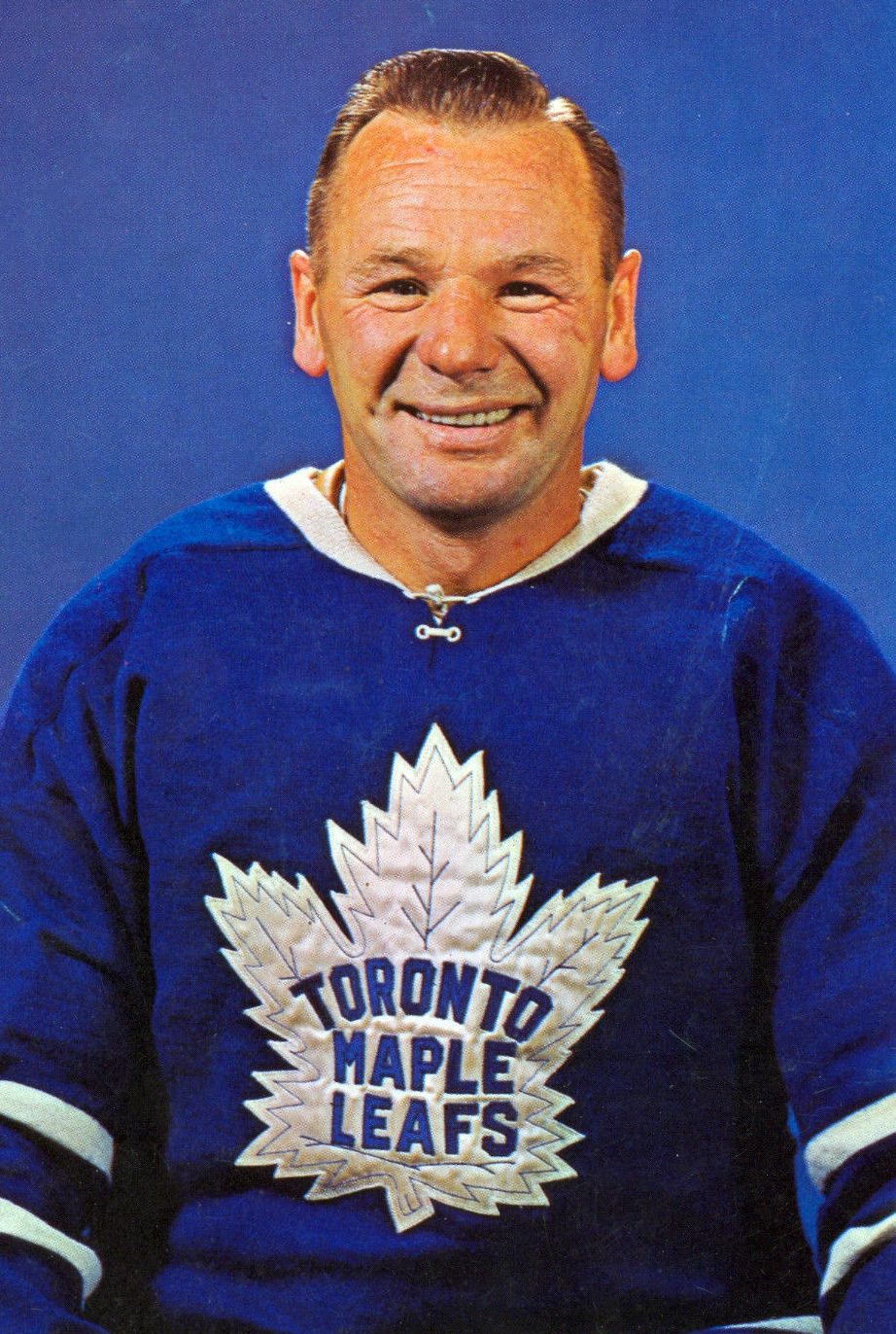
John William Bower (né Kiszkan; November 8, 1924 – December 26, 2017) nicknamed "The China Wall", was a Canadian ice hockey goaltender and inductee to the Hockey Hall of Fame, who won four Stanley Cups during his career with the Toronto Maple Leafs. In 2017 he was named one of the "100 Greatest NHL Players" in history. His song "Honky (The Christmas) Goose" reached #29 on the CHUM Charts in December 1965.
Bower was born John William Kiszkan into a Ukrainian-Canadian family in Prince Albert, Saskatchewan, to Johnny Kiszkan, a labourer born Dmytro Kiszkan, and his wife, Lizzie, née Jacobson. (His father had previously been a homesteader.) He had one brother and seven sisters. He taught himself how to play hockey, using a branch as a stick, and made himself goalie pads out of old mattresses. Around age 10, his parents separated. An uncommon practice at the time, it created a stigma around the family in their town. When he was 15, he lied about his age and enlisted in the Canadian Army during World War II; from 1940 to 1943 he was stationed in England as a gunner with the 2nd Canadian Division. He was discharged due to rheumatoid arthritis in his hands.
Kiszkan returned to Prince Albert in 1944 to play junior hockey there. In 1945, he turned professional in the American Hockey League (AHL), where he spent eleven seasons playing mostly for the Cleveland Barons in the late 1940s and 1950s.
Bower told various stories about his name change, including that "Bower" was his mother's maiden name, or that he was adopted. Biographer Dan Robson was also told that Barons management may have asked him to, to avoid the post-war discrimination against eastern Europeans, while other sources claim that it was because sports writers often misspelled "Kiszkan". His parents' break up may also have been a factor, suggests Robson, as Bower rarely talked about the situation. His surname was legally changed during his first year of professional hockey. Robson's 2018 book, Bower: A Legendary Life, dedicates a chapter to the topic.
In the AHL, he proved himself the star goaltender of the circuit, winning numerous awards and leading his teams to three Calder Cup championships.
Bower made his debut in the National Hockey League (NHL) with the New York Rangers in 1953–54, at the age of 29. The Rangers made him their starting goaltender over Gump Worsley, who had been rookie of the year the previous season. Bower played in all 70 games that season and recorded 29 wins. The following season Worsley won back the starting job for the Rangers, and Bower returned to the minor leagues. He played there for four more years with three teams, the Providence Reds, the Vancouver Canucks and the Cleveland Barons, and was called up briefly by the Rangers in 1954–55 and 1956–57.
In the 1958 Inter-League draft he was claimed by the Toronto Maple Leafs, who were an up-and-coming team of young star players at the time. Nonetheless, Bower preferred to stay with the Barons, as he was tired of moving all over the country. Punch Imlach, whom the Maple Leafs had recently hired, visited Bower and convinced him to give the NHL one more try, as he considered him "the most remarkable — and maybe the best — athlete in the world."
Bower won his first Vezina Trophy in 1961 for allowing the fewest goals in the 1960–61 season. The height of his NHL career came during the Maple Leafs' three consecutive Stanley Cup victories from 1962 to 1964. He later said, "When we won the Stanley Cup, my head went numb, my whole body went numb. That was my dream from Day One. You just can't explain the feelings inside you."
Hub AI
Johnny Bower AI simulator
(@Johnny Bower_simulator)
Johnny Bower
John William Bower (né Kiszkan; November 8, 1924 – December 26, 2017) nicknamed "The China Wall", was a Canadian ice hockey goaltender and inductee to the Hockey Hall of Fame, who won four Stanley Cups during his career with the Toronto Maple Leafs. In 2017 he was named one of the "100 Greatest NHL Players" in history. His song "Honky (The Christmas) Goose" reached #29 on the CHUM Charts in December 1965.
Bower was born John William Kiszkan into a Ukrainian-Canadian family in Prince Albert, Saskatchewan, to Johnny Kiszkan, a labourer born Dmytro Kiszkan, and his wife, Lizzie, née Jacobson. (His father had previously been a homesteader.) He had one brother and seven sisters. He taught himself how to play hockey, using a branch as a stick, and made himself goalie pads out of old mattresses. Around age 10, his parents separated. An uncommon practice at the time, it created a stigma around the family in their town. When he was 15, he lied about his age and enlisted in the Canadian Army during World War II; from 1940 to 1943 he was stationed in England as a gunner with the 2nd Canadian Division. He was discharged due to rheumatoid arthritis in his hands.
Kiszkan returned to Prince Albert in 1944 to play junior hockey there. In 1945, he turned professional in the American Hockey League (AHL), where he spent eleven seasons playing mostly for the Cleveland Barons in the late 1940s and 1950s.
Bower told various stories about his name change, including that "Bower" was his mother's maiden name, or that he was adopted. Biographer Dan Robson was also told that Barons management may have asked him to, to avoid the post-war discrimination against eastern Europeans, while other sources claim that it was because sports writers often misspelled "Kiszkan". His parents' break up may also have been a factor, suggests Robson, as Bower rarely talked about the situation. His surname was legally changed during his first year of professional hockey. Robson's 2018 book, Bower: A Legendary Life, dedicates a chapter to the topic.
In the AHL, he proved himself the star goaltender of the circuit, winning numerous awards and leading his teams to three Calder Cup championships.
Bower made his debut in the National Hockey League (NHL) with the New York Rangers in 1953–54, at the age of 29. The Rangers made him their starting goaltender over Gump Worsley, who had been rookie of the year the previous season. Bower played in all 70 games that season and recorded 29 wins. The following season Worsley won back the starting job for the Rangers, and Bower returned to the minor leagues. He played there for four more years with three teams, the Providence Reds, the Vancouver Canucks and the Cleveland Barons, and was called up briefly by the Rangers in 1954–55 and 1956–57.
In the 1958 Inter-League draft he was claimed by the Toronto Maple Leafs, who were an up-and-coming team of young star players at the time. Nonetheless, Bower preferred to stay with the Barons, as he was tired of moving all over the country. Punch Imlach, whom the Maple Leafs had recently hired, visited Bower and convinced him to give the NHL one more try, as he considered him "the most remarkable — and maybe the best — athlete in the world."
Bower won his first Vezina Trophy in 1961 for allowing the fewest goals in the 1960–61 season. The height of his NHL career came during the Maple Leafs' three consecutive Stanley Cup victories from 1962 to 1964. He later said, "When we won the Stanley Cup, my head went numb, my whole body went numb. That was my dream from Day One. You just can't explain the feelings inside you."
Recent media