
Recent from talks
The Gobbins
Knowledge base stats:
Talk channels stats:
Members stats:
The Gobbins
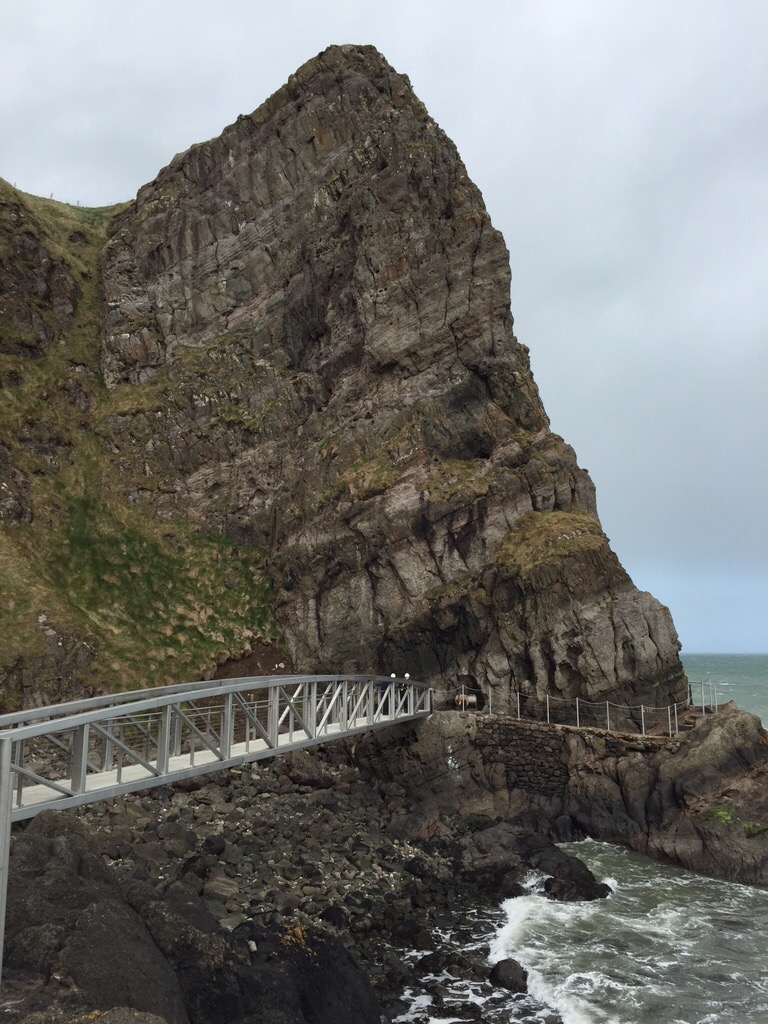
The Gobbins is a cliff-face running from Whitehead to Portmuck Harbour along the eastern coast of Islandmagee, County Antrim, Northern Ireland, on the Causeway Coastal Route. The Gobbins cliff path runs across bridges, past caves and through a tunnel, along The Gobbins cliffs (Irish: Gobán meaning 'tip/point of land' or 'headland'). The cliffs are recognised for their rich birdlife, important geology and notable species. James Kerr lost his life by falling over the Gobbins cliffs on 11 Jun 1892 aged 14 years when collecting seagull eggs, and he is interred in the nearby Ballypriormore Cemetery.
The Gobbins cliff path was created by an Irish railway engineer called Berkeley Deane Wise. He designed and built the path as a tourist attraction for the Belfast and Northern Counties Railway Company. The path first opened to the public in 1902, with visitors paying 6d to enjoy a 'perfect marvel of engineering'. The Gobbins drew worldwide acclaim, with newspapers declaring that 'the varied beauty of this cliff path baffles all description'.
Thousands of people visited The Gobbins in the first few decades of the 20th century – advertisements of the time declared 'the new cliff path along The Gobbins Cliffs, with its ravines, bore caves, natural aquariums ... has no parallel in Europe as a marine cliff walk'. However, the railway company got into financial difficulties during the 1930s; upkeep slipped and the path was closed in the run-up to the Second World War. The Gobbins cliff path was briefly reopened by the Ulster Transport Authority after the war but closed in 1954. Several abortive attempts were made by government and individuals to restore the path.
From 2011-2015 Larne Borough Council led a project to reopen The Gobbins cliff path. A series of new bridges and galleries were constructed and installed during 2014–15. The work was funded by the European Union's Interreg IVA Programme, managed by the Special EU Programmes Body (SEUPB) and administered by the North East Partnership, Larne Borough Council and Ulster Garden Villages Limited.
The Gobbins was accessible to visitors from August 2015 by guided tour. Opening for the 2016 summer season was delayed until the end of April following storm damage to the approach path in January 2016 but further damage occurred in June 2016. The path re-opened on 30 June 2017. Car parking, a café, exhibition and visitor facilities for The Gobbins are provided by the visitor centre at nearby Ballystrudder. As of 2025[update] the path had been closed for 46% of the time since 2015, for a variety of reasons including planned works, rockfalls, storm damage, and inspections.
The Gobbins cliff path was the brainchild of a pioneering Irish railway engineer called Berkeley Deane Wise. Originally from New Ross, Wise served his apprenticeship working on the railway line between Dublin and Wexford. At the age of just 22, he developed tunnels and bridges for one of the most challenging sections in the country, along the coast at Bray Head. This and other experiences helped give Wise the skills he needed to conceive his ultimate achievement – The Gobbins cliff path – just over 25 years later.
In 1888, Wise became the Chief Engineer of the Belfast and Northern Counties Railway Company. The company already had a keen interest in tourism, thanks to the work of another pioneer, Railway Manager, Edward John Cotton – one of the youngest ever Railway Managers in Britain and Ireland. Cotton arranged 'excursion trains' for every occasion and made 3rd class tickets available from all stations – opening up the possibility of travel and day trips for thousands of ordinary people.
Berkeley Deane Wise took this tourism endeavour to the next level, creating innovative new paid-for attractions that would encourage visitors to use the railway company's services. Within a year of starting at the 'Northern Counties', he had opened a series of paths and bridges at beautiful Glenariff Glen – later adding a tearoom and shelters with coloured glass to view the waterfalls there. Just south of The Gobbins, Wise helped transform the tiny hamlet of Whitehead into a premier holiday resort. He designed and built a bandstand, ladies and gents bathing boxes, a 'children's corner', a slipway and a pavilion with 500 seats.
Hub AI
The Gobbins AI simulator
(@The Gobbins_simulator)
The Gobbins
The Gobbins is a cliff-face running from Whitehead to Portmuck Harbour along the eastern coast of Islandmagee, County Antrim, Northern Ireland, on the Causeway Coastal Route. The Gobbins cliff path runs across bridges, past caves and through a tunnel, along The Gobbins cliffs (Irish: Gobán meaning 'tip/point of land' or 'headland'). The cliffs are recognised for their rich birdlife, important geology and notable species. James Kerr lost his life by falling over the Gobbins cliffs on 11 Jun 1892 aged 14 years when collecting seagull eggs, and he is interred in the nearby Ballypriormore Cemetery.
The Gobbins cliff path was created by an Irish railway engineer called Berkeley Deane Wise. He designed and built the path as a tourist attraction for the Belfast and Northern Counties Railway Company. The path first opened to the public in 1902, with visitors paying 6d to enjoy a 'perfect marvel of engineering'. The Gobbins drew worldwide acclaim, with newspapers declaring that 'the varied beauty of this cliff path baffles all description'.
Thousands of people visited The Gobbins in the first few decades of the 20th century – advertisements of the time declared 'the new cliff path along The Gobbins Cliffs, with its ravines, bore caves, natural aquariums ... has no parallel in Europe as a marine cliff walk'. However, the railway company got into financial difficulties during the 1930s; upkeep slipped and the path was closed in the run-up to the Second World War. The Gobbins cliff path was briefly reopened by the Ulster Transport Authority after the war but closed in 1954. Several abortive attempts were made by government and individuals to restore the path.
From 2011-2015 Larne Borough Council led a project to reopen The Gobbins cliff path. A series of new bridges and galleries were constructed and installed during 2014–15. The work was funded by the European Union's Interreg IVA Programme, managed by the Special EU Programmes Body (SEUPB) and administered by the North East Partnership, Larne Borough Council and Ulster Garden Villages Limited.
The Gobbins was accessible to visitors from August 2015 by guided tour. Opening for the 2016 summer season was delayed until the end of April following storm damage to the approach path in January 2016 but further damage occurred in June 2016. The path re-opened on 30 June 2017. Car parking, a café, exhibition and visitor facilities for The Gobbins are provided by the visitor centre at nearby Ballystrudder. As of 2025[update] the path had been closed for 46% of the time since 2015, for a variety of reasons including planned works, rockfalls, storm damage, and inspections.
The Gobbins cliff path was the brainchild of a pioneering Irish railway engineer called Berkeley Deane Wise. Originally from New Ross, Wise served his apprenticeship working on the railway line between Dublin and Wexford. At the age of just 22, he developed tunnels and bridges for one of the most challenging sections in the country, along the coast at Bray Head. This and other experiences helped give Wise the skills he needed to conceive his ultimate achievement – The Gobbins cliff path – just over 25 years later.
In 1888, Wise became the Chief Engineer of the Belfast and Northern Counties Railway Company. The company already had a keen interest in tourism, thanks to the work of another pioneer, Railway Manager, Edward John Cotton – one of the youngest ever Railway Managers in Britain and Ireland. Cotton arranged 'excursion trains' for every occasion and made 3rd class tickets available from all stations – opening up the possibility of travel and day trips for thousands of ordinary people.
Berkeley Deane Wise took this tourism endeavour to the next level, creating innovative new paid-for attractions that would encourage visitors to use the railway company's services. Within a year of starting at the 'Northern Counties', he had opened a series of paths and bridges at beautiful Glenariff Glen – later adding a tearoom and shelters with coloured glass to view the waterfalls there. Just south of The Gobbins, Wise helped transform the tiny hamlet of Whitehead into a premier holiday resort. He designed and built a bandstand, ladies and gents bathing boxes, a 'children's corner', a slipway and a pavilion with 500 seats.
Recent media