
Recent from talks
Gochujang
Knowledge base stats:
Talk channels stats:
Members stats:
Gochujang
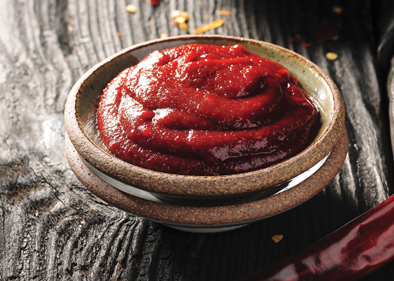
Gochujang or red chili paste is a savory, sweet, and spicy fermented condiment popular in Korean cooking. It is made from gochugaru (red chili powder), glutinous rice, meju (fermented soybean) powder, yeotgireum (barley malt powder), and salt. The sweetness comes from the starch of cooked glutinous rice, cultured with saccharifying enzymes during the fermentation process. Traditionally, it would be naturally fermented over years in jangdok (earthenware) on an elevated stone platform called jangdokdae in the backyard.
Shiyi xinjian (食醫心鑑), a mid-9th century Chinese document, recorded the Korean pepper paste as 苦椒醬 (lit. 'pepper paste'). The second-oldest documentation of pepper paste is found in the 1433 Korean book Collected Prescriptions of Native Korean Medicines. Pepper paste is again mentioned in a 1445 medical encyclopedia named Compendia of Medical Prescriptions. However, all these sources are from the time before the actual chili peppers were introduced to Korea.
Chili peppers, which originated in the Americas, were introduced to East Asia by Portuguese traders in the early 16th century. There is mention of a type of chili pepper brought to Korea found in Collected Essays of Jibong, an encyclopedia published in 1614. Farm Management, a book from c. 1700, discussed the cultivation methods of chili peppers.
The history of Sunchang gochujang's becoming a regional speciality dates back to the 14th century at the start of the Joseon Dynasty era (1392–1910) when the founder Yi Seong-gye made gochujang from the Sunchang region a part of Korean palace cuisine.
When Yi Seong-gye, who went on to become the founder and first king of Joseon as King Taejo, was on a trip to Manilsa Temple to pray to the mountain god, he is said to have eaten a bowl of barley bibimbab (spicy mixed rice with vegetables) with gochujang that he found unforgettably delicious. He loved it so much that he ordered it served to the royal family when he became king. Thus Sunchang gochujang gained fame as a regional specialty.
In the 18th-century books, Somun saseol (소문사설; 謏聞事說) and Revised and Augmented Farm Management, gochujang is written as gochojang, using hanja characters 苦椒醬 and 古椒醬. It is also mentioned that Sunchang County was renowned for its gochujang production. China and Japan, the countries with which Korea has historically shared the most culture and trade, do not include gochujang in their traditional cuisines.[citation needed]
Gochujang ingredients reported in Jeungbo sallim gyeongje were 18 litres (19 US quarts) of powdered and sieved meju (fermented soybeans), 540 mL (18+1⁄2 US fl oz) of chili powder, and 1.8 L (1+7⁄8 U.S. qt) of glutinous rice flour, as well as soup soy sauce for adjusting the consistency. The gochujang recipe in Gyuhap chongseo, an 1809 cookbook, uses powdered meju made from 18 L (19 US qt) of soybeans and 3.6 L (3+3⁄4 US qt) of glutinous rice, then adding 900–1,260 mL (30+1⁄2–42+1⁄2 US fl oz) of chili powder and bap made from 3.6 L (3.8 US qt) of glutinous rice.
Gochujang's primary ingredients are red chili powder (고추가루; gochugaru), glutinous rice powder, powdered fermented soybeans, and salt. Korean chili peppers, of the species Capsicum annuum, are spicy yet sweet, making them ideal for gochujang production. Gochujang is typically made from 25% red pepper powder, 22.2% glutinous rice, 5.5% meju powder (60% cooked soybeans and 40% non-glutinous rice), 12.8% salt, 5% malt, and 29% water .
Hub AI
Gochujang AI simulator
(@Gochujang_simulator)
Gochujang
Gochujang or red chili paste is a savory, sweet, and spicy fermented condiment popular in Korean cooking. It is made from gochugaru (red chili powder), glutinous rice, meju (fermented soybean) powder, yeotgireum (barley malt powder), and salt. The sweetness comes from the starch of cooked glutinous rice, cultured with saccharifying enzymes during the fermentation process. Traditionally, it would be naturally fermented over years in jangdok (earthenware) on an elevated stone platform called jangdokdae in the backyard.
Shiyi xinjian (食醫心鑑), a mid-9th century Chinese document, recorded the Korean pepper paste as 苦椒醬 (lit. 'pepper paste'). The second-oldest documentation of pepper paste is found in the 1433 Korean book Collected Prescriptions of Native Korean Medicines. Pepper paste is again mentioned in a 1445 medical encyclopedia named Compendia of Medical Prescriptions. However, all these sources are from the time before the actual chili peppers were introduced to Korea.
Chili peppers, which originated in the Americas, were introduced to East Asia by Portuguese traders in the early 16th century. There is mention of a type of chili pepper brought to Korea found in Collected Essays of Jibong, an encyclopedia published in 1614. Farm Management, a book from c. 1700, discussed the cultivation methods of chili peppers.
The history of Sunchang gochujang's becoming a regional speciality dates back to the 14th century at the start of the Joseon Dynasty era (1392–1910) when the founder Yi Seong-gye made gochujang from the Sunchang region a part of Korean palace cuisine.
When Yi Seong-gye, who went on to become the founder and first king of Joseon as King Taejo, was on a trip to Manilsa Temple to pray to the mountain god, he is said to have eaten a bowl of barley bibimbab (spicy mixed rice with vegetables) with gochujang that he found unforgettably delicious. He loved it so much that he ordered it served to the royal family when he became king. Thus Sunchang gochujang gained fame as a regional specialty.
In the 18th-century books, Somun saseol (소문사설; 謏聞事說) and Revised and Augmented Farm Management, gochujang is written as gochojang, using hanja characters 苦椒醬 and 古椒醬. It is also mentioned that Sunchang County was renowned for its gochujang production. China and Japan, the countries with which Korea has historically shared the most culture and trade, do not include gochujang in their traditional cuisines.[citation needed]
Gochujang ingredients reported in Jeungbo sallim gyeongje were 18 litres (19 US quarts) of powdered and sieved meju (fermented soybeans), 540 mL (18+1⁄2 US fl oz) of chili powder, and 1.8 L (1+7⁄8 U.S. qt) of glutinous rice flour, as well as soup soy sauce for adjusting the consistency. The gochujang recipe in Gyuhap chongseo, an 1809 cookbook, uses powdered meju made from 18 L (19 US qt) of soybeans and 3.6 L (3+3⁄4 US qt) of glutinous rice, then adding 900–1,260 mL (30+1⁄2–42+1⁄2 US fl oz) of chili powder and bap made from 3.6 L (3.8 US qt) of glutinous rice.
Gochujang's primary ingredients are red chili powder (고추가루; gochugaru), glutinous rice powder, powdered fermented soybeans, and salt. Korean chili peppers, of the species Capsicum annuum, are spicy yet sweet, making them ideal for gochujang production. Gochujang is typically made from 25% red pepper powder, 22.2% glutinous rice, 5.5% meju powder (60% cooked soybeans and 40% non-glutinous rice), 12.8% salt, 5% malt, and 29% water .
Recent media