


Community hub
Recent from talks
Contribute something
Nothing was collected or created yet.
Capsicum annuum
View on Wikipedia
| Capsicum annuum | |
|---|---|

| |
Scientific classification 
| |
| Kingdom: | Plantae |
| Clade: | Tracheophytes |
| Clade: | Angiosperms |
| Clade: | Eudicots |
| Clade: | Asterids |
| Order: | Solanales |
| Family: | Solanaceae |
| Genus: | Capsicum |
| Species: | C. annuum
|
| Binomial name | |
| Capsicum annuum | |
| Varieties and Groups | |
| |

Capsicum annuum is a flowering plant in the family Solanaceae (nightshades), native to the northern regions of South America and to southwestern North America. The plant produces berries of many colors including red, green, and yellow, often with pungent taste. It is one of the oldest cultivated crops, with domestication dating back to around 6,000 years ago in regions of Mexico.[5] The genus Capsicum has over 30 species but Capsicum annuum is the primary species in its genus, as it has been widely cultivated for human consumption for a substantial amount of time and has spread across the world. This species has many uses in culinary, medicine, self-defense, and ornamental applications.[5]
Name
[edit]The genus name Capsicum derives from a Greek-based derivative of the Latin word capto, meaning 'to grasp, to seize', in reference to the heat or pungency of the species' fruit, although it has also been speculated to derive from the Latin word capsa, 'box', referring to the shape of the fruit in forms of the typical species.[6] Although the species name annuum means 'annual' (from the Latin annus, 'year'), the plant is not an annual but is frost tender.[7] In the absence of winter frosts it can survive several seasons and grow into a large, shrubby perennial herb.[8]
Common names including the word pepper stem from a misconception on the part of Europeans taking part in the Columbian exchange. They mistakenly thought the spicy fruits were a variety of the black pepper plant, which also has spicy fruit. However, these two plants are not closely related.[9] Commonly used names for the fruit of Capsicum annuum in English vary by location and cultivar. The larger, sweeter cultivars are called "capsicum" in Australia and New Zealand.[10] In Great Britain and Ireland, cultivars of the plant are typically discussed in groups of either "sweet" or "hot/chilli" peppers, only rarely providing the specific cultivar.[11] In Canada and the United States it is commonplace to provide the cultivar in most instances, for example "bell", "jalapeño", "cayenne", or "bird's eye" peppers, to convey differences in taste including sweetness or pungency.[12]
Characteristics
[edit]
Capsicum annuum cultivars look like small shrubs with many branches and thin stems, with a tendency to climb. Some varieties can grow up to two meters tall (6.56 feet) using others to climb on.[13] The shrub has oval glossy leaves sometimes growing to 7.5 cm (3 inches) in length, while generally green, depending on the cultivar the leaves can turn dark purple or black as the plant ages.[9] Capsicum annuum are annual or biennial herbaceous plants that have a life cycle consisting of four stages (seedling, vegetation, flowering, and fruiting.)[14] Being a flowering plant with variations there are different shapes of flowers and fruits produced on individuals typically having star or bell shaped flowers coming in a range of colors including purple, white, and green. Just as the flowers, the fruits of this species comes in various shapes (berry shape to bell pepper shape), and colors including red, yellow, green, and black.[9]
Chiltepin pepper
[edit]Variants of this species also have the ability to produce and retain capsaicinoid compounds giving their fruits a powerful (spicy) taste which can vary in strengths. One semi-domesticated variation of Capsicum annuum is a variety named Capsicum annuum L. var. glabriusculum (Chiltepin peppers). It grows white flowers and produces berry fruits that are red when mature.[13] Similar to other variants the Chiltepin pepper produces and contains capsaicin which is responsible for its intense heat ranging from 100,000 to 200,000 Scoville heat units making it one of the hottest fruits grown in Mexico.[13]
Bell pepper
[edit]Another variant of Capsicum annuum, the bell pepper, is quite different from Chiltepin peppers, being described as "sweet", as it does not contain high concentrations of capsaicin and is rated a 0 on the Scoville heat scale.[14] Bell peppers grow on shrub body plants, and the fruits are large, quadrangular, and fleshy. They can also grow to a weight of 500 grams and come in many colors, including yellow, orange, red, and green.[15] Although this variant lacks in capsaicinoids, it is still packed with various bioactive compounds, carotinoids, and vitamins making them a valuable crop.[15]
Domestication
[edit]Capsicum annuum today have many variations of fruits, the origin of which is estimated to be from indigenous peoples of Mesoamerica around 6,000 years ago using selective breeding to domesticate wild forms of the peppers. Scientists have also found remnants of wild peppers ancestral to modern Capsicum annuum varieties in various locations and caves in places such as the Oaxaca Valley in Mexico, which has led researchers to believe that wild chili peppers were consumed before their domestication dating back to more than 8,000 years ago.[5]
Domestication of crops using conscious and unconscious selective methods usually leads to a decrease in the plants natural defensive traits. This has not always held true for Capsicum annuum, as some variants have been bred to increase the defensive compound capsaicin, making the fruit more powerful.[16] Capsicum annuum have also experienced "domestication syndrome" leading to several morphological and phytochemical changes leading to increased fruit and/or seed size, changes in reproductive cycles, and changes in plant structure. However, as a consequence of the cultivation of the wild species, some variants have experienced decreased fitness, leaving them vulnerable (and unlikely to survive) when not being cultivated.[17]
Pollination
[edit]
Flowers of Capsicum annuum generally consist of 6–7 petals and sepals, have 7 stamens, and contain an ovary that is superior to a single style consisting of 2–3 carpels and a single stamen.
Members are self pollinators, but cross pollination often occurs when plants are grown in large quantities, via bees, wasps, and ants.[5] In commercial production of Capsicum annuum, human pollination is often used to produce hybrid seeds that can grow into new variants of the pepper, which is a form of selective breeding that demonstrates how the pepper was domesticated.[18]
Within the flowers there are several reproductive structures that are used in pollination and fertilization, the two relative include the anthers and the ovary. Anthers are the male organ producing the microgametes (pollen) that will disperse to fertilize the megagamete that is located in the ovary of the female reproductive organ, leading to the development of the propagule (fruit).[19]
After fertilization the fruit of the plant begins to develop which is determined by the specific variety that is being grown. The fruit grows to maturity, then is ready for dispersal of its seeds.[5]
Seed dispersal
[edit]The seeds of some varieties of Capsicum annuum are coated in the compound capsaicin. This was a defensive mechanism of wild chilis before their domestication roughly 6,000 years ago. Capsaicin is a compound that can be extremely powerful depending on the concentration, and this was used to protect the seeds from predation, and increase their chance of survival. However, birds are not affected by the presence of capsaicin and are able to eat the fruits and seeds. The seeds are then passed through the birds' digestive system and dispersed to new environments via defecation.[16]
Bird dispersal for seeds has proven to be beneficial for the peppers as they have the ability to spread large distances. One example of this is the wild chiltepin, which has a massive range of habitat from Northern Peru to Southwestern United States.[13]
Uses
[edit]Capsicum annuum has been widely cultivated and modified through breeding for certain traits, which allows them to be used in multiple applications. These include in food, traditional medicine, cosmetics, and even self defense (pepper spray).[5]
Culinary
[edit]
There are multiple ways this species can be used in food, this includes fresh, dried, pickled, and powdered. It is widely used in traditional Mexican cuisine to create dishes such as Oaxacan black mole.[5] It is added to many dishes worldwide for spice and flavor and is used as a colorant for aesthetics.[citation needed] According to a study looking at Capsicum annuum as a contender for alleviating micronutrient deficiencies, along with their flavor and coloring properties, they are also very rich in micronutrients, including vitamins A, B, B3, and C.[20]
The species is a source of popular sweet peppers and hot chilis, with numerous varieties cultivated all around the world, and is the source of popular spices such as cayenne, chili, pimentón and paprika powders, as well as pimiento (pimento).
Capsinoid chemicals provide the distinctive tastes in C. annuum variants. In particular, capsaicin creates a burning sensation ("hotness"), which in extreme cases can last for several hours after ingestion. A measurement called the Scoville scale has been created to describe the hotness of peppers and other foods.
Traditional medicine
[edit]In old civilizations such as the Mayan and Aztec, capsicum species including C. annuum were used to treat many illnesses including asthma, toothaches, coughs, and sores. Today these practices still exist in developing countries, using them for their antioxidant, antimicrobial, antifungal, and antiviral properties.[5] There have also been studies linking the consumption of capsaicinoids and a decreased risk of cardiovascular disease and cancer.[13]
Ornamental
[edit]Some cultivars grown specifically for their aesthetic value include the U.S. National Arboretum's "Black Pearl".[21]
Pests
[edit]Even with its defensive strategies, Capsicum annuum can still fall victim to several pests and viruses.[22] Some can harbor viruses deadly to the species, these include whiteflies and aphids. Another pest which is quite vicious is a weevil (Anthonomus eugenii Cano) which the larva of this pest affects the plants during the flowering and fruiting stages of its life, and can reduce its production rate by up to 90%.[5] Other pests that can cause damage to the plants are the tobacco budworms and thrips.[22] Diseases include phytophthora blight, anthracnose, phytophthora root and basal rot.[23]
Gallery
[edit]-
 Capsicum annuum L var. fasciculatum Irish
 -
 Capsicum annuum L. var. fasciculatum Irish
 -
 Dried Capsicum annuum Red chili pepper
 -
 Capsicum annuum cultivars
 -
 Dried Guajillo chili pod
 -
 Typical Capsicum annuum flower, Royal Embers
 -
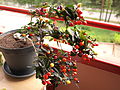 Bolivian Rainbow with its fruits in different stages of ripeness
 -
 Capsicum annuum var. bola or ñora
 -
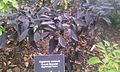 Capsicum annuum Count Dracula
 -
 Dried Capsicum annuum Red chili pepper on Nanglo
 -
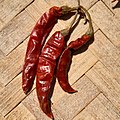 Dried Capsicum annuum Red chili pepper
 -
 NuMex Memorial Day
 -
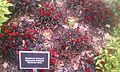 Capsicum annuum Explosive Embers
 -
 Chili pepper 'subicho' seeds for planting
 -
 Bell pepper in Eastern Siberia
 -
 Chicago-style hot dog with sport peppers
 -
 Capsicum annuum flower in Behbahan, Iran
 -
 Capsicum annuum fruits in Behbahan
 -
 Capsicum annuum fruits
 -
 Capsicum annuum fruits in Behbahan, Iran


_-_dried.jpg)


See also
[edit]
References
[edit]
- ^ Aguilar-Meléndez, A., Azurdia, C., Cerén-López, J., Menjívar, J. & Contreras, A. 2020. Capsicum annuum (amended version of 2019 assessment). The IUCN Red List of Threatened Species 2020: e.T100895534A172969027. https://dx.doi.org/10.2305/IUCN.UK.2020-2.RLTS.T100895534A172969027.en. Downloaded on 11 October 2021.
- ^ "Capsicum annuum L." Plants of the World Online. Royal Botanic Gardens, Kew. Retrieved 21 December 2024.
- ^ "Capsicum annuum". Germplasm Resources Information Network. Agricultural Research Service, United States Department of Agriculture. Retrieved 2010-07-29.
- ^ Minguez Mosquera M. I., Hornero Mendez D. (1994). "Comparative study of the effect of paprika processing on the carotenoids in peppers (Capsicum annuum) of the Bola and Agridulce varieties". Journal of Agricultural and Food Chemistry. 42 (7): 1555–1560. Bibcode:1994JAFC...42.1555M. doi:10.1021/jf00043a031.
- ^ a b c d e f g h i García-Gaytán, Víctor; Gómez-Merino, Fernando Carlos; Trejo-Téllez, Libia I.; Baca-Castillo, Gustavo Adolfo; García-Morales, Soledad (2017-03-19). "The Chilhuacle Chili (Capsicum annuum L.) in Mexico: Description of the Variety, its Cultivation, and Uses". International Journal of Agronomy. 2017 e5641680. doi:10.1155/2017/5641680. ISSN 1687-8159.
- ^ "Capsicum annuum (bell pepper)". Cabi Compendium. CABI Compendium. 2022. doi:10.1079/cabicompendium.15784. S2CID 253616052.
- ^ "Peppers and chillies". Royal Horticultural Society. Retrieved 21 Dec 2017.
- ^ Katzer, Gernot (May 27, 2008). "Paprika (Capsicum annuum L.)". Retrieved December 1, 2012.
- ^ a b c "Capsicum annuum - Britannica Encyclopedia". Britannica. 28 May 2023.
- ^ "Expat baffled by common Aussie supermarket item". news.com.au.
- ^ OxfordDictionaries.com, s.v.
- ^ "Bell and Chili Peppers". Agricultural Marketing Resource Center, US Department of Agriculture. 22 May 2023. Retrieved 1 October 2021.
- ^ a b c d e Hayano-Kanashiro, Corina; Gámez-Meza, Nohemí; Medina-Juárez, Luis Ángel (January 2016). "Wild Pepper Capsicum annuum L. var. glabriusculum: Taxonomy, Plant Morphology, Distribution, Genetic Diversity, Genome Sequencing, and Phytochemical Compounds". Crop Science. 56 (1): 1–11. Bibcode:2016CrSci..56....1H. doi:10.2135/cropsci2014.11.0789. ISSN 0011-183X.
- ^ a b Nadeem, Muhammad (2011). "Antioxidant Potential of Bell Pepper (Capsicum annum L.)-A Review". Pakistan Journal of Food Sciences. 21 (1–4): 45–51 – via Academia.edu.
- ^ a b Anaya-Esparza, Luis Miguel; Mora, Zuamí Villagrán-de la; Vázquez-Paulino, Olga; Ascencio, Felipe; Villarruel-López, Angélica (January 2021). "Bell Peppers (Capsicum annum L.) Losses and Wastes: Source for Food and Pharmaceutical Applications". Molecules. 26 (17): 5341. doi:10.3390/molecules26175341. ISSN 1420-3049. PMC 8434037. PMID 34500773.
- ^ a b Noss, Clay F. (2014). "Does Gut Passage Affect Post-dispersal Seed Fate in a Wild Chili, Capsicum annuum?". Southeastern Naturalist. 13 (3): 475–483. doi:10.1656/058.013.0308. S2CID 84728663 – via google scholar.
- ^ Luna-Ruiz, Jose de Jesus; Nabhan, Gary P.; Aguilar-Meléndez, Araceli (2018). "Shifts in Plant Chemical Defenses of Chile Pepper (Capsicum annuum L.) Due to Domestication in Mesoamerica". Frontiers in Ecology and Evolution. 6 48. Bibcode:2018FrEEv...6...48L. doi:10.3389/fevo.2018.00048. ISSN 2296-701X.
- ^ Swamy, B. N.; Hedau, N. K.; G.v., Chaudhari; Kant, Lakshmi; Pattanayak, A. (2017-08-19). "CMS system and its stimulation in hybrid seed production of Capsicum annuum L.". Scientia Horticulturae. 222: 175–179. Bibcode:2017ScHor.222..175S. doi:10.1016/j.scienta.2017.05.023. ISSN 0304-4238.
- ^ Adhikari, Prakash B.; Liu, Xiaoyan; Wu, Xiaoyan; Zhu, Shaowei; Kasahara, Ryushiro D. (2020-05-01). "Fertilization in flowering plants: an odyssey of sperm cell delivery". Plant Molecular Biology. 103 (1): 9–32. Bibcode:2020PMolB.103....9A. doi:10.1007/s11103-020-00987-z. ISSN 1573-5028. PMID 32124177. S2CID 211730516.
- ^ Olatunji, Tomi L.; Afolayan, Anthony J. (November 2018). "The suitability of chili pepper ( Capsicum annuum L.) for alleviating human micronutrient dietary deficiencies: A review". Food Science & Nutrition. 6 (8): 2239–2251. doi:10.1002/fsn3.790. ISSN 2048-7177. PMC 6261225. PMID 30510724.
- ^ "Capsicum annuum "Black Pearl"" (PDF). U.S. National Arboretum. March 2006. Retrieved February 21, 2011.
- ^ a b Jo, Yeonhwa; Choi, Hoseong; Lee, Jeong Hun; Cho, Won Kyong; Moh, Sang Hyun (2022). "Viromes of 15 Pepper (Capsicum annuum L.) Cultivars". International Journal of Molecular Sciences. 23 (18) 10507. doi:10.3390/ijms231810507. PMC 9504177. PMID 36142418.
- ^ Mohammadbagheri, Leila; Nasr-Esfahani, Mehdi; Abdossi, Vahid; Naderi, Davood (2021-10-01). "Genetic diversity and biochemical analysis of Capsicum annuum (Bell pepper) in response to root and basal rot disease, Phytophthora capsici". Phytochemistry. 190 112884. Bibcode:2021PChem.190k2884M. doi:10.1016/j.phytochem.2021.112884. ISSN 0031-9422. PMID 34388481.
Further reading
[edit]- Malgorzata, Materska (March 2015). "Flavone C-glycosides from Capsicum annuum L.: relationships between antioxidant activity and lipophilicity". European Food Research and Technology. 240 (3): 549–557. doi:10.1007/s00217-014-2353-2.
- Arimboor, Ranjith; Natarajan, Ramesh Babu; Menon, K. Ramakrishna; Chandrasekhar, Lekshmi. P; Moorkoth, Vidya (March 2015). "Red pepper (Capsicum annuum) carotenoids as a source of natural food colors: analysis and stability-a review". Journal of Food Science and Technology. 52 (3): 1258–1271. doi:10.1007/s13197-014-1260-7. PMC 4348314. PMID 25745195.
External links
[edit]- Capsicum annuum in the CalPhotos photo database, University of California, Berkeley
- "Capsicum annuum". Calflora. Berkeley, California: The Calflora Database.
- "Capsicum annuum". Plants for a Future.


Capsicum annuum
View on GrokipediaTaxonomy and nomenclature
Etymology
The genus name Capsicum was first proposed by French botanist Joseph Pitton de Tournefort in his 1700 publication Institutiones rei herbariae, and subsequently adopted by Carl Linnaeus as the generic name for peppers in Species Plantarum (1753).[6][7] The etymology of Capsicum remains uncertain, with the most widely accepted derivation from the Latin capsa, meaning "box" or "capsule," in reference to the pod-like shape of the fruits.[8][9][10] An alternative interpretation traces the name to the Greek verb kaptō (κάπτω), meaning "to bite" or "to gulp," highlighting the sharp, burning sensation produced by capsaicin in many species.[3] This dual etymology reflects both morphological and sensory characteristics of the plants. The specific epithet annuum derives from the Latin annuus, meaning "annual" or "yearly," based on Linnaeus's classification of the species as completing its life cycle within a single growing season, particularly in temperate regions where it is typically grown as an annual; however, C. annuum is perennial in its native tropical habitats.[9][7]Classification
Capsicum annuum is a species within the genus Capsicum of the family Solanaceae, classified under the order Solanales in the class Magnoliopsida. Its full taxonomic hierarchy is as follows: Kingdom: Plantae; Phylum: Tracheophyta; Class: Magnoliopsida; Order: Solanales; Family: Solanaceae; Genus: Capsicum L.; Species: C. annuum L.[1][11] The species was first formally described by Carl Linnaeus in his Species Plantarum in 1753, based on descriptions and cultivated specimens from the Americas, establishing it as a key member of the nightshade family known for its edible fruits.[12][13] The genus Capsicum comprises approximately 40 species, primarily native to the Americas; a 2023 taxonomic monograph recognizes 43 accepted species, including recent additions such as C. mirum. Five of these are domesticated: C. annuum, C. baccatum, C. chinense, C. frutescens, and C. pubescens.[7][14] C. annuum is the most economically significant and widely cultivated, encompassing a diverse array of forms from mild bell peppers to hot chilies.[9] Infraspecific classification recognizes varieties such as C. annuum var. annuum (cultivated sweet and hot peppers) and C. annuum var. glabriusculum (bird pepper, a semi-wild form considered ancestral to domesticated types).[15][16][17]Description and morphology
Plant structure
Capsicum annuum is an herbaceous perennial subshrub, typically grown as an annual in temperate regions, reaching heights of 0.3 to 1.5 meters with an erect, much-branched growth habit.[18][19] The plant exhibits dichotomous branching, initially developing a single main stem that produces 9 to 11 leaves before bifurcating into 2 to 3 shoots at the apex, often following the emergence of the first flower bud.[19] In optimal warm, dry conditions, it forms a bushy, upright structure up to 1 meter wide, with stems that become woody at the base over time.[18][3] The stem is usually glabrous but often tomentose near branchings, angular to subterete, and irregularly branched, attaining diameters up to 1 cm, with a green to brown-green coloration often marked by purplish spots near the nodes.[18] It features 5 to 6 vascular bundles in primary growth, developing a complete ring of open vascular tissue during secondary growth, and nodes are unilacunar with two vascular traces emerging from a single gap.[20] The epidermis consists of a single layer of cells, supported by 5 layers of collenchyma in the hypodermis, while the cortex is composed of thin-walled parenchyma cells.[20] Leaves are simple, alternate or opposite, and petiolate, measuring 4 to 16 cm in length and 1.5 to 8 cm in width, with shapes ranging from lanceolate to ovate or oblong.[18][21] They feature an acuminate apex, cuneate or acute base, entire margins, and a smooth, glabrous texture, appearing light to dark green and glossy.[18][3] Petioles are short, up to 10 cm long and 0.2 cm thick, with two vascular traces and rib bundle wings in primary growth that form vascular arcs during secondary development.[18][20] Internally, leaves show pinnate venation, with palisade and spongy mesophyll layers contributing to their thickness, which varies under different light conditions but generally supports photosynthetic efficiency.[19][22] The root system is a strong taproot with numerous fibrous lateral roots, extending 20 to 30 cm deep and wide, remaining relatively fine and close to the surface to facilitate nutrient uptake in well-drained soils.[18][19] The root epidermis is a single-cell-thick piliferous layer, surrounding radially symmetrical vascular bundles with exarch xylem and a central pith of parenchymatous cells.[20] This structure enables adaptation to various soil types, though it is susceptible to rot in poorly aerated conditions.[19]Flowers and fruits
The flowers of Capsicum annuum are solitary and axillary, arising at the leaf axils, and are bisexual, hypogynous, and typically pentamerous, though sometimes hexamerous or heptamerous.[23] They measure 9–15 mm in diameter, with a campanulate calyx featuring 5–7 short teeth, and a rotate corolla composed of 5–7 petals that are white to dingy white, occasionally greenish or purplish in certain cultivars.[23] The five stamens have white or violet filaments and blue-purple anthers that dehisce longitudinally, while the pistil consists of 2–4 united carpels with a capitate stigma and a style measuring 3.5–6.5 mm.[23] Anthesis occurs shortly after sunrise, with stigma receptivity lasting 5–8 days and peak fertility at the time of flower opening; pollen grains are medium yellow, subspheroidal, and tricolporate, numbering 11,000–18,000 per anther, with optimal germination at 20–25°C.[23] These flowers are primarily self-pollinating due to the species' self-compatibility, though outcrossing rates can reach 2–90% facilitated by insect pollinators such as bees, leading to fruit set 2–6 days after petal drop in many cultivars.[23][3] Flower morphology varies slightly among varieties; for instance, in the cayenne type, blooms are star-shaped, about 1 cm wide, with five stamens bearing black oval anthers and a central yellow stigma of equal length.[24] Overall, the flowers are inconspicuous and bell- or star-shaped, ranging from white to yellow or purple, and typically 1–2.5 cm in diameter.[3][25] The fruits of C. annuum are true berries, highly variable in form due to domestication and breeding, ranging from small and conical to large and blocky, with lengths from less than 1 cm to over 32 cm and weights up to 500 g in some cultivars.[23][2] They develop from the superior ovary, featuring 2–4 locules and a fleshy pericarp, with maturity occurring 35–50 days post-anthesis; immature fruits are typically green, ripening to red, yellow, orange, purple, or black depending on the variety.[23] Seeds, numbering 50–300 per fruit (fewer in wild forms, 1–34), are kidney-shaped, flattened, and typically 3–5 mm long, attached to the central placenta which may contain capsaicinoid glands responsible for pungency in hot types.[23] Fruit shape and surface texture provide taxonomic markers among varieties; for example, var. grossum (bell peppers) often exhibits blocky, attenuated forms with rounded surfaces and three locules, while var. glabriusculum shows elongated, attenuated shapes with four locules and conspicuously hollow interiors, averaging 126.7 mm in length and 108 seeds.[26] In contrast, var. annuum fruits are cordate with flexuous surfaces, bilocular, and around 71 mm long with 41 seeds on average.[26] The epidermal cells are polygonal with straight to curved anticlinal walls across varieties, and the berries are indehiscent, aiding seed dispersal by animals or human consumption.[26] Pungency, absent in sweet cultivars like bells, is genetically controlled by the Pun1 locus and serves as a defense against herbivores.[23]Varieties and cultivars
Wild forms
The wild forms of Capsicum annuum are primarily represented by the variety C. annuum var. glabriusculum (Dunal) Heiser & Pickersgill, commonly referred to as chiltepin or bird pepper, which serves as the ancestral progenitor for domesticated cultivars within the species. This variety is classified under the Solanaceae family and is distinguished from domesticated forms by its retention of primitive traits, such as small fruit size and high pungency, reflecting its adaptation to natural ecosystems. Synonyms include C. annuum var. aviculare, highlighting taxonomic variations in historical classifications.[27] Morphologically, C. annuum var. glabriusculum typically grows as a highly branched perennial shrub or semi-woody vine, reaching heights of 0.78 to 1.57 meters, with alternate leaves on petioles and small, white, five-lobed flowers borne in leaf axils.[27] The fruits are diminutive, erect berries, approximately 0.6 to 1.3 cm in diameter, that mature from green to a brilliant red, containing numerous small seeds; shrub growth predominates in arid environments, while climbing forms occur in shadier habitats.[27] These plants exhibit variability in traits like leaf area (489 to 866 cm²) and stem diameter (8.6 to 17.6 mm) across populations, underscoring local adaptations.[27] Geographically, wild populations of C. annuum var. glabriusculum are distributed from the southwestern United States (including Texas and Arizona) through Mexico and Central America to northern South America, such as Colombia, thriving in diverse habitats like dry tropical forests, desert scrubs, and coastal hammocks at elevations of 200 to 700 meters above sea level. In Mexico, particularly in regions like Baja California Sur and northwestern states, these plants are found near biosphere reserves, such as El Vizcaíno and La Laguna, where they face threats from habitat fragmentation and overcollection.[27] Genetic analyses reveal substantial diversity in wild C. annuum var. glabriusculum, higher than in domesticated varieties, supporting its role as a valuable gene pool for breeding. Studies of 15 wild populations in northwestern Mexico using RAPD markers detected 166 polymorphic bands, with 56.7% of variation occurring within populations and 43.3% among them, indicating moderate differentiation influenced by elevation and isolation.[28] This diversity, coupled with evidence of gene flow between wild and feral populations, emphasizes the need for conservation to preserve adaptive traits like drought tolerance and pest resistance.Domesticated varieties
Capsicum annuum represents the most extensively domesticated and economically significant species in the genus Capsicum, encompassing a wide array of cultivars that vary in fruit size, shape, color, wall thickness, and pungency levels, ranging from non-pungent sweet types to intensely hot varieties. These domesticated forms originated from wild ancestors in Mexico and were selectively bred by indigenous peoples, particularly the Aztecs, who developed dozens of unique cultivars for culinary, medicinal, and ceremonial uses by the 16th century. Today, C. annuum accounts for the majority of global pepper production, with over 3,000 registered cultivars adapted to diverse climates and markets. Recent genomic studies, including the 2014 sequencing of the wild chiltepin genome, have further elucidated the genetic basis of varietal diversity and aided breeding programs.[29][30][31][32] Botanically, domesticated varieties of C. annuum are classified into four main cultivar groups based on fruit morphology: the Grossum Group (blocky, thick-walled fruits), Longum Group (elongated, often thin-walled fruits), Cerasiforme Group (small, spherical fruits), and Conoides Group (cone-shaped fruits). This classification highlights the species' phenotypic diversity, which has been enhanced through selective breeding for traits like reduced seediness, larger fruit size, and varied capsaicin content. Pungency is measured in Scoville Heat Units (SHU), with sweet varieties at 0 SHU and hot ones exceeding 50,000 SHU.[33] The Grossum Group includes non-pungent bell peppers, prized for their crisp texture and use in fresh salads or stuffed dishes; representative cultivars are 'California Wonder' (green to red, 4-5 inches wide) and 'Bell Boy' (compact plants for home gardens). The Longum Group comprises pungent chili types like jalapeños ('Early Jalapeño', 2,500-8,000 SHU, 2-3 inches long) and cayenne ('Arapaho', 30,000-50,000 SHU, dried for spices). The Cerasiforme Group features small, round cherry peppers (e.g., 1/2-1 inch diameter, often 2,500-5,000 SHU), suitable for pickling. The Conoides Group encompasses mild to hot cone-shaped varieties, such as poblanos ('Ancho', 1,000-2,000 SHU, heart-shaped, 3-4 inches), used dried or fresh in Mexican cuisine. Additional notable cultivars include New Mexico-bred types like 'NuMex Big Jim' (mild, up to 13 inches long) and 'NuMex Joe E. Parker' (hot, for green chile roasting), developed for regional adaptation and yield.[31][30][29]| Cultivar Group | Fruit Characteristics | Pungency Range (SHU) | Example Cultivars | Primary Uses |
|---|---|---|---|---|
| Grossum | Blocky, 4-lobed, thick-walled | 0 | 'California Wonder', 'Yolo Wonder' | Fresh eating, cooking |
| Longum | Elongated, cylindrical or wrinkled | 2,500-50,000+ | 'Early Jalapeño', 'Arapaho' cayenne | Fresh, dried, sauces |
| Cerasiforme | Small, round, cherry-like | 2,500-5,000 | Cherry bomb types | Pickling, garnishes |
| Conoides | Cone- or heart-shaped | 1,000-4,000 | 'Ancho' poblano | Roasting, stuffing, drying |