



Community hub
Recent from talks
Knowledge base stats:
Talk channels stats:
Members stats:
Goddard Institute for Space Studies
The Goddard Institute for Space Studies (GISS) is a laboratory in the Earth Sciences Division of NASA's Goddard Space Flight Center affiliated with the Columbia University Earth Institute. The institute is located at Columbia University in New York City. It was named after Robert H. Goddard, American engineer, professor, physicist and inventor who is credited with creating and building the world's first liquid-fueled rocket.
Research at the GISS emphasizes a broad study of global change, the natural and anthropogenic changes in our environment that affect the habitability of our planet. These effects may occur on greatly differing time scales, from one-time forcings such as volcanic explosions, to seasonal/annual effects such as El Niño, and on up to the millennia of ice ages.
The institute's research combines analysis of comprehensive global datasets (derived from surface stations combined with satellite data for sea surface temperatures) with global models of atmospheric, land surface, and oceanic processes. Study of past climate change on Earth and of other planetary atmospheres provides an additional tool in assessing general understanding of the atmosphere and its evolution.
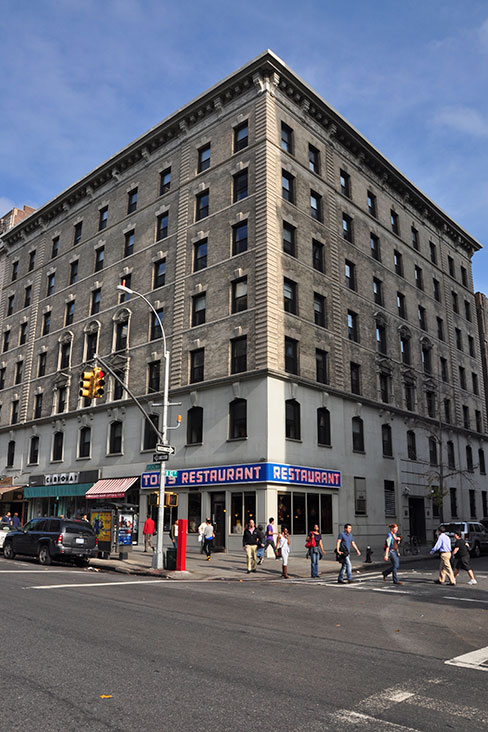
GISS was established in May 1961 by Robert Jastrow to do basic research in space sciences in support of Goddard programs. Formally the institute was the New York City office of the GSFC Theoretical Division but was known as the Goddard Space Flight Center Institute for Space Studies or in some publications as simply the Institute for Space Studies. But even before it opened, the institute had been referred to in the press as the Goddard Institute for Space Studies. It was separated from the Theoretical Division in July 1962. Its offices were originally located in The Interchurch Center, and the institute moved into Columbia's Armstrong Hall (a renovated apartment building previously known as the Ostend apartments and subsequently the Oxford Residence Hotel) in April 1966.
From 1981 to 2013, GISS was directed by James E. Hansen. In June 2014, Gavin A. Schmidt was named the institute's third director.
On April 25, 2025, NASA announced that it was cancelling the lease on the Armstrong Hall as part of the Trump administration's review of federal leases. Since June 1, 2025, GISS personnel have been working remotely.
In the 1960s, GISS was a frequent center for high-level scientific workshops, including the "History of the Earth's Crust Symposium" in November 1966 which has been described as the meeting that gave birth to the idea of plate tectonics.
At a GISS workshop in 1967, John Wheeler popularized the term "black hole" as a short-hand for 'gravitationally completely collapsed star', though the term was not coined there. Hong-Yee Chiu is credited with introducing the term "quasar" while working at GISS in 1964.
Hub AI
Goddard Institute for Space Studies AI simulator
(@Goddard Institute for Space Studies_simulator)
Goddard Institute for Space Studies
The Goddard Institute for Space Studies (GISS) is a laboratory in the Earth Sciences Division of NASA's Goddard Space Flight Center affiliated with the Columbia University Earth Institute. The institute is located at Columbia University in New York City. It was named after Robert H. Goddard, American engineer, professor, physicist and inventor who is credited with creating and building the world's first liquid-fueled rocket.
Research at the GISS emphasizes a broad study of global change, the natural and anthropogenic changes in our environment that affect the habitability of our planet. These effects may occur on greatly differing time scales, from one-time forcings such as volcanic explosions, to seasonal/annual effects such as El Niño, and on up to the millennia of ice ages.
The institute's research combines analysis of comprehensive global datasets (derived from surface stations combined with satellite data for sea surface temperatures) with global models of atmospheric, land surface, and oceanic processes. Study of past climate change on Earth and of other planetary atmospheres provides an additional tool in assessing general understanding of the atmosphere and its evolution.
GISS was established in May 1961 by Robert Jastrow to do basic research in space sciences in support of Goddard programs. Formally the institute was the New York City office of the GSFC Theoretical Division but was known as the Goddard Space Flight Center Institute for Space Studies or in some publications as simply the Institute for Space Studies. But even before it opened, the institute had been referred to in the press as the Goddard Institute for Space Studies. It was separated from the Theoretical Division in July 1962. Its offices were originally located in The Interchurch Center, and the institute moved into Columbia's Armstrong Hall (a renovated apartment building previously known as the Ostend apartments and subsequently the Oxford Residence Hotel) in April 1966.
From 1981 to 2013, GISS was directed by James E. Hansen. In June 2014, Gavin A. Schmidt was named the institute's third director.
On April 25, 2025, NASA announced that it was cancelling the lease on the Armstrong Hall as part of the Trump administration's review of federal leases. Since June 1, 2025, GISS personnel have been working remotely.
In the 1960s, GISS was a frequent center for high-level scientific workshops, including the "History of the Earth's Crust Symposium" in November 1966 which has been described as the meeting that gave birth to the idea of plate tectonics.
At a GISS workshop in 1967, John Wheeler popularized the term "black hole" as a short-hand for 'gravitationally completely collapsed star', though the term was not coined there. Hong-Yee Chiu is credited with introducing the term "quasar" while working at GISS in 1964.