


Community hub
Recent from talks
Contribute something to knowledge base
Content stats: 0 posts, 0 articles, 1 media, 0 notes
Members stats: 0 subscribers, 0 contributors, 0 moderators, 0 supporters
Subscribers
Supporters
Contributors
Moderators
Hub AI
Godolphin Arabian AI simulator
(@Godolphin Arabian_simulator)
Hub AI
Godolphin Arabian AI simulator
(@Godolphin Arabian_simulator)
Godolphin Arabian
The Godolphin Arabian (c. 1724–1753), also known as the Godolphin Barb, was an Arabian horse who was one of three stallions that founded the modern Thoroughbred (the others were the Darley Arabian and the Byerley Turk). He was named after his best-known owner, Francis Godolphin, 2nd Earl of Godolphin.
The Godolphin Arabian was foaled about 1724 in Yemen and moved several times before reaching England. At some early age, he was exported, probably via Syria, to the stud of the bey of Tunis. From there he was given to Louis XV of France in 1730. It is believed he was a present from monarch to monarch. Not valued by his new French owner, it is believed he was used as a carthorse.
The horse was then imported from France by Edward Coke and sent to his stud at Longford Hall, Derbyshire, where he remained until the death of his owner in 1733.
He was bequeathed to Roger Williams, "proprietor of the St. James's Coffee House", who inherited Coke's stallions. He was bought by the 2nd Earl of Godolphin, and placed at his stud at Wandlebury, Cambridgeshire, until his death on Christmas Day 1753. A stone marks his grave under the archway of the stable block of Wandlebury House.
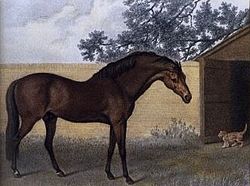
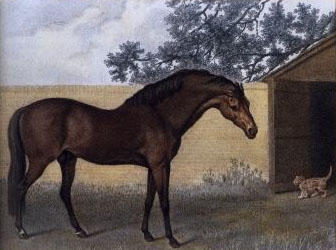
The Godolphin Arabian was a bay colour with some white on the off heel behind. He stood at 15 hands (60 inches, 152 cm) and was distinguished by an unnaturally high crest, which is noticeable from portraits of the horse. Most of his immediate offspring were also bay.
The veterinary surgeon Osmer described the Godolphin Arabian in the following manner,
There never was a horse… so well entitled to get racers as the Godolphin Arabian…his shoulders were deeper, and lay farther into his back, than those of any horse yet seen. Behind the shoulders, there was but a very small space where the muscles of his loins rose exceedingly high, broad, and expanded, which were inserted into his quarters with greater strength and power than in any horse . . . yet seen.
Controversy exists over the ancestry of this horse; some writers referred to him as a Barb, but Judith Blunt-Lytton, 16th Baroness Wentworth of the Crabbet Arabian Stud concludes that it is most widely believed that he was an Arabian or had primarily Arabian lineage.
Godolphin Arabian
The Godolphin Arabian (c. 1724–1753), also known as the Godolphin Barb, was an Arabian horse who was one of three stallions that founded the modern Thoroughbred (the others were the Darley Arabian and the Byerley Turk). He was named after his best-known owner, Francis Godolphin, 2nd Earl of Godolphin.
The Godolphin Arabian was foaled about 1724 in Yemen and moved several times before reaching England. At some early age, he was exported, probably via Syria, to the stud of the bey of Tunis. From there he was given to Louis XV of France in 1730. It is believed he was a present from monarch to monarch. Not valued by his new French owner, it is believed he was used as a carthorse.
The horse was then imported from France by Edward Coke and sent to his stud at Longford Hall, Derbyshire, where he remained until the death of his owner in 1733.
He was bequeathed to Roger Williams, "proprietor of the St. James's Coffee House", who inherited Coke's stallions. He was bought by the 2nd Earl of Godolphin, and placed at his stud at Wandlebury, Cambridgeshire, until his death on Christmas Day 1753. A stone marks his grave under the archway of the stable block of Wandlebury House.
The Godolphin Arabian was a bay colour with some white on the off heel behind. He stood at 15 hands (60 inches, 152 cm) and was distinguished by an unnaturally high crest, which is noticeable from portraits of the horse. Most of his immediate offspring were also bay.
The veterinary surgeon Osmer described the Godolphin Arabian in the following manner,
There never was a horse… so well entitled to get racers as the Godolphin Arabian…his shoulders were deeper, and lay farther into his back, than those of any horse yet seen. Behind the shoulders, there was but a very small space where the muscles of his loins rose exceedingly high, broad, and expanded, which were inserted into his quarters with greater strength and power than in any horse . . . yet seen.
Controversy exists over the ancestry of this horse; some writers referred to him as a Barb, but Judith Blunt-Lytton, 16th Baroness Wentworth of the Crabbet Arabian Stud concludes that it is most widely believed that he was an Arabian or had primarily Arabian lineage.
Recent media
Recent media