Hubbry Logo
Hand (unit)Hand (unit)Main
Open search
Hand (unit)
Community hub
Hand (unit)
logo
8 pages, 0 posts
0 subscribers
Be the first to start a discussion here.
Hand (unit)
Hand (unit)
from Wikipedia
Hand (unit)
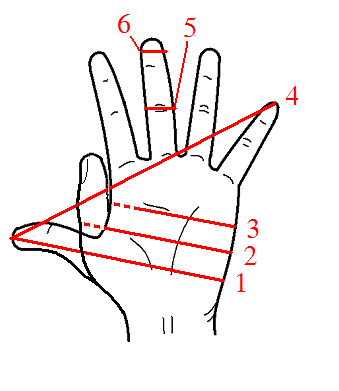
The hand (2) and palm (3) measurements shown, among others, on a human hand
General information
Unit systemImperial/US units
Unit ofLength
Symbolh, hh
Conversions
1 h in ...... is equal to ...
   Imperial/US units   
  • 4 in
  • 1/3 ft
   SI units   
  • 101.6 mm
  • 10.16 cm

The hand is a non-SI unit of measurement of length standardized to 4 in (101.6 mm). It is used to measure the height of horses in many English-speaking countries, including Australia,[1] Canada, Ireland, the United Kingdom, and the United States.[2] It was originally based on the breadth of a human hand. The adoption of the international inch in 1959 allowed for a standardized imperial form and a metric conversion.[citation needed] It may be abbreviated to "h" or "hh".[3] Although measurements between whole hands are usually expressed in what appears to be decimal format, the subdivision of the hand is not decimal but is in base 4, so subdivisions after the radix point are in quarters of a hand, which are inches.[2] Thus, 62 inches is fifteen and a half hands, or 15.2 hh (normally said as "fifteen-two", or occasionally in full as "fifteen hands two inches").[2]

Terminology

[edit]

"Hands" may be abbreviated to "h", or "hh". The "hh" form is sometimes interpreted as standing for "hands high".[4][5][6] When spoken aloud, hands are stated by numbers, 15.0 is "fifteen hands", 15.2 is alternately "fifteen-two" or "fifteen hands, two inches", and so on.[5][6][7]

To convert inches to hands, the number in inches is divided by four, then the remainder is added after the radix point. Thus, a horse that measures 60 inches is 15 hands high (15 × 4 = 60) and a horse halfway between 15 and 16 hands is 15.2 hands, or 62 inches tall (15 × 4 + 2 = 62)[5][7] Because the subdivision of a hand is a base 4 system, a horse 64 inches high is 16.0 hands high, not 15.4.[2] A designation of "15.5 hands" is not halfway between 15 and 16 hands, but rather reads 15 hands and five inches, an impossibility in a base 4 radix numbering system, where a hand is four inches.[8]

History

[edit]

Ancient Egypt

[edit]
Detail of the cubit rod in the Museo Egizio of Turin, showing digit, palm, hand and fist lengths

The hand, sometimes also called a handbreadth or handsbreadth, is an anthropic unit, originally based on the breadth of a male human hand, either with or without the thumb,[2] or on the height of a clenched fist.[9]

On surviving Ancient Egyptian cubit-rods, the royal cubit is divided into seven palms of four digits or fingers each.[10] Five digits are equal to a hand, with thumb; and six to a closed fist.[11] The royal cubit measured approximately 525 mm,[12] so the width of the ancient Egyptian hand was about 94 mm.

Ancient Egyptian units of length[11]
Name Egyptian name Equivalent Egyptian values Metric equivalent Imperial equivalent
Royal cubit
M23t
n
D42
meh niswt
7 palms or 28 digits 525 mm      20.67 in
Fist 6 digits 108 mm      4.25 in
Hand 5 digits 94 mm      3.70 in
Palm
D48
shesep
4 digits 75 mm      2.95 in
Digit
D50
djeba
1/4 palm 19 mm      0.75 in

Biblical use

[edit]

In Biblical exegesis the hand measurement, as for example in the Vision of the Temple, Authorized Version Ezekiel 40:43, is usually taken to be palm or handbreadth, and in modern translations may be rendered as "handbreadth"[13] or "three inches".[14]

United Kingdom

[edit]

The hand is a traditional unit in the UK.[2] It was standardised at four inches by a statute of King Henry VIII, the Horses Act 1540 (32 Hen. 8. c. 13),[15][16] but some confusion between the various types of hand measurement, and particularly between the hand and the handsbreadth, appears to have persisted. Phillips's dictionary of 1706 gives four inches for the length of the handful or hand, and three inches for the handsbreadth;[17] Mortimer gives the same, three inches for the Hand's-breadth, and four for the "Handful, or simply, Hand",[16] but adds "The hand among horse-dealers, &c. is four-fingers' breadth, being the fist clenched, whereby the height of a horse is measured", thus equating "hand" with both the palm and the fist. Similarly, Wright's 1831 translation of Buffon mentions "A hand breadth (palmus), the breadth of the four fingers of the hand, or three inches",[18] but the Encyclopædia Perthensis of 1816 gives under Palm (4): "A hand, or measure of lengths comprising three inches".[19]

Use in measuring horses

[edit]
Chart illustrating the increase in height of racehorses, from 14 hh (142 cm) in 1700 to 15.2+12 hh (159 cm) in 1900.

Today the hand is used to measure the height of horses,[2] ponies, and other equines. It is used in the US and also in some other nations that use the metric system, such as Australia, New Zealand, Canada, Ireland and the UK. In other parts of the world, including continental Europe and in FEI-regulated international competition, horses are measured in metric units, usually metres or centimetres. In South Africa, measurements may be given in both hands and centimetres,[2] while in Australia, the equestrian regulations stipulate that both measurements are to be given.[20]

In those countries where hands are the usual unit for measuring horse height, inches rather than hands are commonly used in the measurement of smaller equines including miniature horses/ponies,[21] miniature mules,[22] donkeys,[23] and Shetland ponies.[24]

A horse is measured from the ground to the top of the highest non-variable point of the skeleton, the withers.[2] For official measurement, the spinous process of the fifth thoracic vertebra may be identified by palpation, and marked if necessary.[25] Some varieties of Miniature horses are measured at the base of the last true hairs of the mane rather than at the withers.[21]

For international competition regulated by the Fédération Équestre Internationale (FEI) and for USEF competition in the US, a horse can be measured with shoes on or off. In the United Kingdom, official measurement of horses is overseen by the Joint Measurement Board (JMB). For JMB purposes, the shoes must be removed and the hooves correctly prepared for shoeing prior to measurement.[25]

See also

[edit]

References

[edit]
Revisions and contributorsEdit on WikipediaRead on Wikipedia
from Grokipedia
The hand (symbol: h) is a non-SI equal to 4 inches (101.6 mm), traditionally employed to measure the height of horses from the ground to the highest point of the (the between the blades). This unit originated in as an approximation of the breadth of a hand, serving as one-seventh of the royal in early measurement systems for various purposes, including animal proportions. By the in , the hand had become a common informal measure for horses, though its exact length varied regionally until standardization. In 1540, King of formalized the hand at precisely 4 inches via the Horses Act (32 Hen. 8. c. 13), aiming to promote the breeding of taller horses for and transportation to support and economic needs. Today, the hand persists as the primary unit for equine height in English-speaking nations such as the , , , , , , and , with heights denoted in whole numbers and fractions (e.g., 16.2 hands for 16 hands plus 2 inches, equivalent to 66 inches or 1.68 m). Although the International Equestrian Federation (FEI) mandates metric measurements (in centimeters) for official international competitions to ensure consistency, the hand remains widely referenced in breeding, sales, and casual equestrian contexts globally due to its historical entrenchment and simplicity.

Definition

Value and standardization

The hand is a non-SI standardized at exactly 4 inches, equivalent to 101.6 millimeters. This measurement was formalized in 16th-century through a issued by King in 1540, aimed at resolving inconsistencies in horse height assessments during trade. The Horses Act 1540 (32 Hen. 8. c. 13), enacted during the same parliamentary session, specified minimum heights for breeding stallions and mares in hands—15 hands for stallions and 13 hands for mares—implicitly confirming the 4-inch standard to ensure uniform application. The choice of 4 inches reflected the average breadth of a hand including the thumb, offering a practical, anthropometric basis for measurement in pre-metric societies where served as accessible references. This body-derived unit facilitated quick estimations without specialized tools, aligning with traditional practices while providing consistency for commercial purposes. In 16th-century , the statute mandated the use of this standardized hand for official evaluations of heights, enforcing penalties for non-compliance to curb fraudulent practices in sales and breeding where sellers might understate or overstate animal sizes. This legal framework promoted by eliminating variability in informal hand measurements, establishing the unit's enduring role in equestrian commerce.

Notation and terminology

In equestrian notation, the height of a is expressed as a whole number of hands followed by a value representing additional inches, with each hand standardized at four inches. For instance, 15.2 hands denotes 15 full hands plus 2 inches, equivalent to 62 inches total, rather than 15 hands plus two-tenths of a hand. This convention ensures clarity, as the decimal specifically accounts for the remainder in inches after whole hands, avoiding confusion with fractional hands. The term "hand" derives from the word for the breadth of the human palm, reflecting its historical basis in anthropometric . In equestrian contexts, it is commonly abbreviated as "hh," standing for "hands high," a shorthand used in pedigrees, sales descriptions, and competition records. Horses are typically described using phrases like "16 hands high" or "14.3 hh," emphasizing the height from the ground to the . Tradition dictates avoiding subdivisions finer than inches, preserving the unit's practical and historical integrity over metric alternatives in descriptive language. Although linguistic variations exist, such as "main" in French equestrian terminology, the "hand" remains the standardized international term for measuring equine height.

Historical origins

Ancient and biblical references

The earliest documented uses of hand-like measurements appear in around 3000 BCE, where the hand served as a key subdivision of the royal for architectural planning and assessments of animals such as . The royal , standardized at approximately 52.5 for official projects like pyramids and , was divided into 7 palms (each 7.5 ) and further into fingers (1.875 each), with the hand defined as or about 9.4 . This system is evidenced by cubit rods recovered from , including the Amenemope cubit from the late 18th Dynasty (circa 1300 BCE), which features inscribed markings for palms, hands, and fingers to facilitate precise scaling in and resource evaluation. Biblical texts from the , reflecting early Semitic measurement practices around 1000–500 BCE, reference the handbreadth (tefach) as a linear unit equivalent to the breadth of four fingers, measured at approximately 8.6 cm through analysis of Iron Age storage jar morphologies. This unit appears explicitly in descriptions such as the handbreadth thickness of the temple's (1 Kings 7:26) and the overlay on the (Exodus 25:25). In Zechariah 2:1–2, a man with a assesses Jerusalem's dimensions, implying integration of handbreadth units within broader body-based systems for urban and sacred proportions. In broader ancient contexts, Mesopotamian records from the third millennium BCE employed digit and hand combinations as foundational elements of , documented in tablets for trade, building, and agriculture prior to specialized equine uses. Ancient Greek systems similarly relied on the daktylos (finger breadth, about 1.93 cm) and spithame (hand span of 12 daktyloi or roughly 23.2 cm) for geometric and architectural applications, as outlined in works by and . These pre-standardized hand units varied significantly across regions, typically ranging from 75 mm to 115 mm, due to differences in average adult hand sizes and local calibration practices, which contributed to inconsistencies in cross-cultural exchanges.

European development and standardization

In medieval , the hand unit emerged as a practical measure for assessing height, particularly horses, drawing on Anglo-Saxon traditions where it approximated the breadth of an adult male's hand, roughly 4 inches (10.16 cm). This usage persisted through the of , blending with reintroduced Roman-influenced systems, though the Roman precursor—the palmus or palm breadth—was shorter at about 3 inches (7.62 cm). During the period from circa 500 to 1500 CE, such body-based measures were common in rural economies for trading animals, but their variability across individuals led to inconsistent applications in markets. Regional differences exacerbated these inconsistencies in the 12th to 15th centuries, as local customs influenced the effective length of the hand; for instance, measures in continental regions like tended toward shorter equivalents (around 3.3 inches or 8.4 cm) compared to the longer English versions nearing 4 inches, contributing to disputes in cross-border and trade. English markets, reliant on and s, saw frequent haggling over perceived discrepancies, prompting calls for regulation to facilitate commerce. These variations reflected broader fragmentation in medieval , where no unified standard existed until royal interventions. Efforts toward uniformity began in 14th-century with statutes regulating and sales to support needs, such as Edward III's ordinances during the that referenced height thresholds for warhorses, implicitly relying on the hand unit. Initial standardization occurred in the 1535 Breed of Horses Act (27 Hen. 8. c. 6), which defined the hand as exactly 4 inches and mandated minimum heights of 14 hands for stallions and 13 for mares to improve breeding stock. This was amended in 1540 by Henry VIII's Horses Act (32 Hen. 8. c. 13), which raised the stallion minimum to 15 hands while retaining 13 for mares and reinforced the 4-inch standard to prevent the export of quality animals. These laws marked a pivotal shift, establishing the hand as a legal measure primarily for equestrian purposes. On the , the hand gained traction in fairs and agricultural from the , but enforcement remained less centralized than in , with local guilds often adapting it flexibly to regional feet or cubits. British colonial expansion in the 16th and 17th centuries exported this standardized English hand to the via networks, embedding it in New World equestrian practices among settlers and indigenous exchanges.

Equestrian applications

Measurement procedure

The height of a is measured perpendicularly from the ground to the highest point of the , which is the ridge between the blades formed by the spinal processes of the vertebrae, while the stands squarely on all four feet with its weight evenly distributed on a level surface such as or asphalt. This location ensures a consistent, non-variable reference point, as the remain stable regardless of head or neck position. The primary tools used are a straight, rigid measuring stick or horse height gauge equipped with a vertical arm for ground contact and a horizontal arm or crossbar to rest atop the ; the device must be calibrated and perpendicular to the ground for accuracy. The horse should be relaxed with its head in a natural position—up but not stretched forward or elevated—to avoid artificial variations; measurements are taken at least twice, once from each side, with the average recorded as the official . The result is expressed in hands (where one hand equals 4 inches) plus any remaining inches, with the number of whole hands determined by flooring the total inches divided by 4, and fractions of an inch typically rounded to the nearest quarter or as specified by the governing body. For foals and young horses, the procedure is the same, but measurements are often taken periodically to track growth, as they continue developing until maturity; official certifications for ponies under 14.2 hands (such as in USEF competitions) require annual measurements until age six. Adult horses are generally considered to have reached full height by 4 to 5 years of age, after which re-measurement may be needed only if prior records are superseded by a new procedure-compliant assessment. Common errors include measuring at the poll (top of the head), which varies with posture, or the croup (rear ridge), which does not represent overall stature; these should be avoided to maintain standardization at the . Shoe thickness is typically excluded from the standard , with a deduction of about 1/4 inch applied if shoes are present during assessment to reflect the horse's natural height.

Usage in breeding and commerce

In , the hand unit plays a key role in classifying equines for registry eligibility and breed standards, particularly in distinguishing ponies from horses. In the , the United States Equestrian Federation (USEF) defines ponies based on height at the : small ponies do not exceed 12.2 hands, medium ponies exceed 12.2 but do not exceed 13.2 hands, and large ponies exceed 13.2 but do not exceed 14.2 hands, with equines over 14.2 hands classified as horses. These classifications determine eligibility for pony-specific divisions in breed registries and competitions, ensuring appropriate matching for breeding programs focused on size and conformation. For Thoroughbreds, The maintains no height requirements for registration, though breeders often consider height in hands when evaluating suitability for breeding lines where stature influences performance traits. In commerce, the hand remains the standard unit for describing horse height in auctions, sales catalogs, and racing entries across English-speaking countries like the and , directly impacting pricing and buyer decisions. Taller horses, often measured at 16 hands or more, command higher values in disciplines such as or due to perceived advantages in stride length and power, while discrepancies in reported height can lead to adjusted sale prices or disputes. Legally, the hand unit is enforced in horse shows and sales under national regulations in the and , where inaccuracies in height can invalidate entries or void contracts. In the , USEF rules require official measurements in hands for pony divisions, with non-compliance potentially disqualifying animals from competitions or breeding endorsements. In the , similar standards apply through bodies like British Showjumping, and court cases have upheld that height misrepresentations constitute , as seen in disputes where a two-inch difference led to significant legal costs and potential refunds. While the International Equestrian Federation (FEI) mandates metric measurements for international events, national rules in English-speaking jurisdictions prioritize hands to align with traditional practices. The persistence of the hand unit in breeding and commerce reflects deep cultural traditions, especially in high-profile events like Royal Ascot and the , where height notations in hands continue despite broader metric adoption elsewhere. This retention preserves historical accuracy in pedigrees and sales records, ensuring continuity in industries valuing equine heritage over modern standardization.

Modern equivalents and usage

Conversions to other systems

The hand unit, standardized at 4 inches, integrates seamlessly with the imperial system where it equals one-third of a foot. For instance, a height of 16 hands corresponds to 64 inches, or 5 feet 4 inches. In metric terms, 1 hand measures exactly 10.16 centimeters, derived from the precise conversion of 4 inches at 2.54 cm per inch. To convert a full horse height expressed in hands (with fractional inches), the formula is height in cm = (number of whole hands × 10.16) + (fractional inches × 2.54). An example is 15.2 hands, which equals 15 hands plus 2 inches, yielding (15 × 10.16) + (2 × 2.54) = 152.4 + 5.08 = 157.48 cm. Relations to other historical systems include the biblical , estimated at 45.72 cm or approximately 4.5 hands. In the traditional French system, 1 pied du roi measures 32.48 cm, equivalent to about 3.2 hands. For practical applications, equestrians and breeders rely on online calculators and printed charts to perform these conversions accurately, particularly when preparing records for international shipping or .

Current international adoption

The hand unit remains the primary standard for measuring horse height in several English-speaking countries, including the , , , , , , , and , where it is exclusively used in equestrian contexts such as breeding, sales, and competitions. This 4-inch (101.6 mm) measurement, taken at the , continues to dominate due to longstanding tradition and its integration into national equine registries and auction houses. In these regions, the unit facilitates precise descriptions of horse stature, with heights commonly expressed in whole hands and fractions (e.g., 16.2 hands), ensuring consistency in an industry valued at over $100 billion globally. In contrast, metric units—primarily centimeters—are the norm in , much of , and , where the hand is rarely used formally and horses are measured in line with SI standards for veterinary and competitive purposes. The International Equestrian Federation (FEI), governing global disciplines like and , mandates metric measurements for official height verifications, particularly for ponies under 148 cm, to promote uniformity across borders. However, in non-adopting regions, informal references to hands may occur when dealing with English Thoroughbreds or imports, bridging cultural gaps in international trade without altering official records. These discussions highlighted the hand's entrenched role in a sector resistant to change, underscoring its cultural significance over practical alignment with metric systems. As of , no revisions to the 4-inch definition have occurred, maintaining its status as a non-SI unit standardized since the 16th century. Modern digital tools, such as equine apps and online converters, increasingly incorporate hand-to-metric functionalities to support global transactions and cross-border competitions.

References

Add your contribution
Related Hubs
User Avatar
No comments yet.