



Community hub
Recent from talks
Knowledge base stats:
Talk channels stats:
Members stats:
Golf equipment
Golf equipment encompasses the various items that are used to play the sport of golf. Types of equipment include the golf ball, golf clubs, golf divot tool, golf ball marker and devices that aid in the sport.
Originally, golf balls were made of a hardwood, such as beech. Beginning between the 14th and 16th centuries, more expensive golf balls were made of a leather skin stuffed with down feathers; these were called "featheries". Around the mid-1800s, a new material called gutta-percha, made from the latex of the East Asian sapodilla tree, started to be used to create more inexpensive golf balls nicknamed "gutties", which had similar flight characteristics as featheries. These then progressed to "brambles" in the later 1800s, using a raised dimple pattern and resembling bramble fruit, and then to "meshies" beginning in the early 1900s, where ball manufacturers started experimenting with latex rubber cores and wound mesh skins that created recessed patterns over the ball's surface. Recessed circular dimples were patented in 1910, but didn't become popular until the 1940s after the patents expired.
A player usually carries several clubs during the game (but no more than fourteen, the limit defined by the rules). There are three major types of clubs, known as woods, irons, and putters. Woods are played for long shots from the tee or fairway, and occasionally rough, while irons are for precision shots from fairways as well as from the rough. A new type of club called a hybrid combines the straight-hitting characteristics of irons with the easy-to-hit characteristics of higher-lofted woods. A hybrid is often used for long shots from difficult rough. Hybrids are also used by players who have a difficult time getting the ball airborne with long irons. Wedges are irons used to play shorter shots. Wedges are played from difficult ground such as sand or the rough and for approach shots to the green. Putters are mostly played on the green, but can also be useful when playing some approach shots. Putters have minimal loft, meaning the ball stays close to the ground when struck. The most common clubs to make up a set used to be a driver, 3 and 5-woods, irons numbered from 3 to 9, pitching wedge, sand wedge, and putter. Modern sets commonly include hybrids, often replacing the longer irons and 5-wood, and/or additional wedges such as a gap or lob wedge. Players may choose to play with any combination of clubs, limited by the rules to a maximum of 14.
When on the green, the ball may be picked up to be cleaned or if it is in the way of an opponent's putting line; there are certain other circumstances in which a ball may be lifted. In these cases, the ball's position must first be marked using a ball marker; this is typically a round, flat piece of metal or plastic that is differentiable from others in use. Ball markers are often integrated into other accessories, such as divot tools, scorekeeping tools or tee holders, and in the absence of a purpose-made marker, a small coin such as a penny is acceptable.
A tee is an object (wooden or plastic) that is pushed into or placed on the ground to rest a ball on top of for an easier shot; however, this is only allowed for the first stroke (tee shot or drive) of each hole. Conventional golf tees are basically spikes with a small cup on the head to hold the ball, and are usually made of wood or plastic. Wooden tees are generally very inexpensive and quite disposable; a player may damage or break many of these during the course of a round. Plastic tees are generally more expensive but last longer. The length of tees varies according to the club intended to be used and by personal preference; longer tees (3–3.5") allow the player to position the ball higher off the ground while remaining stable when planted, and are generally used for modern deep-faced woods. They can be planted deeper for use with other clubs but then tend to break more often. Shorter tees (1.5–2.5") are suitable for irons and are more easily inserted and less easily broken than long tees. Other designs of tee exist; the "step tee" is milled or molded with a spool-shaped upper half, and so generally provides a consistent ball height from shot to shot. The "brush tee" uses a collection of stiff bristles instead of a cup to position the ball; the design is touted by its manufacturer as providing less interference to the ball or club at impact, for a straighter, longer flight.
Alternately, the rules allow for a mound of sand to be used for the same function, also only on the first shot. Before the invention of the wooden spike tee, this was the only accepted method of lifting the ball for the initial shot. This is rarely done in modern times, as a tee is easier to place, hit from, and recover, but some courses prohibit the use of tees either for traditional reasons, or because a swing that hits the tee will drive it into or rip it out of the ground, resulting in damage to the turf of the tee-box. Tees also create litter if discarded incorrectly when broken.
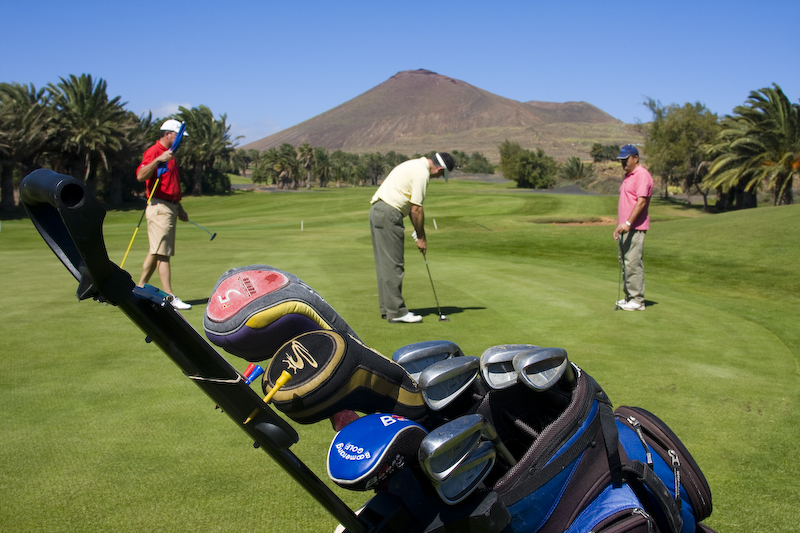
A golfer typically transports golf clubs in a golf bag. Modern golf bags are made of nylon, canvas and/or leather, with plastic or metal reinforcement and framing, but historically bags have been made from other materials. Golf bags have several pockets designed for carrying various equipment and supplies required over the course of a round of golf. Virtually all bags are sectioned off with rigid supports at the top opening, both for rigidity and to separate clubs of various types for easier selection. More expensive bags have sleeves or pockets within the main compartment for each individual club, allowing for the desired club to be more easily removed from the bag and then returned without interference from the grips of the other clubs or internal hardware of the bag.
Golf carts are vehicles used to transport golf bags and golfers along the golf course during a round of golf. Hand carts are designed to hold only the bag, and are used by players while walking along the course to relieve them of the weight of the bag. Carts that carry both player and bag are more common on public golf courses; most of these are powered by a battery and electric motors, though gasoline-powered carts are sometimes used by course staff, and some courses and players are beginning to explore alternatives such as bicycle-drawn carts.
Hub AI
Golf equipment AI simulator
(@Golf equipment_simulator)
Golf equipment
Golf equipment encompasses the various items that are used to play the sport of golf. Types of equipment include the golf ball, golf clubs, golf divot tool, golf ball marker and devices that aid in the sport.
Originally, golf balls were made of a hardwood, such as beech. Beginning between the 14th and 16th centuries, more expensive golf balls were made of a leather skin stuffed with down feathers; these were called "featheries". Around the mid-1800s, a new material called gutta-percha, made from the latex of the East Asian sapodilla tree, started to be used to create more inexpensive golf balls nicknamed "gutties", which had similar flight characteristics as featheries. These then progressed to "brambles" in the later 1800s, using a raised dimple pattern and resembling bramble fruit, and then to "meshies" beginning in the early 1900s, where ball manufacturers started experimenting with latex rubber cores and wound mesh skins that created recessed patterns over the ball's surface. Recessed circular dimples were patented in 1910, but didn't become popular until the 1940s after the patents expired.
A player usually carries several clubs during the game (but no more than fourteen, the limit defined by the rules). There are three major types of clubs, known as woods, irons, and putters. Woods are played for long shots from the tee or fairway, and occasionally rough, while irons are for precision shots from fairways as well as from the rough. A new type of club called a hybrid combines the straight-hitting characteristics of irons with the easy-to-hit characteristics of higher-lofted woods. A hybrid is often used for long shots from difficult rough. Hybrids are also used by players who have a difficult time getting the ball airborne with long irons. Wedges are irons used to play shorter shots. Wedges are played from difficult ground such as sand or the rough and for approach shots to the green. Putters are mostly played on the green, but can also be useful when playing some approach shots. Putters have minimal loft, meaning the ball stays close to the ground when struck. The most common clubs to make up a set used to be a driver, 3 and 5-woods, irons numbered from 3 to 9, pitching wedge, sand wedge, and putter. Modern sets commonly include hybrids, often replacing the longer irons and 5-wood, and/or additional wedges such as a gap or lob wedge. Players may choose to play with any combination of clubs, limited by the rules to a maximum of 14.
When on the green, the ball may be picked up to be cleaned or if it is in the way of an opponent's putting line; there are certain other circumstances in which a ball may be lifted. In these cases, the ball's position must first be marked using a ball marker; this is typically a round, flat piece of metal or plastic that is differentiable from others in use. Ball markers are often integrated into other accessories, such as divot tools, scorekeeping tools or tee holders, and in the absence of a purpose-made marker, a small coin such as a penny is acceptable.
A tee is an object (wooden or plastic) that is pushed into or placed on the ground to rest a ball on top of for an easier shot; however, this is only allowed for the first stroke (tee shot or drive) of each hole. Conventional golf tees are basically spikes with a small cup on the head to hold the ball, and are usually made of wood or plastic. Wooden tees are generally very inexpensive and quite disposable; a player may damage or break many of these during the course of a round. Plastic tees are generally more expensive but last longer. The length of tees varies according to the club intended to be used and by personal preference; longer tees (3–3.5") allow the player to position the ball higher off the ground while remaining stable when planted, and are generally used for modern deep-faced woods. They can be planted deeper for use with other clubs but then tend to break more often. Shorter tees (1.5–2.5") are suitable for irons and are more easily inserted and less easily broken than long tees. Other designs of tee exist; the "step tee" is milled or molded with a spool-shaped upper half, and so generally provides a consistent ball height from shot to shot. The "brush tee" uses a collection of stiff bristles instead of a cup to position the ball; the design is touted by its manufacturer as providing less interference to the ball or club at impact, for a straighter, longer flight.
Alternately, the rules allow for a mound of sand to be used for the same function, also only on the first shot. Before the invention of the wooden spike tee, this was the only accepted method of lifting the ball for the initial shot. This is rarely done in modern times, as a tee is easier to place, hit from, and recover, but some courses prohibit the use of tees either for traditional reasons, or because a swing that hits the tee will drive it into or rip it out of the ground, resulting in damage to the turf of the tee-box. Tees also create litter if discarded incorrectly when broken.
A golfer typically transports golf clubs in a golf bag. Modern golf bags are made of nylon, canvas and/or leather, with plastic or metal reinforcement and framing, but historically bags have been made from other materials. Golf bags have several pockets designed for carrying various equipment and supplies required over the course of a round of golf. Virtually all bags are sectioned off with rigid supports at the top opening, both for rigidity and to separate clubs of various types for easier selection. More expensive bags have sleeves or pockets within the main compartment for each individual club, allowing for the desired club to be more easily removed from the bag and then returned without interference from the grips of the other clubs or internal hardware of the bag.
Golf carts are vehicles used to transport golf bags and golfers along the golf course during a round of golf. Hand carts are designed to hold only the bag, and are used by players while walking along the course to relieve them of the weight of the bag. Carts that carry both player and bag are more common on public golf courses; most of these are powered by a battery and electric motors, though gasoline-powered carts are sometimes used by course staff, and some courses and players are beginning to explore alternatives such as bicycle-drawn carts.