
Recent from talks
Wood (golf)
Knowledge base stats:
Talk channels stats:
Members stats:
Wood (golf)
A wood is a type of club used in the sport of golf. Woods have longer shafts and larger, rounder heads than other club types, and are used to hit the ball longer distances than other types.
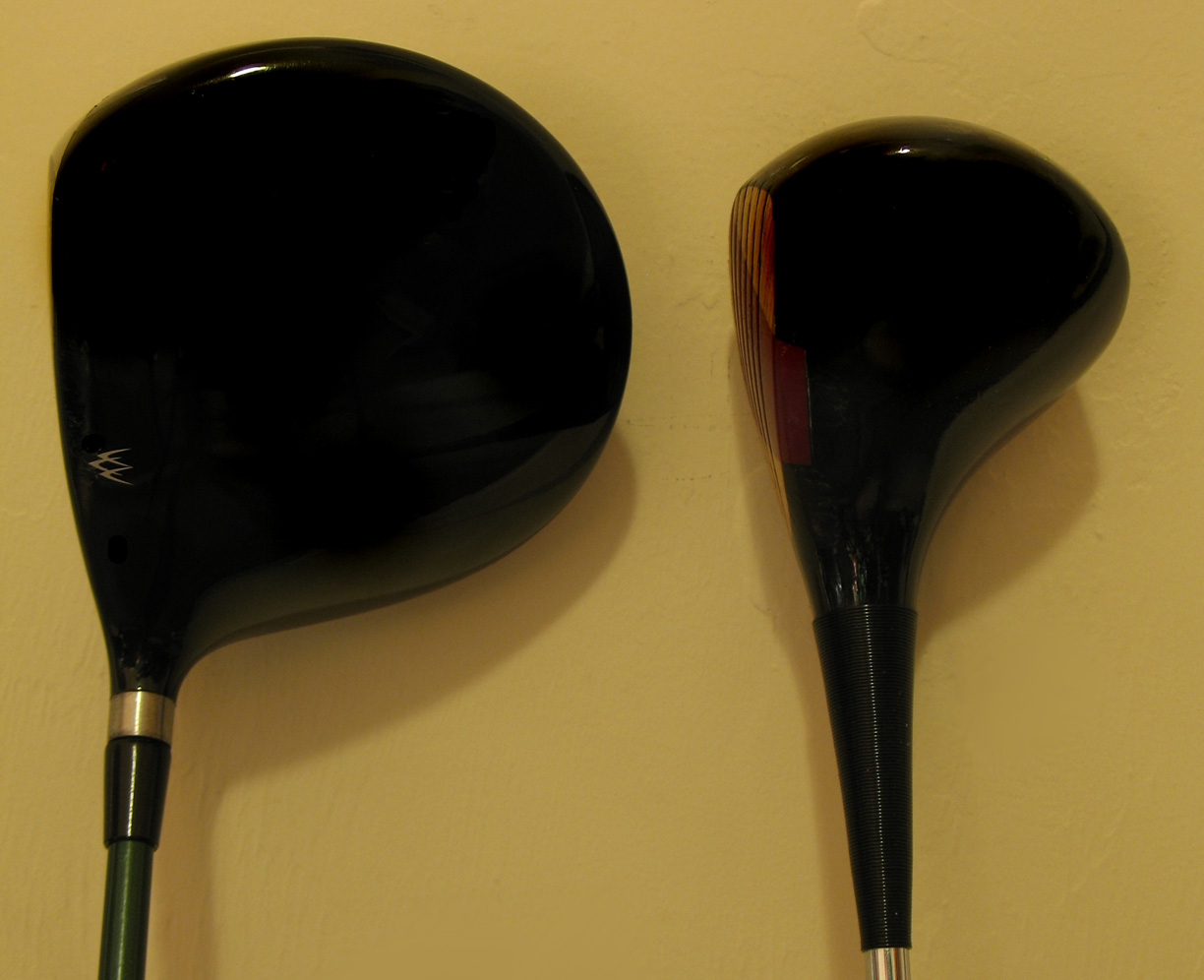
Woods are so called because, traditionally, they had a club head that was made from hardwood, generally persimmon, but modern clubs have heads made from metal, for example titanium, or composite materials, such as carbon fiber. Some golf enthusiasts refer to these as "metals" or "metal woods" but this change in terminology is not strictly necessary, because while the material has changed, the style and intended use has not. The change to stronger materials has allowed the design of the modern woods to incorporate significantly larger heads than in the past. Because of the increase in club head size, in 2004, the USGA created a new stipulation for the size of the club head. The legal maximum volume displacement of any clubhead (by the rules of golf) is 460 cm3 (28.1 cu in)[failed verification]
Woods are numbered in ascending order starting with the driver, or 1-wood, which has the lowest loft (usually between 9 and 13 degrees), and continuing with progressively higher lofts and numbers. Most modern woods are sold as individual clubs allowing the player to customize their club set, but matched sets of woods, especially as part of a complete club set, are readily available. Odd-numbered lofts are most common in players' bags, though 2- and 4-woods are available in many model lines. The number of the club is mainly a reference for the player to easily identify the clubs; the actual loft angle of a particular number varies between manufacturers, and there is often some overlap of lofts (one 3-wood might be higher-lofted than a 4-wood of a different brand or model). Other identifiers have been utilized such as "strong" and "plus" to differentiate various lofts within a line of clubs.
Woods generally fall into two classes, drivers and fairway woods, with a traditional set of clubs including a driver and one or two fairway woods (usually numbered 3 and 5). Many modern sets tend to include hybrid clubs, which combine some of the characteristics of a wood and an iron, to replace the 5-wood and low-lofted irons.
During the 2010s, golf club producers popularized the idea of woods and hybrids that can be adjusted by the player to provide different settings, such as loft and lie angle. This is done by unscrewing the club head from the shaft, adjusting the adapter located on the hosel to the desired configuration, and screwing the club head back on using a torque wrench.
The 1-wood, or driver, is the lowest-lofted, longest, and often lightest club in a player's bag, and is meant to launch the ball the longest distance of any club. Originally, the driver was only slightly larger than any other wood and was designed to be used from the tee or the fairway, but with the advent of hollow metal clubhead construction, the driver has become highly specialized for use off the tee by incorporating an oversized head and a deep striking face to maximize the "sweet spot" that gives the best results. It is possible to hit a modern driver off the fairway turf, but it requires a high degree of skill and a certain amount of luck regarding the lie of the ball. Certain 2-woods are available with a similar deep-faced design but a higher loft, which can be used in situations when a player needs slightly less distance than their average drive, or must make a driver-distance shot from the fairway or rough. However, 2-woods of any kind are uncommon, as a player in these situations will more often opt for the 3-wood, and save the space in the bag for a less specialised club like a wedge or hybrid.
The driver has become the most expensive single club of the modern clubset, largely due to the high emphasis placed on a player's drive distance; a longer drive gets the ball closer to the green in fewer strokes allowing for better chances of a birdie or eagle. While drivers are available cheaply, these are mainly marketed at junior players; drivers marketed to adult amateur players are an order of magnitude more expensive, with custom-made clubs for high-end players and touring professionals costing one or two additional orders of magnitude (in the case of prototype or preproduction clubs supplied by a sponsor club-maker). As a comparison, the upper end of the retail drivers is comparable to the price of an entire matched set of irons, and the next most expensive single clubs, the putter and the fairway woods.
With such high emphasis on drive distance and accuracy by players wanting to "play like the pros", a large amount of customization is available in drivers in order to provide the club configuration that best matches the player's specific swing mechanics. Club-makers generally provide for selection and/or customization of five things: the shaft flex, which determines how energy is stored and released during the player's swing; the loft angle, which is a determinant of launch angle and backspin; the offset, which determines the angle the clubface will have to the ball at impact; the clubhead mass, which can "fine-tune" the clubhead behaviour for a player's swing tempo; and the centre of mass, which is also a factor in launch angle and backspin.
Hub AI
Wood (golf) AI simulator
(@Wood (golf)_simulator)
Wood (golf)
A wood is a type of club used in the sport of golf. Woods have longer shafts and larger, rounder heads than other club types, and are used to hit the ball longer distances than other types.
Woods are so called because, traditionally, they had a club head that was made from hardwood, generally persimmon, but modern clubs have heads made from metal, for example titanium, or composite materials, such as carbon fiber. Some golf enthusiasts refer to these as "metals" or "metal woods" but this change in terminology is not strictly necessary, because while the material has changed, the style and intended use has not. The change to stronger materials has allowed the design of the modern woods to incorporate significantly larger heads than in the past. Because of the increase in club head size, in 2004, the USGA created a new stipulation for the size of the club head. The legal maximum volume displacement of any clubhead (by the rules of golf) is 460 cm3 (28.1 cu in)[failed verification]
Woods are numbered in ascending order starting with the driver, or 1-wood, which has the lowest loft (usually between 9 and 13 degrees), and continuing with progressively higher lofts and numbers. Most modern woods are sold as individual clubs allowing the player to customize their club set, but matched sets of woods, especially as part of a complete club set, are readily available. Odd-numbered lofts are most common in players' bags, though 2- and 4-woods are available in many model lines. The number of the club is mainly a reference for the player to easily identify the clubs; the actual loft angle of a particular number varies between manufacturers, and there is often some overlap of lofts (one 3-wood might be higher-lofted than a 4-wood of a different brand or model). Other identifiers have been utilized such as "strong" and "plus" to differentiate various lofts within a line of clubs.
Woods generally fall into two classes, drivers and fairway woods, with a traditional set of clubs including a driver and one or two fairway woods (usually numbered 3 and 5). Many modern sets tend to include hybrid clubs, which combine some of the characteristics of a wood and an iron, to replace the 5-wood and low-lofted irons.
During the 2010s, golf club producers popularized the idea of woods and hybrids that can be adjusted by the player to provide different settings, such as loft and lie angle. This is done by unscrewing the club head from the shaft, adjusting the adapter located on the hosel to the desired configuration, and screwing the club head back on using a torque wrench.
The 1-wood, or driver, is the lowest-lofted, longest, and often lightest club in a player's bag, and is meant to launch the ball the longest distance of any club. Originally, the driver was only slightly larger than any other wood and was designed to be used from the tee or the fairway, but with the advent of hollow metal clubhead construction, the driver has become highly specialized for use off the tee by incorporating an oversized head and a deep striking face to maximize the "sweet spot" that gives the best results. It is possible to hit a modern driver off the fairway turf, but it requires a high degree of skill and a certain amount of luck regarding the lie of the ball. Certain 2-woods are available with a similar deep-faced design but a higher loft, which can be used in situations when a player needs slightly less distance than their average drive, or must make a driver-distance shot from the fairway or rough. However, 2-woods of any kind are uncommon, as a player in these situations will more often opt for the 3-wood, and save the space in the bag for a less specialised club like a wedge or hybrid.
The driver has become the most expensive single club of the modern clubset, largely due to the high emphasis placed on a player's drive distance; a longer drive gets the ball closer to the green in fewer strokes allowing for better chances of a birdie or eagle. While drivers are available cheaply, these are mainly marketed at junior players; drivers marketed to adult amateur players are an order of magnitude more expensive, with custom-made clubs for high-end players and touring professionals costing one or two additional orders of magnitude (in the case of prototype or preproduction clubs supplied by a sponsor club-maker). As a comparison, the upper end of the retail drivers is comparable to the price of an entire matched set of irons, and the next most expensive single clubs, the putter and the fairway woods.
With such high emphasis on drive distance and accuracy by players wanting to "play like the pros", a large amount of customization is available in drivers in order to provide the club configuration that best matches the player's specific swing mechanics. Club-makers generally provide for selection and/or customization of five things: the shaft flex, which determines how energy is stored and released during the player's swing; the loft angle, which is a determinant of launch angle and backspin; the offset, which determines the angle the clubface will have to the ball at impact; the clubhead mass, which can "fine-tune" the clubhead behaviour for a player's swing tempo; and the centre of mass, which is also a factor in launch angle and backspin.
Recent media