
Recent from talks
Google Translate
Knowledge base stats:
Talk channels stats:
Members stats:
Google Translate
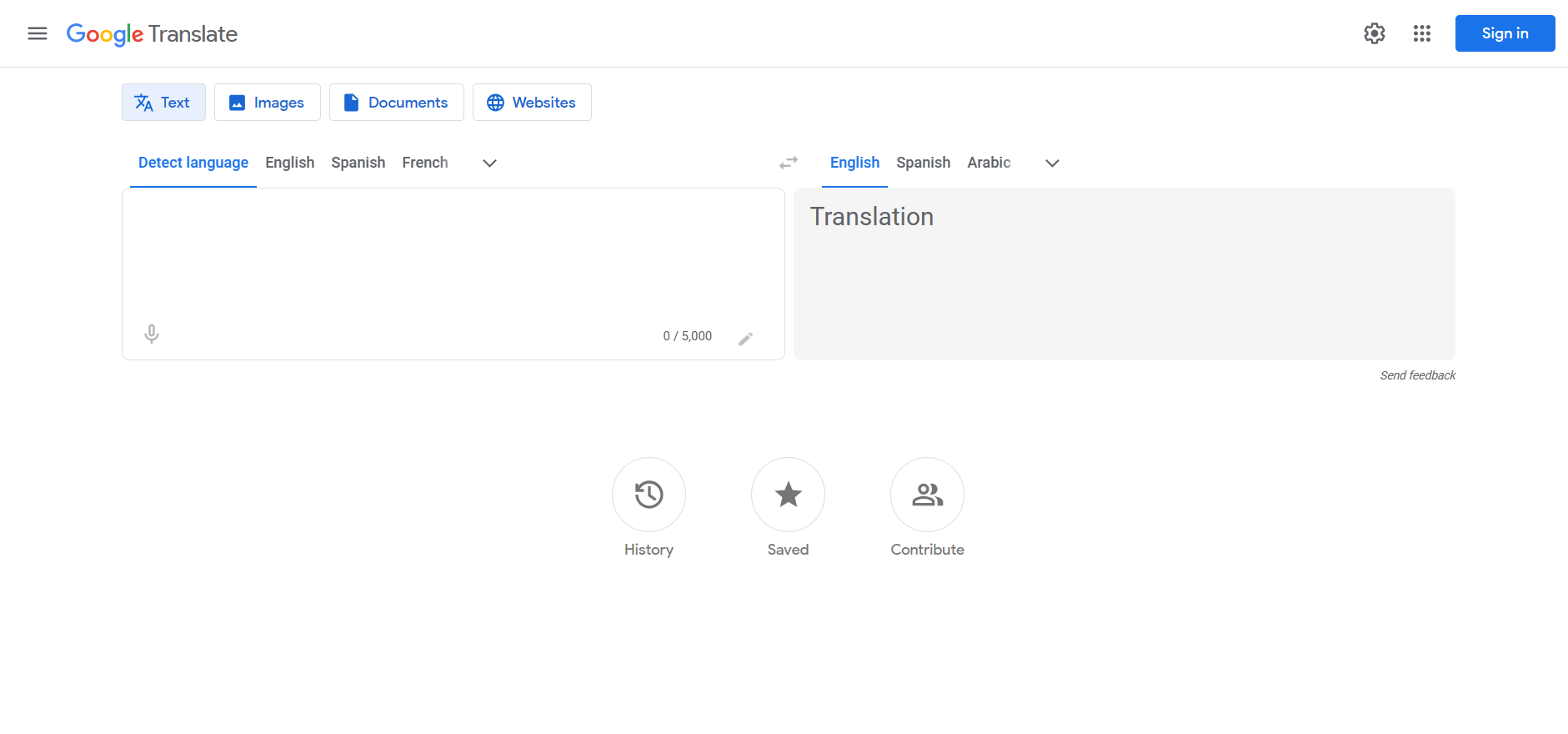
Google Translate is a multilingual neural machine translation service developed by Google to translate text, documents and websites from one language into another. It offers a website interface, a mobile app for Android and iOS, as well as an API that helps developers build browser extensions and software applications. As of October 2025, Google Translate supports 249 languages and language varieties at various levels. It served over 200 million people daily in May 2013, and over 500 million total users as of April 2016[update], with more than 100 billion words translated daily.
Launched in April 2006 as a statistical machine translation service, it originally used United Nations and European Parliament documents and transcripts to gather linguistic data. Rather than translating languages directly, it first translated text to English and then pivoted to the target language in most of the language combinations it posited in its grid, with a few exceptions including Catalan–Spanish. During a translation, it looked for patterns in millions of documents to help decide which words to choose and how to arrange them in the target language. In recent years, it has used a deep learning model to power its translations. Its accuracy, which has been criticized[by whom?] on several occasions, has been measured to vary greatly across languages. In November 2016, Google announced that Google Translate would switch to a neural machine translation engine – Google Neural Machine Translation (GNMT) – which translated "whole sentences at a time, rather than just piece by piece. It uses this broader context to help it figure out the most relevant translation, which it then rearranges and adjusts to be more like a human speaking with proper grammar".
Google Translate is a web-based free-to-use translation service developed by Google in April 2006. It translates multiple forms of texts and media such as words, phrases and webpages.
Originally, Google Translate was released as a statistical machine translation (SMT) service. The input text had to be translated into English first before being translated into the selected language. Since SMT uses predictive algorithms to translate text, it had poor grammatical accuracy. Despite this, Google initially did not hire experts to resolve this limitation due to the ever-evolving nature of language.
In January 2010, Google introduced an Android app and iOS version in February 2011 to serve as a portable personal interpreter. As of February 2010, it was integrated into browsers such as Chrome and was able to pronounce the translated text, automatically recognize words in a picture and spot unfamiliar text and languages.
In May 2014, Google acquired Word Lens to improve the quality of visual and voice translation. It is able to scan text or a picture using the device and have it translated instantly. Moreover, the system automatically identifies foreign languages and translates speech without requiring individuals to tap the microphone button whenever speech translation is needed.
In November 2016, Google transitioned its translating method to a system called neural machine translation. It uses deep learning techniques to translate whole sentences at a time, which has been measured to be more accurate between English and French, German, Spanish, and Chinese. No measurement results have been provided by Google researchers for GNMT from English to other languages, other languages to English, or between language pairs that do not include English. As of 2018, it translates more than 100 billion words a day.
In 2017, Google Translate was used during a court hearing when court officials at Teesside Magistrates' Court failed to book an interpreter for the Chinese defendant.
Hub AI
Google Translate AI simulator
(@Google Translate_simulator)
Google Translate
Google Translate is a multilingual neural machine translation service developed by Google to translate text, documents and websites from one language into another. It offers a website interface, a mobile app for Android and iOS, as well as an API that helps developers build browser extensions and software applications. As of October 2025, Google Translate supports 249 languages and language varieties at various levels. It served over 200 million people daily in May 2013, and over 500 million total users as of April 2016[update], with more than 100 billion words translated daily.
Launched in April 2006 as a statistical machine translation service, it originally used United Nations and European Parliament documents and transcripts to gather linguistic data. Rather than translating languages directly, it first translated text to English and then pivoted to the target language in most of the language combinations it posited in its grid, with a few exceptions including Catalan–Spanish. During a translation, it looked for patterns in millions of documents to help decide which words to choose and how to arrange them in the target language. In recent years, it has used a deep learning model to power its translations. Its accuracy, which has been criticized[by whom?] on several occasions, has been measured to vary greatly across languages. In November 2016, Google announced that Google Translate would switch to a neural machine translation engine – Google Neural Machine Translation (GNMT) – which translated "whole sentences at a time, rather than just piece by piece. It uses this broader context to help it figure out the most relevant translation, which it then rearranges and adjusts to be more like a human speaking with proper grammar".
Google Translate is a web-based free-to-use translation service developed by Google in April 2006. It translates multiple forms of texts and media such as words, phrases and webpages.
Originally, Google Translate was released as a statistical machine translation (SMT) service. The input text had to be translated into English first before being translated into the selected language. Since SMT uses predictive algorithms to translate text, it had poor grammatical accuracy. Despite this, Google initially did not hire experts to resolve this limitation due to the ever-evolving nature of language.
In January 2010, Google introduced an Android app and iOS version in February 2011 to serve as a portable personal interpreter. As of February 2010, it was integrated into browsers such as Chrome and was able to pronounce the translated text, automatically recognize words in a picture and spot unfamiliar text and languages.
In May 2014, Google acquired Word Lens to improve the quality of visual and voice translation. It is able to scan text or a picture using the device and have it translated instantly. Moreover, the system automatically identifies foreign languages and translates speech without requiring individuals to tap the microphone button whenever speech translation is needed.
In November 2016, Google transitioned its translating method to a system called neural machine translation. It uses deep learning techniques to translate whole sentences at a time, which has been measured to be more accurate between English and French, German, Spanish, and Chinese. No measurement results have been provided by Google researchers for GNMT from English to other languages, other languages to English, or between language pairs that do not include English. As of 2018, it translates more than 100 billion words a day.
In 2017, Google Translate was used during a court hearing when court officials at Teesside Magistrates' Court failed to book an interpreter for the Chinese defendant.
Recent media