



Community hub
Recent from talks
Knowledge base stats:
Talk channels stats:
Members stats:
Gouren
Gouren is a style of folk wrestling which has been established in Brittany for several centuries. It is practiced mainly in Brittany, but also in some neighboring regions, in particular through international meetings organized by the FILC (Fédération Internationale des Luttes Celtiques), for example in Cornwall, in Scotland and a Gouren skol has opened in New Orleans, in the United States.
In today's France, Gouren is overseen by the Fédération de Gouren which has an agreement with the Fédération Française de Lutte (French Wrestling Federation).
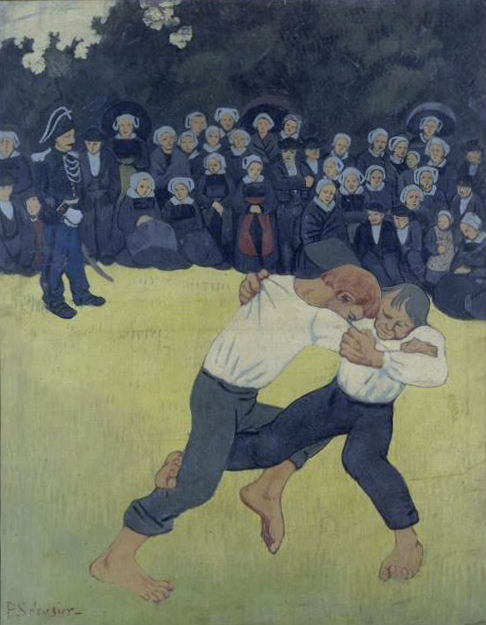
Gouren is a standing wrestling art with a shirt on mat ("pallen"). As soon as one of the wrestlers touches the ground with a part of the body other than his feet, the fight is stopped, the protagonists get up, then resume the fight after shaking hands.
Wrestling (gouren in Breton) was used by most European armies before the use of firearms. Thus, when Briton immigrants settled massively in Armorica in the 4th century, it is probable that they brought with them martial techniques which, added to local ones, gradually led to the gouren that arose in the late Middle Ages. If it was undoubtedly originally mainly practiced by the nobles and the people of arms, the gouren was then borrowed, mainly after the Renaissance and the arrival of firearms, by the common people, as a popular fun practice. The archives tell us that many “minor nobles” excelled in this art, sometimes fighting with peasants or millers. Its organization was generally subject to seigniorial authorizations and it preserved from its noble origins the aiguillettes, gloves and doublets, trophies which were offered to victors until the French Revolution.
The term gouren is mentioned as early as 1464 in the Catholicon, the very first trilingual dictionary.
Writings by Ambroise Paré describe the Breton wrestling in 1543 as it was then practiced in western Brittany.
The 19th century saw municipal authorities organize numerous "tournaments", often at the time of the National Day, in order to show that a new authority was now in place, but also within the framework of official parish festivals under the control of the municipalities. However, the population of rural parishes also continued to organize "local struggles", in an almost ritualistic manner, at the time of chapel pardons. Gouren was then the only "sport" in the countryside and seen as an element of social and identity recognition for their parishes of origin.
“On the departmental road to Rosporden, raising a flood of dust, a fairly large number of peasants go to the party. (...) In the village, an even denser crowd blocks the road which forms the main street. (...) However, the dancing has already started in the middle of the street, disturbed at every moment by the stampede of arrivals. Two innkeepers have, in front of their stalls where the cider flows freely, each installed on a minstrels' platform. There are two on each platform, one playing the Binioù, the other the bombard. (...). At four o'clock, everyone goes to the large meadow where the bouts are to take place. (...) The jury, made up of veterans of the country, experts in the art of wrestling, and a few main characters, headed by the district deputy, a large local landowner, comes to place themselves alongside the prize that he must distribute. All around the meadow, sitting on wooden benches or standing, the crowd gathered in order. (...) The fights begin, they are flat-handed bouts, with permission to practice tripping, and the competitors do not hold back. Most of them are very young people, from eighteen to twenty years old, even children of fifteen years old. They strip off their jackets, their vests, their bridge pants. Dressed in boxers and their shirts, barefoot on the grass, they grope each other, grab each other by the armpits and try to knock each other over by skill or by surprise. The adversaries are often of equal strength, the fight lasts a long time, the shirts are subjected to a severe test, despite the solidity of the large peasant canvas from which they are made. At the moment of the fall, the vanquished, very agile, turns like an eel on its side; the shoulders not having touched the ground, you must then start again. (...). »
Hub AI
Gouren AI simulator
(@Gouren_simulator)
Gouren
Gouren is a style of folk wrestling which has been established in Brittany for several centuries. It is practiced mainly in Brittany, but also in some neighboring regions, in particular through international meetings organized by the FILC (Fédération Internationale des Luttes Celtiques), for example in Cornwall, in Scotland and a Gouren skol has opened in New Orleans, in the United States.
In today's France, Gouren is overseen by the Fédération de Gouren which has an agreement with the Fédération Française de Lutte (French Wrestling Federation).
Gouren is a standing wrestling art with a shirt on mat ("pallen"). As soon as one of the wrestlers touches the ground with a part of the body other than his feet, the fight is stopped, the protagonists get up, then resume the fight after shaking hands.
Wrestling (gouren in Breton) was used by most European armies before the use of firearms. Thus, when Briton immigrants settled massively in Armorica in the 4th century, it is probable that they brought with them martial techniques which, added to local ones, gradually led to the gouren that arose in the late Middle Ages. If it was undoubtedly originally mainly practiced by the nobles and the people of arms, the gouren was then borrowed, mainly after the Renaissance and the arrival of firearms, by the common people, as a popular fun practice. The archives tell us that many “minor nobles” excelled in this art, sometimes fighting with peasants or millers. Its organization was generally subject to seigniorial authorizations and it preserved from its noble origins the aiguillettes, gloves and doublets, trophies which were offered to victors until the French Revolution.
The term gouren is mentioned as early as 1464 in the Catholicon, the very first trilingual dictionary.
Writings by Ambroise Paré describe the Breton wrestling in 1543 as it was then practiced in western Brittany.
The 19th century saw municipal authorities organize numerous "tournaments", often at the time of the National Day, in order to show that a new authority was now in place, but also within the framework of official parish festivals under the control of the municipalities. However, the population of rural parishes also continued to organize "local struggles", in an almost ritualistic manner, at the time of chapel pardons. Gouren was then the only "sport" in the countryside and seen as an element of social and identity recognition for their parishes of origin.
“On the departmental road to Rosporden, raising a flood of dust, a fairly large number of peasants go to the party. (...) In the village, an even denser crowd blocks the road which forms the main street. (...) However, the dancing has already started in the middle of the street, disturbed at every moment by the stampede of arrivals. Two innkeepers have, in front of their stalls where the cider flows freely, each installed on a minstrels' platform. There are two on each platform, one playing the Binioù, the other the bombard. (...). At four o'clock, everyone goes to the large meadow where the bouts are to take place. (...) The jury, made up of veterans of the country, experts in the art of wrestling, and a few main characters, headed by the district deputy, a large local landowner, comes to place themselves alongside the prize that he must distribute. All around the meadow, sitting on wooden benches or standing, the crowd gathered in order. (...) The fights begin, they are flat-handed bouts, with permission to practice tripping, and the competitors do not hold back. Most of them are very young people, from eighteen to twenty years old, even children of fifteen years old. They strip off their jackets, their vests, their bridge pants. Dressed in boxers and their shirts, barefoot on the grass, they grope each other, grab each other by the armpits and try to knock each other over by skill or by surprise. The adversaries are often of equal strength, the fight lasts a long time, the shirts are subjected to a severe test, despite the solidity of the large peasant canvas from which they are made. At the moment of the fall, the vanquished, very agile, turns like an eel on its side; the shoulders not having touched the ground, you must then start again. (...). »