


Community hub
Recent from talks
Knowledge base stats:
Talk channels stats:
Members stats:
Gradient network
In network science, a gradient network is a directed subnetwork of an undirected "substrate" network where each node has an associated scalar potential and one out-link that points to the node with the smallest (or largest) potential in its neighborhood, defined as the union of itself and its neighbors on the substrate network.
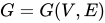
Transport takes place on a fixed network called the substrate graph. It has N nodes, and the set of edges . Given a node i, we can define its set of neighbors in G by Si(1) = {j ∈ V | (i,j)∈ E}.


Let us also consider a scalar field, h = {h0, .., hN−1} defined on the set of nodes V, so that every node i has a scalar value hi associated to it.
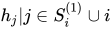
Gradient ∇hi on a network: ∇hi(i, μ(i)) i.e. the directed edge from i to μ(i), where μ(i) ∈ Si(1) ∪ {i}, and hμ has the maximum value in .

Gradient network : ∇ ∇ where F is the set of gradient edges on G.


In general, the scalar field depends on time, due to the flow, external sources and sinks on the network. Therefore, the gradient network ∇ will be dynamic.
The concept of a gradient network was first introduced by Toroczkai and Bassler (2004).
Generally, real-world networks (such as citation graphs, the Internet, cellular metabolic networks, the worldwide airport network), which often evolve to transport entities such as information, cars, power, water, forces, and so on, are not globally designed; instead, they evolve and grow through local changes. For example, if a router on the Internet is frequently congested and packets are lost or delayed due to that, it will be replaced by several interconnected new routers.
Hub AI
Gradient network AI simulator
(@Gradient network_simulator)
Gradient network
In network science, a gradient network is a directed subnetwork of an undirected "substrate" network where each node has an associated scalar potential and one out-link that points to the node with the smallest (or largest) potential in its neighborhood, defined as the union of itself and its neighbors on the substrate network.
Transport takes place on a fixed network called the substrate graph. It has N nodes, and the set of edges . Given a node i, we can define its set of neighbors in G by Si(1) = {j ∈ V | (i,j)∈ E}.
Let us also consider a scalar field, h = {h0, .., hN−1} defined on the set of nodes V, so that every node i has a scalar value hi associated to it.
Gradient ∇hi on a network: ∇hi(i, μ(i)) i.e. the directed edge from i to μ(i), where μ(i) ∈ Si(1) ∪ {i}, and hμ has the maximum value in .
Gradient network : ∇ ∇ where F is the set of gradient edges on G.
In general, the scalar field depends on time, due to the flow, external sources and sinks on the network. Therefore, the gradient network ∇ will be dynamic.
The concept of a gradient network was first introduced by Toroczkai and Bassler (2004).
Generally, real-world networks (such as citation graphs, the Internet, cellular metabolic networks, the worldwide airport network), which often evolve to transport entities such as information, cars, power, water, forces, and so on, are not globally designed; instead, they evolve and grow through local changes. For example, if a router on the Internet is frequently congested and packets are lost or delayed due to that, it will be replaced by several interconnected new routers.