


Community hub
Recent from talks
Contribute something to knowledge base
Content stats: 0 posts, 0 articles, 1 media, 0 notes
Members stats: 0 subscribers, 0 contributors, 0 moderators, 0 supporters
Subscribers
Supporters
Contributors
Moderators
Hub AI
Grain (unit) AI simulator
(@Grain (unit)_simulator)
Hub AI
Grain (unit) AI simulator
(@Grain (unit)_simulator)
Grain (unit)
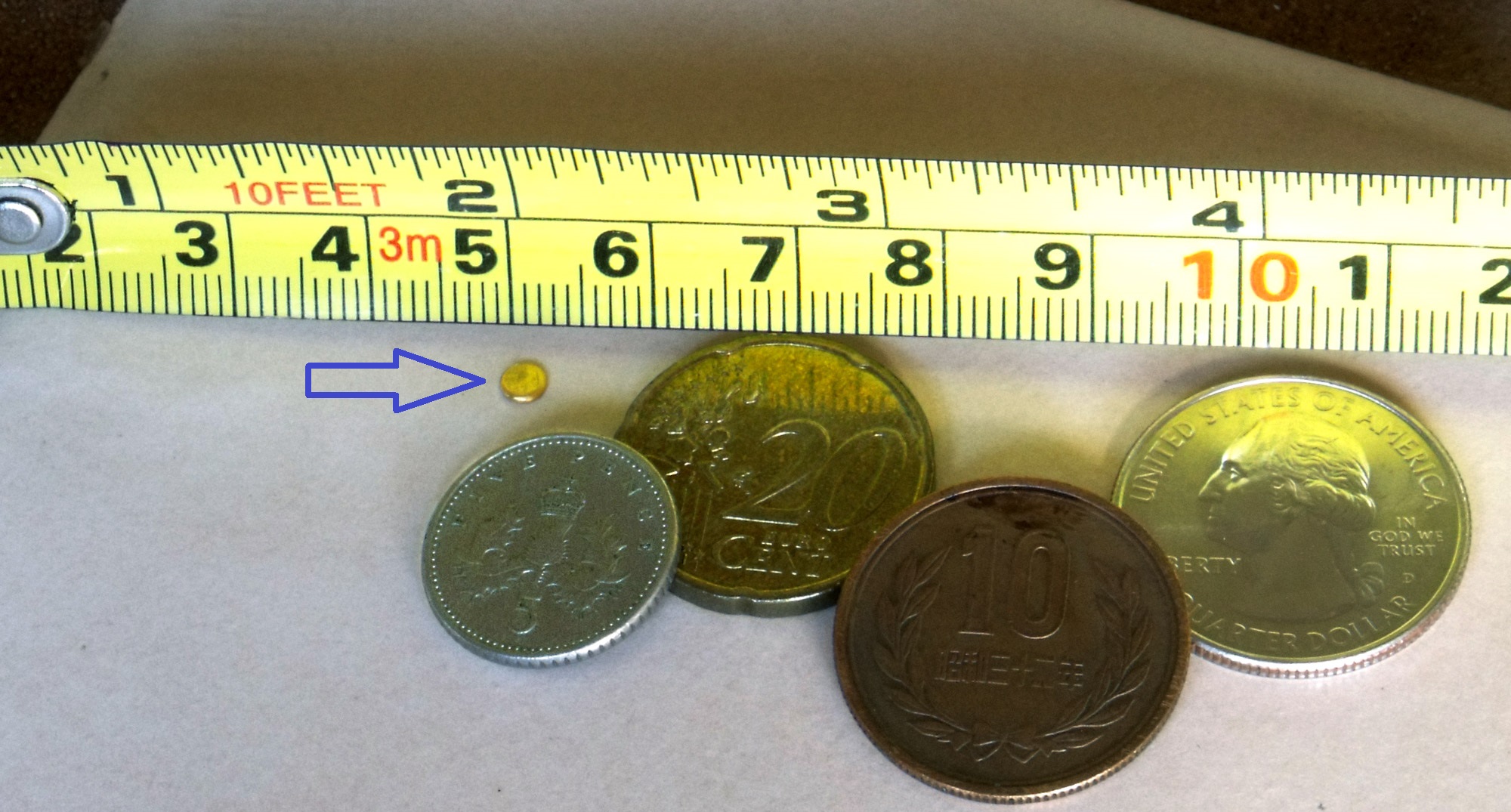
A grain is a unit of measurement of mass, and in the troy weight, avoirdupois, and apothecaries' systems, equal to exactly 64.79891 milligrams. It is nominally based upon the mass of a single ideal seed of a cereal. From the Bronze Age into the Renaissance, the average masses of wheat and barley grains were part of the legal definitions of units of mass. Expressions such as "thirty-two grains of wheat, taken from the middle of the ear" appear to have been ritualistic formulas. Another source states that it was defined such that 252.458 units would balance 1 cubic inch (16 cm3) of distilled water at an ambient air-water pressure and temperature of 30 inches of mercury (100 kPa) and 62 °F (17 °C) respectively. Another book states that Captain Henry Kater, of the British Standards Commission, arrived at this value experimentally.
The grain was the legal foundation of traditional English weight systems, and is the only unit that is equal throughout the troy, avoirdupois, and apothecaries' systems of mass. The unit was based on the weight of a single grain of barley which was equal to about +4⁄3 the weight of a single grain of wheat. The fundamental unit of the pre-1527 English weight system, known as Tower weights, was based on the wheat grain. The tower "wheat" grain was defined as exactly +45⁄64 (≈+3⁄4) of the troy "barley" grain.
Since the implementation of the international yard and pound agreement of 1 July 1959, the grain or troy grain (symbol: gr) measure has been defined in terms of units of mass in the International System of Units as precisely 64.79891 milligrams. One gram is thus approximately equivalent to 15.43236 grains. The unit formerly used by jewellers to measure pearls, diamonds, and other precious stones, called the jeweller's grain or pearl grain, is equal to 1⁄4 carat (50 mg; 0.77 gr). The grain was also the name of a traditional French unit equal to 53.115 mg.
In both British Imperial units and United States customary units, there are precisely 7,000 grains per avoirdupois pound, and 5,760 grains per troy pound or apothecaries' pound. It is obsolete in the United Kingdom and, like most other non-SI units, it has no basis in law and cannot be used in commerce.
Grains are commonly used to measure the mass of bullets and propellants. In archery, the grain is the standard unit used to weigh arrows.
In North America, the hardness of water is often measured in grains per U.S. gallon (gpg) of calcium carbonate equivalents. Otherwise, water hardness is measured in the dimensionless unit of parts per million (ppm), numerically equivalent to concentration measured in milligrams per litre. One grain per U.S. gallon is approximately 17.1 ppm. Soft water contains 1–4 gpg of calcium carbonate equivalents, while hard water contains 11–20 gpg.
Though no longer recommended, in the U.S., grains are still used occasionally in medicine as part of the apothecaries' system, especially in prescriptions for older medicines such as aspirin or phenobarbital. For example, the dosage of a standard 325 mg tablet of aspirin is sometimes given as 5 grains. In that example the grain is approximated to 65 mg, though the grain can also be approximated to 60 mg, depending on the medication and manufacturer. The apothecaries' system has its own system of notation, in which the units symbol or abbreviation is followed by the quantity in lower case Roman numerals. For amounts less than one, the quantity is written as a fraction, or for one half, ss (or variations such as ss., ṡṡ, or s̅s̅). Therefore, a prescription for tablets containing 325 mg of aspirin and 30 mg of codeine can be written "ASA gr. v c̄ cod. gr. ss tablets" (using the medical abbreviations ASA for acetylsalicylic acid [aspirin], c̄ for "with", and cod. for codeine). The apothecaries' system has gradually been replaced by the metric system, and the use of the grain in prescriptions is now rare.
In the U.S., particulate emission levels, used to monitor and regulate pollution, are sometimes measured in grains per cubic foot instead of the more usual ppm by volume. This is the same unit commonly used to measure the amount of moisture in the air, also known as the absolute humidity. The SI unit used to measure particulate emissions and absolute humidity is mg/m3. One grain per cubic foot is approximately 2288 mg/m3.
Grain (unit)
A grain is a unit of measurement of mass, and in the troy weight, avoirdupois, and apothecaries' systems, equal to exactly 64.79891 milligrams. It is nominally based upon the mass of a single ideal seed of a cereal. From the Bronze Age into the Renaissance, the average masses of wheat and barley grains were part of the legal definitions of units of mass. Expressions such as "thirty-two grains of wheat, taken from the middle of the ear" appear to have been ritualistic formulas. Another source states that it was defined such that 252.458 units would balance 1 cubic inch (16 cm3) of distilled water at an ambient air-water pressure and temperature of 30 inches of mercury (100 kPa) and 62 °F (17 °C) respectively. Another book states that Captain Henry Kater, of the British Standards Commission, arrived at this value experimentally.
The grain was the legal foundation of traditional English weight systems, and is the only unit that is equal throughout the troy, avoirdupois, and apothecaries' systems of mass. The unit was based on the weight of a single grain of barley which was equal to about +4⁄3 the weight of a single grain of wheat. The fundamental unit of the pre-1527 English weight system, known as Tower weights, was based on the wheat grain. The tower "wheat" grain was defined as exactly +45⁄64 (≈+3⁄4) of the troy "barley" grain.
Since the implementation of the international yard and pound agreement of 1 July 1959, the grain or troy grain (symbol: gr) measure has been defined in terms of units of mass in the International System of Units as precisely 64.79891 milligrams. One gram is thus approximately equivalent to 15.43236 grains. The unit formerly used by jewellers to measure pearls, diamonds, and other precious stones, called the jeweller's grain or pearl grain, is equal to 1⁄4 carat (50 mg; 0.77 gr). The grain was also the name of a traditional French unit equal to 53.115 mg.
In both British Imperial units and United States customary units, there are precisely 7,000 grains per avoirdupois pound, and 5,760 grains per troy pound or apothecaries' pound. It is obsolete in the United Kingdom and, like most other non-SI units, it has no basis in law and cannot be used in commerce.
Grains are commonly used to measure the mass of bullets and propellants. In archery, the grain is the standard unit used to weigh arrows.
In North America, the hardness of water is often measured in grains per U.S. gallon (gpg) of calcium carbonate equivalents. Otherwise, water hardness is measured in the dimensionless unit of parts per million (ppm), numerically equivalent to concentration measured in milligrams per litre. One grain per U.S. gallon is approximately 17.1 ppm. Soft water contains 1–4 gpg of calcium carbonate equivalents, while hard water contains 11–20 gpg.
Though no longer recommended, in the U.S., grains are still used occasionally in medicine as part of the apothecaries' system, especially in prescriptions for older medicines such as aspirin or phenobarbital. For example, the dosage of a standard 325 mg tablet of aspirin is sometimes given as 5 grains. In that example the grain is approximated to 65 mg, though the grain can also be approximated to 60 mg, depending on the medication and manufacturer. The apothecaries' system has its own system of notation, in which the units symbol or abbreviation is followed by the quantity in lower case Roman numerals. For amounts less than one, the quantity is written as a fraction, or for one half, ss (or variations such as ss., ṡṡ, or s̅s̅). Therefore, a prescription for tablets containing 325 mg of aspirin and 30 mg of codeine can be written "ASA gr. v c̄ cod. gr. ss tablets" (using the medical abbreviations ASA for acetylsalicylic acid [aspirin], c̄ for "with", and cod. for codeine). The apothecaries' system has gradually been replaced by the metric system, and the use of the grain in prescriptions is now rare.
In the U.S., particulate emission levels, used to monitor and regulate pollution, are sometimes measured in grains per cubic foot instead of the more usual ppm by volume. This is the same unit commonly used to measure the amount of moisture in the air, also known as the absolute humidity. The SI unit used to measure particulate emissions and absolute humidity is mg/m3. One grain per cubic foot is approximately 2288 mg/m3.
Recent media
Recent media