


Community hub
Recent from talks
Contribute something
Nothing was collected or created yet.
Grand Loop Road
View on Wikipedia
Grand Loop Road | |
 | |
   | |
| Location | Yellowstone National Park, Wyoming |
|---|---|
| Coordinates | 44°38′16″N 110°36′54″W / 44.63778°N 110.61500°W |
| Architect | U.S. Army Corps of Engineers; National Park Service |
| NRHP reference No. | 03001345 |
| Added to NRHP | December 23, 2003[1] |
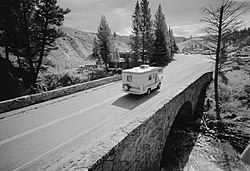
The Grand Loop Road is a historic district which encompasses the primary road system in Yellowstone National Park. Much of the 140-mile (230 km) system was originally planned by Captain Hiram M. Chittenden of the US Army Corps of Engineers in the early days of the park, when it was under military administration. The Grand Loop Road provides access to the major features of the park, including the Upper, Midway and Lower geyser basins, Mammoth Hot Springs, Tower Fall, the Grand Canyon of the Yellowstone and Yellowstone Lake.[2]
A number of other historic districts adjoin the Grand Loop in Yellowstone, including Mammoth Hot Springs, North Entrance Road, Roosevelt Lodge, Lake Fish Hatchery and Old Faithful historic districts.
Grand Loop Rd. includes unsigned portions of US 20, US 89, US 191 and US 287, all of which traverse the park. The road was named by Harry W. Frantz in 1923, who served as the park's publicist before beginning a long career as a journalist.[3]
Route
[edit]Beginning at the junction of the North Entrance Road and Grand Loop Rd. at Yellowstone National Park headquarters at Fort Yellowstone near Mammoth Hot Springs 44°58′34″N 110°42′2″W / 44.97611°N 110.70056°W, the road travels south, passing through Golden Gate Canyon on a viaduct and ascending the Gallatin Range, crossing Kingman Pass near Bunsen Peak. From the pass, the road descends into the Gardner River valley. At the south end of the valley, the road passes Sheepeater Cliff, a prominent columnar basalt cliff. After crossing the Gardner River, the road follows Obsidian Creek into Obsidian Canyon, passing Obsidian Cliff about halfway through the canyon. From Obsidian Canyon, the road continues south into the Norris Valley and the Norris Geyser Basin (44°43′38″N 110°41′47″W / 44.72722°N 110.69639°W). Here, the road meets the Gibbon River and follows it into the Gibbon Geyser Basin and Gibbon Canyon. Emerging from the canyon the Gibbon River merges with the Firehole River to form the Madison River. At this point—Madison Junction (44°38′43″N 110°51′29″W / 44.64528°N 110.85806°W), the road junctions with West Entrance Road which follows the Madison River west out of the park and to West Yellowstone, Montana.
Grand Loop Rd. continues to follow the Firehole River south and east. In a relatively short distance, the road travels through the three most notable geyser basins in the park: Lower Geyser Basin, Midway Geyser Basin and Upper Geyser Basin. The Old Faithful Historic District is located on Grand Loop Rd. adjacent to the Upper Geyser Basin. Turning east from Old Faithful the road crosses the Continental Divide over Craig Pass, and descends to the West Thumb Geyser Basin on the shore of Yellowstone Lake. West Thumb (44°24′49″N 110°34′42″W / 44.41361°N 110.57833°W) is the southernmost point on Great Loop Rd. Here the road junctions with South Entrance Road which continues south to Grand Teton National Park.
Grand Loop Rd. continues north along the shore of Yellowstone Lake. Near the northern end of the lake it passes the Lake Hotel and the Lake Fish Hatchery Historic District. Just past the Lake Hotel area (44°34′1″N 110°23′11″W / 44.56694°N 110.38639°W), the East Entrance Road turns right and crosses the Yellowstone River over Fishing Bridge and continues east to Cody, Wyoming. Grand Loop Rd. follows the western side of the Yellowstone River north into the Hayden Valley and past upper Yellowstone Falls near the mouth of the Grand Canyon of the Yellowstone (44°44′9″N 110°29′35″W / 44.73583°N 110.49306°W). The road then crosses Dunraven Pass near Mount Washburn and descends to Tower Fall and Tower Junction (44°54′57″N 110°24′56″W / 44.91583°N 110.41556°W) where it intersects with the Northeast Entrance Road to Cooke City, Montana.
From Tower Junction, the road travels north and then west through the Gallatin Range to complete the loop at Mammoth Hot Springs.
Major junctions
[edit]Counterclockwise (CCW) reads down; clockwise (CW) reads up.
| County | Location | mi[4] | km | Destinations | Notes | ||
|---|---|---|---|---|---|---|---|
| Park | Mammoth Hot Springs | 0.0 | 0.0 |   US 89 north (North Entrance Road) – Visitor Center, Campground, Gardiner US 89 north (North Entrance Road) – Visitor Center, Campground, Gardiner | CW end of US 89 overlap | ||
| Stretch of road closed December–April | |||||||
| Madison Junction | 34.3 | 55.2 |     US 20 west / US 191 / US 287 north (West Entrance Road) – Campground, West Yellowstone US 20 west / US 191 / US 287 north (West Entrance Road) – Campground, West Yellowstone | CW end of US 20/US 191/US 287 overlap; West Entrance Rd. closed December–April | |||
| Teton | | 50.2 | 80.8 | Old Faithful | Interchange | ||
| West Thumb Geyser Basin | 67.8 | 109.1 |  US 89 / US 191 / US 287 south (South Entrance Road) – Grant Village, Lewis Lake, Grand Teton, Jackson US 89 / US 191 / US 287 south (South Entrance Road) – Grant Village, Lewis Lake, Grand Teton, Jackson | CCW end of US 89/US 191/US 287 overlap; South Entrance Rd. closed winters | |||
| Stretch of road closed winters | |||||||
| Fishing Bridge | 88.4 | 142.3 |    US 14 / US 16 / US 20 east (East Entrance Road) – Sylvan Pass, Cody US 14 / US 16 / US 20 east (East Entrance Road) – Sylvan Pass, Cody | CCW end of US 20 overlap; western terminus of US 14/US 16; East Entrance Rd. closed winters | |||
| Stretch of road closed winters | |||||||
| Park | Tower Junction | 122.0 | 196.3 |  US 212 east (Northeast Entrance Road) – Northeast Entrance, Silver Gate, Cooke City US 212 east (Northeast Entrance Road) – Northeast Entrance, Silver Gate, Cooke City | Western terminus of US 212 | ||
| Mammoth Hot Springs | 140.1 | 225.5 | US 89 north (North Entrance Road) – Visitor Center, Campground, Gardiner | See above | |||
1.000 mi = 1.609 km; 1.000 km = 0.621 mi
| |||||||
See also
[edit]References
[edit]- ^ "National Register Information System". National Register of Historic Places. National Park Service. April 15, 2008.
- ^ "Grand Loop Road Historic District". National Register of Historic Places. Wyoming State Preservation Office. October 24, 2008. Archived from the original on June 15, 2011. Retrieved August 17, 2010.
- ^ "Yellowstone Net". Archived from the original on May 13, 2008.
- ^ "Overview of Grand Loop Rd". Google Maps. Google, Inc. Retrieved September 11, 2016.
External links
[edit]
- "The History of the Construction of the Road System in Yellowstone National Park". National Park Service. Archived from the original on June 29, 2007.
- Grand Loop Road Historic District Archived 2011-06-15 at the Wayback Machine at the Wyoming State Historic Preservation Office
- Historic American Engineering Record (HAER) documentation filed under Lake, Teton County, WY, except as noted below:
- HAER No. WY-24, "Yellowstone Roads & Bridges", 86 photos, 12 measured drawings, 255 data pages, 7 photo caption pages
- HAER No. WY-28, "Seven Mile Bridge, Spanning Gardner River at Grand Loop Road", 3 photos, 1 color transparency, 6 measured drawings, 23 data pages, 1 photo caption page
- HAER No. WY-29, "Gibbon River Bridge No. 1, Spanning Gibbon River at Grand Loop Road", 6 photos, 3 measured drawings, 4 data pages, 1 photo caption page
- HAER No. WY-30, "Gibbon River Bridge No. 2, Spanning Gibbon River at Grand Loop Road", 1 photo, 4 data pages, 1 photo caption page
- HAER No. WY-31, "Isa Lake Bridge, Spanning Isa Lake at Grand Loop Road", 3 photos, 14 data pages, 1 photo caption page
- HAER No. WY-32, "Otter Creek Bridge No. 1, Spanning Otter Creek at Grand Loop Road", 3 photos, 3 data pages, 1 photo caption page
- HAER No. WY-33, "Tower Creek Bridge, Spanning Tower Creek at Grand Loop Road", 2 photos, 17 data pages, 1 photo caption page
- HAER No. WY-34, "Lava Creek Bridge, Spanning Lava Creek at Grand Loop Road", 2 photos, 10 data pages, 1 photo caption page
- HAER No. WY-47, "Otter Creek Bridge No. 2, Spanning Otter Creek at spur of Grand Loop Road", 1 photo, 3 data pages, 1 photo caption page
- HAER No. WY-48, "Nez Perce Bridge, Spanning Nez Perce Creek at Grand Loop Road", 4 photos, 11 data pages, 1 photo caption page
- HAER No. WY-55, "Grand Loop Road, Forming circuit between Mammoth Hot Springs, Norris Junction, Madison Junction, Old Faithful, Mammoth, Park County, WY", 6 color transparencies, 65 data pages, 1 photo caption page


Yellowstone National Park - Tower-Roosevelt and Lamar Valley | ||
|---|---|---|
Geography, historic structures and other attractions in the Tower Roosevelt and Lamar Valley areas | ||
| Structures and history |  | |
| Geography and geology |
| |
| ||
Yellowstone National Park – lake and environs | ||
|---|---|---|
Historic structures and other attractions in the Yellowstone Lake, West Thumb, South and East Entrance areas | ||
| Structures and history |  | |
| West Thumb Geyser Basin | ||
| Geography and geology |
| |

Grand Loop Road
View on GrokipediaOverview
Description
The Grand Loop Road constitutes the primary road system in Yellowstone National Park, serving as the main thoroughfare and core circulation route for visitors.[5] It provides essential access to the park's major points of interest and visitor facilities, enabling travel to prominent attractions such as Old Faithful Geyser, Mammoth Hot Springs, and the Grand Canyon of the Yellowstone.[5][1] Encompassing approximately 140 miles (230 km), the road forms a figure-eight loop that connects the park's key entrances and destinations, facilitating efficient visitor movement across Yellowstone's vast landscape.[4][1] This configuration supports exploration of the park's diverse geothermal features, wildlife habitats, and scenic areas, making it central to the visitor experience in the national park.[5][4] The road is also recognized as the Grand Loop Road Historic District.[1]Figure-eight configuration
The Grand Loop Road forms a figure-eight configuration that serves as the primary road system in Yellowstone National Park.[5] The road spans approximately 140 miles (230 km), consisting of an upper northern loop and a lower southern loop that intersect in the central portion of the park near Canyon Village.[1][6] This layout connects the park's five main entrances (North, Northeast, East, South, and West) and provides efficient access to its major attractions.Historic district status
The Grand Loop Road is designated as the Grand Loop Road Historic District, encompassing the park's primary 140-mile (230 km) road system in Yellowstone National Park.[7][5] It was listed on the National Register of Historic Places on December 23, 2003, under reference number 03001345.[7][5] The district is significant under National Register Criteria A, B, and C for its role in the broad patterns of transportation and tourism development in the national parks, its association with U.S. Army Corps of Engineers officer Hiram Martin Chittenden, and its embodiment of distinctive landscape architecture that harmonizes road design with the natural environment using native materials and sensitive alignment.[7] This recognition highlights the road's influence as one of the first large-scale planned systems providing access to scenic and geothermal features in a national park, serving as a model for subsequent park road planning nationwide.[3][7] The historic district includes road segments, bridges, culverts, retaining walls, guardrails, and related features that collectively illustrate the evolution of park infrastructure while preserving environmental integration.[7][5]History
Early road development
The early roads in Yellowstone National Park evolved from indigenous trails used by Native American peoples, which were later adopted by trappers, prospectors, and early explorers. Expeditions such as the 1870 Washburn-Langford-Doane Expedition highlighted the region's challenging terrain and laid groundwork for future access by identifying potential routes.[8] Following the park's establishment in 1872, travel relied entirely on rudimentary trails traversed on foot or horseback, with no formal roads in existence. Early civilian superintendents faced limited funding and resources; Nathaniel P. Langford, the first superintendent, struggled to develop access systems. His successor, Philetus W. Norris (serving 1877–1882), secured some funding to survey, widen, and mark existing trails, particularly those connecting the north entrance near Mammoth Hot Springs to geyser basins. These improvements remained basic, involving vegetation clearing and minor smoothing rather than engineered construction.[9] In the 1880s, under subsequent civilian superintendents, modest enhancements continued, including extensions toward the Grand Canyon of the Yellowstone and Yellowstone Lake, often supported by private entrepreneurs building narrow wagon paths for stagecoach use. The 1883 arrival of the Northern Pacific Railroad at Cinnabar, Montana, near the north entrance improved external access, enabling visitors to transfer to stagecoaches for travel into the park along improved but still rudimentary routes.[8] In 1883, Army Engineer Captain Dan C. Kingsman advanced earlier efforts by focusing on the emerging Grand Loop route, including improvements to segments such as Mammoth Hot Springs to Norris Geyser Basin, marking an early step toward more planned development. The transition to U.S. Army administration in 1886 brought greater organization to park management overall, setting the stage for later systematic road construction by the U.S. Army Corps of Engineers.[2][9]Construction by US Army Corps
The construction of the Grand Loop Road was primarily undertaken by the United States Army Corps of Engineers, beginning in 1883 and continuing during the military administration of Yellowstone National Park from 1886 to 1918.[2][10] In 1883, the Corps assumed responsibility for road and bridge construction in the park, building on earlier rudimentary efforts and focusing on systematic improvements to create a cohesive network for visitor access.[2][10] Major progress occurred under Lieutenant Hiram M. Chittenden (later promoted to Captain and Major), who took charge of road improvements in 1891 and initiated a comprehensive construction program to complete the Grand Loop.[2][11] Chittenden planned and designed the road's alignment to harmonize with the park's natural landscape, prioritizing scenic views of key attractions over the shortest possible routes between points of interest.[2] His efforts included grading roads, constructing bridges (such as those using durable Melan arch designs for strength and aesthetics), and surfacing segments suitable for horse-drawn wagons and stagecoaches.[10] Chittenden's work, carried out during assignments from 1891 onward (with key periods in the early 1890s and 1899–1906), resulted in the first iteration of the full Grand Loop being completed by 1906, providing reliable wagon access throughout the park and establishing the foundational layout still evident today.[2][10]Naming and modern recognition
The Grand Loop Road received its name in 1923 from Harry W. Frantz, who served as Director of Publicity for Yellowstone National Park. Frantz, a nationally known writer and journalist, coined the term to describe the road's distinctive figure-eight configuration encircling the park's primary attractions.[12][13] Previously referred to as the Belt Line Road in earlier planning documents, the name "Grand Loop Road" emphasized its role as a comprehensive loop providing access to the park's key features.[13] In modern recognition, the road is designated as the Grand Loop Road Historic District and was listed on the National Register of Historic Places on December 23, 2003, acknowledging its historical and architectural significance as a pioneering road system designed to harmonize with Yellowstone's natural landscape.[5][7]Route description
Northern and eastern segments
The northern and eastern segments of the Grand Loop Road form the upper portion of the figure-eight loop in Yellowstone National Park, beginning at Mammoth Hot Springs near the North Entrance and proceeding southward through Golden Gate Canyon to Norris Geyser Basin.[14] From Norris Geyser Basin, the road continues southeastward to Canyon Village, a key junction and developed area in the park's central region.[4] East of Canyon Village, the route ascends through Dunraven Pass, a high-elevation segment, before descending to Tower Fall and continuing northeastward to Tower-Roosevelt Junction.[4] At Tower-Roosevelt, the road connects to the Northeast Entrance road near Cooke City, Montana, completing the eastern arc and linking back toward the northern starting point at Mammoth Hot Springs to close the upper loop.[14] These segments provide primary vehicular access between the park's northern and northeastern developed areas and junctions.[4]Southern and western segments
The southern and western segments of the Grand Loop Road form the lower portion of the park's figure-eight road system, connecting Madison Junction in the west to the Old Faithful area, then east across Craig Pass to West Thumb, and north along the western shore of Yellowstone Lake.[4] From Madison Junction, the road proceeds south toward Old Faithful, traversing the Lower Geyser Basin and paralleling the Firehole River for much of the distance. This segment provides access to the Old Faithful developed area and the Upper Geyser Basin.[15] At the Old Faithful Interchange, the road turns east and ascends over Craig Pass, crossing the continental divide at Isa Lake before descending to West Thumb on the western edge of Yellowstone Lake. This segment, known as West Thumb to Old Faithful via Craig Pass, links the geothermal features near Old Faithful with the lake area.[16][4] From West Thumb, the road continues north along the western shoreline of Yellowstone Lake, passing through developed areas including Grant Village and Bridge Bay before reaching Lake Village. Beyond Lake Village, the route proceeds northeast through Hayden Valley en route to Canyon Village, completing the southern connection to the eastern park sections.[14][4]Key junctions and intersections
The Grand Loop Road features several major junctions that serve as critical intersections within Yellowstone National Park's figure-eight road system, connecting the upper and lower loops while providing access to entrance roads and park areas. Madison Junction marks the intersection where the West Entrance Road from West Yellowstone, Montana, meets the Grand Loop Road. From here, the Grand Loop Road extends south toward Old Faithful and north toward Norris Junction, a distance of 13.6 miles. This junction serves as a primary gateway for visitors entering from the west.[17] Norris Junction is a three-way intersection on the Grand Loop Road. From this point, the road heads south toward Madison Junction, north toward Mammoth Hot Springs, and east toward Canyon Junction (a distance of 11.8 miles). A short side road to the west leads directly to Norris Geyser Basin. This hub is central to navigating between the upper and lower loops.[18] Canyon Junction connects multiple segments of the Grand Loop Road, including the Norris-to-Canyon section (via a right turn from certain approaches), the Canyon-to-Fishing Bridge section (straight ahead), and access to Canyon Village and the Grand Canyon of the Yellowstone area (via a left turn). It facilitates movement between the eastern and central parts of the park.[19] Tower Junction (also known as Tower-Roosevelt Junction) is where the Grand Loop Road intersects the Northeast Entrance Road leading to Cooke City, Montana. From here, the Grand Loop Road continues west toward Mammoth Hot Springs and south toward Canyon Junction (a distance of 18.6 miles). This junction provides access to the northeastern part of the park and the year-round open road segment to the North Entrance.[19]Seasonal access
Typical opening and closing patterns
The Grand Loop Road is typically open to regular wheeled vehicles (such as cars, motorcycles, and RVs) from late April or early May through late October or early November, with exact dates varying by segment and subject to weather conditions.[4] Lower-elevation segments, such as those near the West Entrance to Madison and Mammoth Hot Springs to Norris, often open earlier, around mid-April, while higher-elevation sections like Dunraven Pass (Canyon Village to Tower Fall) generally open later, around late May.[4] Most segments of the Grand Loop Road close to regular vehicle traffic from early November until late April or early May, when winter conditions make wheeled access impractical.[20][4] During this extended winter closure period, the road is inaccessible to standard vehicles, with closures typically beginning on or around November 1.[20] The only portion of the Grand Loop Road open year-round to regular wheeled vehicles is the segment from the North Entrance (near Gardiner, Montana) through Mammoth Hot Springs to the Northeast Entrance (near Cooke City, Montana), though even this route may experience temporary closures due to severe weather.[21][4]Projected 2026 dates
The National Park Service provides anticipated regular vehicle travel dates for segments of the Grand Loop Road in Yellowstone National Park for 2026, though all dates remain subject to change depending on weather conditions.[4] Key projected dates for Grand Loop Road segments include:- West Entrance to Madison, Madison to Old Faithful, Madison to Norris, Mammoth Hot Springs to Norris, and Norris to Canyon Village: open April 17 to October 31, 2026.[4]
- East Entrance to Fishing Bridge (Sylvan Pass) and Canyon Village to Bridge Bay: open May 1 to October 31, 2026.[4]
- South Entrance to West Thumb, West Thumb to Old Faithful (Craig Pass), West Thumb to Lake Village, and Tower-Roosevelt to Tower Fall: open May 8 to October 31, 2026.[4]
- Canyon Village to Tower Fall (Dunraven Pass): open May 22 to October 12, 2026. This high-elevation pass typically experiences more winter weather than other park roads, and its closing date is particularly subject to change.[4]