


Community hub
Recent from talks
Contribute something to knowledge base
Content stats: 0 posts, 0 articles, 1 media, 0 notes
Members stats: 0 subscribers, 0 contributors, 0 moderators, 0 supporters
Subscribers
Supporters
Contributors
Moderators
Hub AI
Grattan massacre AI simulator
(@Grattan massacre_simulator)
Hub AI
Grattan massacre AI simulator
(@Grattan massacre_simulator)
Grattan massacre
The Grattan massacre, also referred to as the Grattan Fight, was the initial conflict of the First Sioux War, occurring on August 19, 1854, between the United States Army and the Lakota Sioux warriors. This event took place east of Fort Laramie, located in the Nebraska Territory, which is now part of Goshen County, Wyoming.
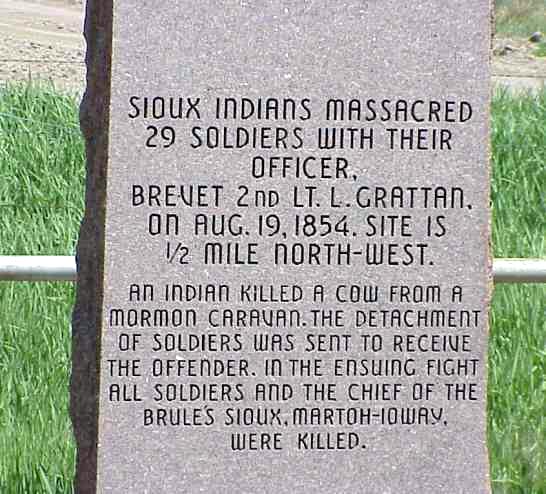
A small contingent of soldiers entered a large Sioux camp to apprehend an individual accused of killing a settler's cow, despite the fact that such issues were supposed to be resolved by the US Indian agent according to treaty agreements. After one of the soldiers fatally shot Chief Matȟó Wayúhi (Conquering Bear), the Sichangu Lakotas returned fire, resulting in the deaths of 29 soldiers, including Lieutenant John Grattan and a civilian interpreter.
From 1845–56, the Great Plains suffered a severe drought. Conditions of this drought dramatically reduced grass coverage, and Kiowa tribes recorded few to no bison on the Plains by the late 1840s. The lack of bison, in turn, caused hunger and starvation among the Plains American Indians. By 1853, U.S. Indian Agents noted, "many of the Cheyennes, Arapahoes, and Sioux, in a starving condition, on account of the scanty supply of buffalo[.]"
Late in summer of 1854, about 4,000 Sichangu and Oglala were camped east of Fort Laramie, in accordance with the terms of the Treaty of 1851. On August 17, a cow belonging to Mormon Christian J. Larsen (chaplain of the Hans P. Olsen Company of Danish immigrants) traveling on the nearby Oregon Trail, strayed and was killed by a visiting Miniconjou (Sioux) named High Forehead. Larsen barely noticed the incident in his journal, writing, "We passed a large encampment of Indians before we reached 'Fort Laramie'. They shot one of our cows, that was lame, and we let them have the meat. They also shot one, belonging to Hans Monsen, and it came into our camp, wounded, where we had it butchered."
Lt. Hugh Fleming, the senior officer of the small garrison, consulted with the chief, Matȟó Wayúhi, also known as Conquering Bear, to discuss the loss of livestock. Lt. Fleming was either unaware, or chose to ignore that these matters were supposed to be handled by the local Indian agent according to the terms of the Treaty of 1851. The Indian agent in this case was John Whitfield, who was due to arrive within days with annuities with which restitution could be made.
Despite knowing that the matter was not under the purview of the military, Conquering Bear still attempted to negotiate with Lt. Fleming, offering a horse from his personal herd or a cow from the tribe's herd; however, Larsen, the owner of the cow, reportedly persisted in demanding $25 instead. Lt. Fleming asked the Sioux to arrest High Forehead and deliver him to the fort, which Conquering Bear refused; he had no authority over the Miniconjou and did not want to violate his people's tradition of hospitality. The day's talk ended in stalemate.
On August 19, 1854, Second Lieutenant John Lawrence Grattan of the U.S. 6th Infantry Regiment, a recent graduate of West Point and supernumerary waiting for a vacancy in the regiment, led an armed detachment into the Indian encampment to take custody of High Forehead and bring him back to the fort. Grattan was inexperienced and described as contemptuous of the Lakotas' ability as warriors. This was his first (and only) encounter with the Sioux.
A commander at Laramie later recalled, "There is no doubt that Lt. Grattan left this post with a desire to have a fight with the Indians, and that he had determined to take the man at all hazards." In Grattan's party were a sergeant, a corporal, 27 privates, and a French-Indian interpreter named Lucien Auguste; the military forces had two artillery pieces in addition to arms.
Grattan massacre
The Grattan massacre, also referred to as the Grattan Fight, was the initial conflict of the First Sioux War, occurring on August 19, 1854, between the United States Army and the Lakota Sioux warriors. This event took place east of Fort Laramie, located in the Nebraska Territory, which is now part of Goshen County, Wyoming.
A small contingent of soldiers entered a large Sioux camp to apprehend an individual accused of killing a settler's cow, despite the fact that such issues were supposed to be resolved by the US Indian agent according to treaty agreements. After one of the soldiers fatally shot Chief Matȟó Wayúhi (Conquering Bear), the Sichangu Lakotas returned fire, resulting in the deaths of 29 soldiers, including Lieutenant John Grattan and a civilian interpreter.
From 1845–56, the Great Plains suffered a severe drought. Conditions of this drought dramatically reduced grass coverage, and Kiowa tribes recorded few to no bison on the Plains by the late 1840s. The lack of bison, in turn, caused hunger and starvation among the Plains American Indians. By 1853, U.S. Indian Agents noted, "many of the Cheyennes, Arapahoes, and Sioux, in a starving condition, on account of the scanty supply of buffalo[.]"
Late in summer of 1854, about 4,000 Sichangu and Oglala were camped east of Fort Laramie, in accordance with the terms of the Treaty of 1851. On August 17, a cow belonging to Mormon Christian J. Larsen (chaplain of the Hans P. Olsen Company of Danish immigrants) traveling on the nearby Oregon Trail, strayed and was killed by a visiting Miniconjou (Sioux) named High Forehead. Larsen barely noticed the incident in his journal, writing, "We passed a large encampment of Indians before we reached 'Fort Laramie'. They shot one of our cows, that was lame, and we let them have the meat. They also shot one, belonging to Hans Monsen, and it came into our camp, wounded, where we had it butchered."
Lt. Hugh Fleming, the senior officer of the small garrison, consulted with the chief, Matȟó Wayúhi, also known as Conquering Bear, to discuss the loss of livestock. Lt. Fleming was either unaware, or chose to ignore that these matters were supposed to be handled by the local Indian agent according to the terms of the Treaty of 1851. The Indian agent in this case was John Whitfield, who was due to arrive within days with annuities with which restitution could be made.
Despite knowing that the matter was not under the purview of the military, Conquering Bear still attempted to negotiate with Lt. Fleming, offering a horse from his personal herd or a cow from the tribe's herd; however, Larsen, the owner of the cow, reportedly persisted in demanding $25 instead. Lt. Fleming asked the Sioux to arrest High Forehead and deliver him to the fort, which Conquering Bear refused; he had no authority over the Miniconjou and did not want to violate his people's tradition of hospitality. The day's talk ended in stalemate.
On August 19, 1854, Second Lieutenant John Lawrence Grattan of the U.S. 6th Infantry Regiment, a recent graduate of West Point and supernumerary waiting for a vacancy in the regiment, led an armed detachment into the Indian encampment to take custody of High Forehead and bring him back to the fort. Grattan was inexperienced and described as contemptuous of the Lakotas' ability as warriors. This was his first (and only) encounter with the Sioux.
A commander at Laramie later recalled, "There is no doubt that Lt. Grattan left this post with a desire to have a fight with the Indians, and that he had determined to take the man at all hazards." In Grattan's party were a sergeant, a corporal, 27 privates, and a French-Indian interpreter named Lucien Auguste; the military forces had two artillery pieces in addition to arms.
Recent media
Recent media