
Recent from talks
Great Naktong Offensive
Knowledge base stats:
Talk channels stats:
Members stats:
Great Naktong Offensive
The Great Naktong Offensive was a North Korean military offensive against United Nations Command (UN) forces early in the Korean War, taking place from September 1–15, 1950. It was the North Korean Korean People's Army (KPA)'s unsuccessful final bid to break the Pusan Perimeter established by the UN forces.
For the first several months of the war, the KPA defeated and pushed back the UN forces south at each encounter. However, by August the UN troops (which were composed mostly of troops from the United States (US) and Republic of Korea Army (ROK) had been forced into the 140-mile (230 km) Pusan Perimeter on the southeast tip of the Korean peninsula. For the first time, the UN troops formed a continuous line which the KPA could neither flank nor overwhelm with superior numbers. KPA offensives on the perimeter were stalled and by the end of August all momentum was lost. Seeing the danger in a prolonged conflict along the perimeter, the KPA sought a massive offensive for September to collapse the UN line.
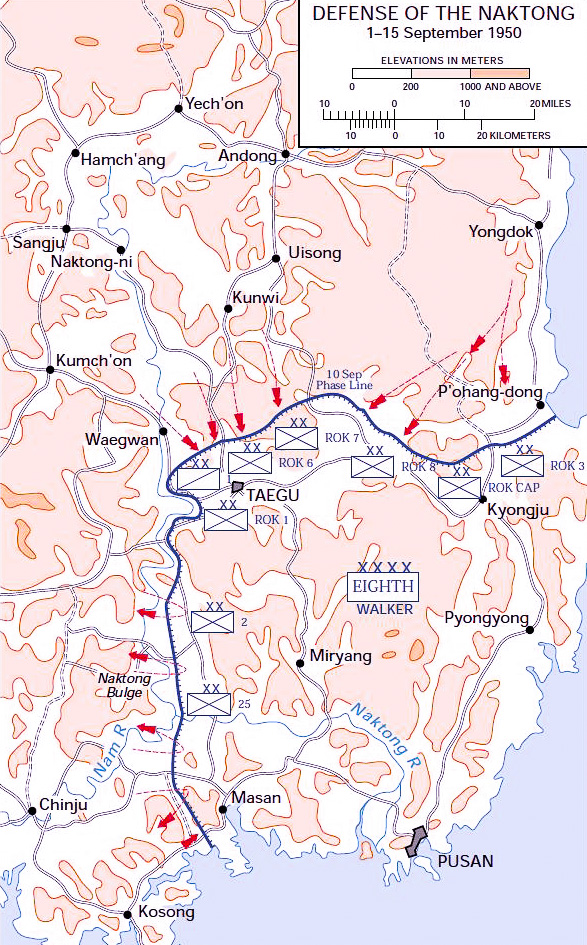
The KPA subsequently planned a simultaneous offensive for their entire army along five axes of the perimeter; and on September 1 intense fighting erupted around the cities of Masan, Kyongju, Taegu, Yongch'on and the Naktong Bulge. What followed was two weeks of extremely brutal fighting as the two sides vied to control the routes into Pusan. Initially successful in some areas, the KPA were unable to hold their gains against the numerically and technologically superior UN force. The KPA, again stalled at the failure of this offensive, was outflanked by the Inchon landings on 15 September and on 16 September the UN forces began their breakout from the Pusan Perimeter.
From the outbreak of the Korean War following the invasion of South Korea by the North in June 1950, the KPA had enjoyed superiority in both manpower and equipment over the ROK and the UN forces dispatched to South Korea to prevent it from collapsing. The North Korean strategy was to aggressively pursue UN forces on all avenues of approach south and to engage them, attacking from the front and initiating a double envelopment of both flanks of the unit, which allowed the KPA to surround and cut off the opposing force, which would then be forced to retreat in disarray, often leaving behind much of its equipment. From their initial June 25 offensive to fights in July and early August, the KPA used this strategy to effectively defeat any UN force and push it south. However, with the establishment of the Pusan Perimeter in August, the UN troops held a continuous line which the KPA could not flank, and their advantages in numbers decreased daily as the superior UN logistical system brought in more troops and supplies to the UN forces.
When the KPA approached the Pusan Perimeter on August 5, they attempted the same frontal assault technique on the four main avenues of approach into the perimeter. Throughout August, the KPA 6th Division, and later the 7th Division engaged the US 25th Infantry Division at the Battle of Masan, initially repelling a UN counteroffensive before attacking Komam-ni and Battle Mountain. These attacks stalled as UN forces, well equipped and with large standing units of reserves, repeatedly repelled KPA attacks. North of Masan, the KPA 4th Division and the US 24th Infantry Division sparred in the Naktong Bulge area. In the First Battle of Naktong Bulge, the KPA was unable to hold its bridgehead across the river as large numbers of US reserves were brought in to repel it, and on August 19, the KPA 4th Division was forced back across the river with 50 percent casualties. In the Taegu region, five KPA divisions were repulsed by three UN divisions in several attempts to attack the city during the Battle of Taegu. Particularly heavy fighting took place at the Battle of the Bowling Alley where the KPA 13th Division was almost completely destroyed in the attack. On the east coast, three more KPA divisions were repulsed by the ROK at P'ohang-dong during the Battle of P'ohang-dong. All along the front, the KPA were reeling from these defeats, the first time in the war their strategies were failing.
By the end of August the KPA had been pushed beyond their limits and many of the original units were at far reduced strength and effectiveness. Logistic problems racked the KPA, and shortages of food, weapons, equipment and replacement soldiers proved devastating for their units. By late August, the UN command had more combat soldiers in Korea than the North Koreans did, and UN superiority over the air and sea meant the North Koreans were at a disadvantage which was growing daily. KPA tank losses had been in the hundreds, and they had fewer than 100 tanks by the time of the Pusan Perimeter fight, to the Americans' 600 tanks. By the end of August the KPA's only remaining advantage was their initiative. However, their forces retained high morale and enough supply to allow for a large-scale offensive.
In planning its new offensive, the KPA command decided any attempt to flank the UN force was impossible thanks to the support of the UN naval forces. Instead, they opted to use a frontal attack to breach the perimeter and collapse it as the only hope of achieving success in the battle. Fed with intelligence from the Soviet Union the North Koreans were aware that the UN forces were building up along the Pusan Perimeter and that it must conduct an offensive soon or it could not win the battle. A secondary objective was to surround Taegu and destroy the UN units in that city. As part of this mission, the KPA would first cut the supply lines to Taegu.
North Korean planners enlarged the KPA force in anticipation of a new offensive. The KPA, originally numbering 10 divisions in two corps, was enlarged to 14 divisions with several independent brigades. The new troops were brought in from reserve forces from North Korea. Marshal Choe Yong Gun served as deputy commander of the KPA, with General Kim Chaek in charge of the Front Headquarters. Beneath them were the II Corps in the east, commanded by Lieutenant General Kim Mu Chong, and I Corps in the west, under Lieutenant General Kim Ung. II Corps controlled the 10th Division, 2nd Division, 4th Division, 9th Division, 7th Division, 6th Division and 105th Armored Division, with the 16th Armored Brigade and 104th Security Brigade in support. I Corps commanded the 3rd Division, 13th Division, 1st Division, 8th Division, 15th Division, 12th Division and 5th Division with the 17th Armored Brigade in support. This force numbered approximately 97,850 men, although a third of it comprised raw recruits, forced conscripts from South Korea, and lacked weapons and equipment. By August 31 they were facing a UN force of 120,000 combat troops plus 60,000 support troops.
Hub AI
Great Naktong Offensive AI simulator
(@Great Naktong Offensive_simulator)
Great Naktong Offensive
The Great Naktong Offensive was a North Korean military offensive against United Nations Command (UN) forces early in the Korean War, taking place from September 1–15, 1950. It was the North Korean Korean People's Army (KPA)'s unsuccessful final bid to break the Pusan Perimeter established by the UN forces.
For the first several months of the war, the KPA defeated and pushed back the UN forces south at each encounter. However, by August the UN troops (which were composed mostly of troops from the United States (US) and Republic of Korea Army (ROK) had been forced into the 140-mile (230 km) Pusan Perimeter on the southeast tip of the Korean peninsula. For the first time, the UN troops formed a continuous line which the KPA could neither flank nor overwhelm with superior numbers. KPA offensives on the perimeter were stalled and by the end of August all momentum was lost. Seeing the danger in a prolonged conflict along the perimeter, the KPA sought a massive offensive for September to collapse the UN line.
The KPA subsequently planned a simultaneous offensive for their entire army along five axes of the perimeter; and on September 1 intense fighting erupted around the cities of Masan, Kyongju, Taegu, Yongch'on and the Naktong Bulge. What followed was two weeks of extremely brutal fighting as the two sides vied to control the routes into Pusan. Initially successful in some areas, the KPA were unable to hold their gains against the numerically and technologically superior UN force. The KPA, again stalled at the failure of this offensive, was outflanked by the Inchon landings on 15 September and on 16 September the UN forces began their breakout from the Pusan Perimeter.
From the outbreak of the Korean War following the invasion of South Korea by the North in June 1950, the KPA had enjoyed superiority in both manpower and equipment over the ROK and the UN forces dispatched to South Korea to prevent it from collapsing. The North Korean strategy was to aggressively pursue UN forces on all avenues of approach south and to engage them, attacking from the front and initiating a double envelopment of both flanks of the unit, which allowed the KPA to surround and cut off the opposing force, which would then be forced to retreat in disarray, often leaving behind much of its equipment. From their initial June 25 offensive to fights in July and early August, the KPA used this strategy to effectively defeat any UN force and push it south. However, with the establishment of the Pusan Perimeter in August, the UN troops held a continuous line which the KPA could not flank, and their advantages in numbers decreased daily as the superior UN logistical system brought in more troops and supplies to the UN forces.
When the KPA approached the Pusan Perimeter on August 5, they attempted the same frontal assault technique on the four main avenues of approach into the perimeter. Throughout August, the KPA 6th Division, and later the 7th Division engaged the US 25th Infantry Division at the Battle of Masan, initially repelling a UN counteroffensive before attacking Komam-ni and Battle Mountain. These attacks stalled as UN forces, well equipped and with large standing units of reserves, repeatedly repelled KPA attacks. North of Masan, the KPA 4th Division and the US 24th Infantry Division sparred in the Naktong Bulge area. In the First Battle of Naktong Bulge, the KPA was unable to hold its bridgehead across the river as large numbers of US reserves were brought in to repel it, and on August 19, the KPA 4th Division was forced back across the river with 50 percent casualties. In the Taegu region, five KPA divisions were repulsed by three UN divisions in several attempts to attack the city during the Battle of Taegu. Particularly heavy fighting took place at the Battle of the Bowling Alley where the KPA 13th Division was almost completely destroyed in the attack. On the east coast, three more KPA divisions were repulsed by the ROK at P'ohang-dong during the Battle of P'ohang-dong. All along the front, the KPA were reeling from these defeats, the first time in the war their strategies were failing.
By the end of August the KPA had been pushed beyond their limits and many of the original units were at far reduced strength and effectiveness. Logistic problems racked the KPA, and shortages of food, weapons, equipment and replacement soldiers proved devastating for their units. By late August, the UN command had more combat soldiers in Korea than the North Koreans did, and UN superiority over the air and sea meant the North Koreans were at a disadvantage which was growing daily. KPA tank losses had been in the hundreds, and they had fewer than 100 tanks by the time of the Pusan Perimeter fight, to the Americans' 600 tanks. By the end of August the KPA's only remaining advantage was their initiative. However, their forces retained high morale and enough supply to allow for a large-scale offensive.
In planning its new offensive, the KPA command decided any attempt to flank the UN force was impossible thanks to the support of the UN naval forces. Instead, they opted to use a frontal attack to breach the perimeter and collapse it as the only hope of achieving success in the battle. Fed with intelligence from the Soviet Union the North Koreans were aware that the UN forces were building up along the Pusan Perimeter and that it must conduct an offensive soon or it could not win the battle. A secondary objective was to surround Taegu and destroy the UN units in that city. As part of this mission, the KPA would first cut the supply lines to Taegu.
North Korean planners enlarged the KPA force in anticipation of a new offensive. The KPA, originally numbering 10 divisions in two corps, was enlarged to 14 divisions with several independent brigades. The new troops were brought in from reserve forces from North Korea. Marshal Choe Yong Gun served as deputy commander of the KPA, with General Kim Chaek in charge of the Front Headquarters. Beneath them were the II Corps in the east, commanded by Lieutenant General Kim Mu Chong, and I Corps in the west, under Lieutenant General Kim Ung. II Corps controlled the 10th Division, 2nd Division, 4th Division, 9th Division, 7th Division, 6th Division and 105th Armored Division, with the 16th Armored Brigade and 104th Security Brigade in support. I Corps commanded the 3rd Division, 13th Division, 1st Division, 8th Division, 15th Division, 12th Division and 5th Division with the 17th Armored Brigade in support. This force numbered approximately 97,850 men, although a third of it comprised raw recruits, forced conscripts from South Korea, and lacked weapons and equipment. By August 31 they were facing a UN force of 120,000 combat troops plus 60,000 support troops.
Recent media