



Recent from talks
Knowledge base stats:
Talk channels stats:
Members stats:
Great Recycling and Northern Development Canal
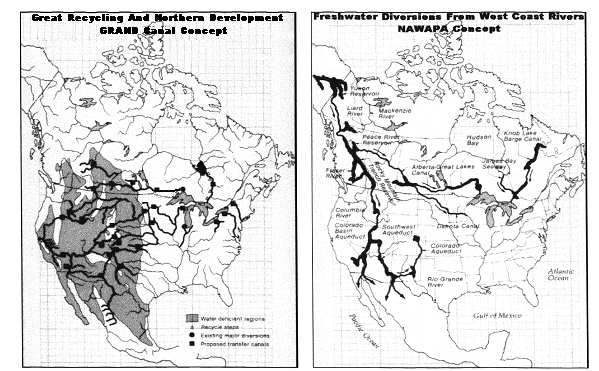
The Great Recycling and Northern Development Canal or GRAND Canal is a water management proposal designed by Newfoundland engineer Thomas Kierans to alleviate North American freshwater shortage problems. It proposed damming James Bay, using the techniques of the Zuiderzee/IJsselmeer, to prevent its waters mixing with the salt water of Hudson Bay to the north. This would produce an enormous freshwater lake, some of which would be pumped south into Georgian Bay where it would increase the freshwater levels of the lower Great Lakes. The flow would be roughly equivalent to "2.5 Niagara Falls".
The plan was promoted by Kierans from 1959 until his death in 2013 and since by his son, Michael Kierans. This plan arose as water quality issues threatened the Great Lakes and other vital areas in Canada and the United States. Kierans proposed that to avoid a water crisis from future droughts in Canada and the United States, in addition to water conservation, acceptable new fresh water sources had to be found.
During the 1960s and again in the 1980s when Great Lake water levels declined dramatically, there was interest in the GRAND Canal. However, the reluctance of the US and Canadian governments to enter into large scale co-operative international water sharing arrangements and claims of potential negative environmental impact of the proposal have prevented serious consideration of the idea.
In 1959, Canada officially claimed that U.S. expansion of a Chicago diversion from Lake Michigan would harm downstream Canadian areas in the Great Lakes Basin.
The Canadian government further stated that exhaustive studies had indicated no additional sources of freshwater were available in Canada to replace the waters that would be removed from the Great Lakes by the proposed diversion. Kierans disputed the accuracy of the 1959 Canadian government's position and asserted that the GRAND Canal could provide additional fresh water to the Great Lakes.
Waters from the Ogoki River and Longlac are now being diverted into the Great Lakes at a rate equivalent to that taken by the U.S. at the Chicago diversion.
In his proposal, Kierans asserts that experience in the Netherlands demonstrates that a large new freshwater source can be created in Canada's James Bay by collecting runoff from many adjacent river basins in a sea level, outflow-only dyke-enclosure. The project would capture and make available for recycling the entire outflows of the La Grande, Eastmain, Rupert, Broadback, Nottaway, Harricana, Moose, Albany, Kapiskau, Attawapiskat and Ekwan rivers. Moreover, Kierans claims that the California Aqueduct proves that runoff to James Bay can be beneficially recycled long distances and over high elevations via the GRAND Canal. The GRAND Canal would stabilize water levels in the Great Lakes and St. Lawrence River and improve water quality. The GRAND Canal system would also deliver new fresh water from the James Bay dyke-enclosure, via the Great Lakes, to many water deficit areas in Canada and the United States. The project was estimated in 1994 to cost C$100 billion to build and a further C$1 billion annually to operate, involving a string of nuclear reactors and hydroelectric dams to pump water uphill and into other water basins.
Kierans argues recycling runoff from a dike-enclosure in Canada's James Bay is not harmful and can bring both nations many useful benefits including:
Hub AI
Great Recycling and Northern Development Canal AI simulator
(@Great Recycling and Northern Development Canal_simulator)
Great Recycling and Northern Development Canal
The Great Recycling and Northern Development Canal or GRAND Canal is a water management proposal designed by Newfoundland engineer Thomas Kierans to alleviate North American freshwater shortage problems. It proposed damming James Bay, using the techniques of the Zuiderzee/IJsselmeer, to prevent its waters mixing with the salt water of Hudson Bay to the north. This would produce an enormous freshwater lake, some of which would be pumped south into Georgian Bay where it would increase the freshwater levels of the lower Great Lakes. The flow would be roughly equivalent to "2.5 Niagara Falls".
The plan was promoted by Kierans from 1959 until his death in 2013 and since by his son, Michael Kierans. This plan arose as water quality issues threatened the Great Lakes and other vital areas in Canada and the United States. Kierans proposed that to avoid a water crisis from future droughts in Canada and the United States, in addition to water conservation, acceptable new fresh water sources had to be found.
During the 1960s and again in the 1980s when Great Lake water levels declined dramatically, there was interest in the GRAND Canal. However, the reluctance of the US and Canadian governments to enter into large scale co-operative international water sharing arrangements and claims of potential negative environmental impact of the proposal have prevented serious consideration of the idea.
In 1959, Canada officially claimed that U.S. expansion of a Chicago diversion from Lake Michigan would harm downstream Canadian areas in the Great Lakes Basin.
The Canadian government further stated that exhaustive studies had indicated no additional sources of freshwater were available in Canada to replace the waters that would be removed from the Great Lakes by the proposed diversion. Kierans disputed the accuracy of the 1959 Canadian government's position and asserted that the GRAND Canal could provide additional fresh water to the Great Lakes.
Waters from the Ogoki River and Longlac are now being diverted into the Great Lakes at a rate equivalent to that taken by the U.S. at the Chicago diversion.
In his proposal, Kierans asserts that experience in the Netherlands demonstrates that a large new freshwater source can be created in Canada's James Bay by collecting runoff from many adjacent river basins in a sea level, outflow-only dyke-enclosure. The project would capture and make available for recycling the entire outflows of the La Grande, Eastmain, Rupert, Broadback, Nottaway, Harricana, Moose, Albany, Kapiskau, Attawapiskat and Ekwan rivers. Moreover, Kierans claims that the California Aqueduct proves that runoff to James Bay can be beneficially recycled long distances and over high elevations via the GRAND Canal. The GRAND Canal would stabilize water levels in the Great Lakes and St. Lawrence River and improve water quality. The GRAND Canal system would also deliver new fresh water from the James Bay dyke-enclosure, via the Great Lakes, to many water deficit areas in Canada and the United States. The project was estimated in 1994 to cost C$100 billion to build and a further C$1 billion annually to operate, involving a string of nuclear reactors and hydroelectric dams to pump water uphill and into other water basins.
Kierans argues recycling runoff from a dike-enclosure in Canada's James Bay is not harmful and can bring both nations many useful benefits including: