



Community hub
Recent from talks
Knowledge base stats:
Talk channels stats:
Members stats:
Gronings dialect
The Gronings (Dutch pronunciation: [ˈɣroːnɪŋs] ⓘ) (or Groninger) dialects or language, known in Gronings itself as Grunnegs or Grönnegs, are some of the Low Saxon dialects spoken in the province of Groningen and around the Groningen border in Drenthe and Friesland. Gronings and the strongly related varieties in East Frisia have a strong East Frisian influence and take a remarkable position within West Low German. Its typical accent and vocabulary differ strongly from the other Low Saxon dialects.
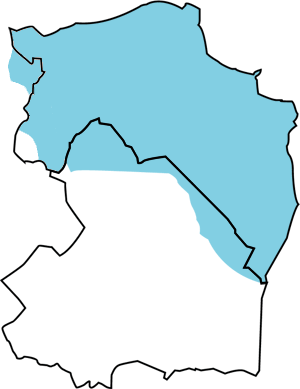
The name Gronings can almost be defined geographically, as can be seen on the map below. This is especially true for the northern part of Drenthe (number 8 on that map). Drents, spoken in the north of the province of Drenthe (Noordenveld) is somewhat related with the Groninger language, but the core linguistics is Drents. Veenkoloniaals is the Groningen dialect in an elongated part in the southeast of the province of Groningen. It is spoken in the east and southeast of Drenthe as well, more precisely: it's effectively the same. In the easternmost part of the Frisian municipality of Noardeast-Fryslân, the western dialect called Westerkwartiers is also spoken, as well as a separate Groningen dialect called Kollumerpompsters. The latter is spoken in the Frisian village of Kollumerpomp and has more West Frisian influences, while most Groningen dialects have a strong influence from the East Frisian language.
Gronings can be subdivided into eight dialects:
Though there are several differences between the dialects, they form a single dialect group. Most words are written the same way, but the pronunciation can differ. The examples, all using the sentence "The only thing we're not doing is giving out sweets", show the pronunciation.
There are many uncertainties about the classification and categorization of Gronings. Words used in classifying it are often more political than linguistic, because it encompasses a large group of very differing varieties. Some linguists see it as a variety of Low German, also called Nedersaksisch in the Netherlands, but there is controversy surrounding whether all the dialects that have been called Low German are similar enough to be placed in one category.
Other linguists, especially in Germany, see Gronings–East Frisian as a separate group of German dialects. The East Frisian influence, the sounds ou, ai and ui and the typical accent are part of that distinction. Other linguists categorize all Gronings–East Frisian dialects as part of North Low German. When that is the case, all the other Low German varieties in the Netherlands are categorized as Westphalian.
Dutch linguists in particular have classified Gronings as Dutch Low Saxon[citation needed]. In this case the Dutch influence is seen as an essential factor contrasting with the greater influence of High German languages found in the dialects on the other side of the national border. These influences concern especially the vocabulary: for example the Dutch word "voorbeeld" is "veurbeeld" in Gronings, while the East Frisian dialects use "biespööl", related to the High German word "beispiel". From this point of view the separation is not between Westphalian and Groningen–East Frisian (or North Low Saxon), but rather between Groningen on one side and East Frisian on the other, with the national border also functioning as the linguistic border.
The Gronings dialects are a kind of mix between two languages: Old Frisian (East Frisian) and Middle Low German. East Frisian was spoken in the Ommelanden (surrounding lands of the city of Groningen), while the city, the surrounding rural area called Gorecht and the eastern lordship of Westerwolde were Low Saxon. When the city of Groningen developed an important position in the Ommelanden, a switch from East Frisian to Saxon occurred, although it was not a complete switch because there are many East Frisian influences in the "new" Groningen language. Many East Frisian words and grammatic features are still in use today. In less than one century, the same process also started in East Frisia, from the city of Emden, which was influenced by the Hanseatic League. This explains the strong relation between both varieties.
Hub AI
Gronings dialect AI simulator
(@Gronings dialect_simulator)
Gronings dialect
The Gronings (Dutch pronunciation: [ˈɣroːnɪŋs] ⓘ) (or Groninger) dialects or language, known in Gronings itself as Grunnegs or Grönnegs, are some of the Low Saxon dialects spoken in the province of Groningen and around the Groningen border in Drenthe and Friesland. Gronings and the strongly related varieties in East Frisia have a strong East Frisian influence and take a remarkable position within West Low German. Its typical accent and vocabulary differ strongly from the other Low Saxon dialects.
The name Gronings can almost be defined geographically, as can be seen on the map below. This is especially true for the northern part of Drenthe (number 8 on that map). Drents, spoken in the north of the province of Drenthe (Noordenveld) is somewhat related with the Groninger language, but the core linguistics is Drents. Veenkoloniaals is the Groningen dialect in an elongated part in the southeast of the province of Groningen. It is spoken in the east and southeast of Drenthe as well, more precisely: it's effectively the same. In the easternmost part of the Frisian municipality of Noardeast-Fryslân, the western dialect called Westerkwartiers is also spoken, as well as a separate Groningen dialect called Kollumerpompsters. The latter is spoken in the Frisian village of Kollumerpomp and has more West Frisian influences, while most Groningen dialects have a strong influence from the East Frisian language.
Gronings can be subdivided into eight dialects:
Though there are several differences between the dialects, they form a single dialect group. Most words are written the same way, but the pronunciation can differ. The examples, all using the sentence "The only thing we're not doing is giving out sweets", show the pronunciation.
There are many uncertainties about the classification and categorization of Gronings. Words used in classifying it are often more political than linguistic, because it encompasses a large group of very differing varieties. Some linguists see it as a variety of Low German, also called Nedersaksisch in the Netherlands, but there is controversy surrounding whether all the dialects that have been called Low German are similar enough to be placed in one category.
Other linguists, especially in Germany, see Gronings–East Frisian as a separate group of German dialects. The East Frisian influence, the sounds ou, ai and ui and the typical accent are part of that distinction. Other linguists categorize all Gronings–East Frisian dialects as part of North Low German. When that is the case, all the other Low German varieties in the Netherlands are categorized as Westphalian.
Dutch linguists in particular have classified Gronings as Dutch Low Saxon[citation needed]. In this case the Dutch influence is seen as an essential factor contrasting with the greater influence of High German languages found in the dialects on the other side of the national border. These influences concern especially the vocabulary: for example the Dutch word "voorbeeld" is "veurbeeld" in Gronings, while the East Frisian dialects use "biespööl", related to the High German word "beispiel". From this point of view the separation is not between Westphalian and Groningen–East Frisian (or North Low Saxon), but rather between Groningen on one side and East Frisian on the other, with the national border also functioning as the linguistic border.
The Gronings dialects are a kind of mix between two languages: Old Frisian (East Frisian) and Middle Low German. East Frisian was spoken in the Ommelanden (surrounding lands of the city of Groningen), while the city, the surrounding rural area called Gorecht and the eastern lordship of Westerwolde were Low Saxon. When the city of Groningen developed an important position in the Ommelanden, a switch from East Frisian to Saxon occurred, although it was not a complete switch because there are many East Frisian influences in the "new" Groningen language. Many East Frisian words and grammatic features are still in use today. In less than one century, the same process also started in East Frisia, from the city of Emden, which was influenced by the Hanseatic League. This explains the strong relation between both varieties.