
Recent from talks
West Frisian language
Knowledge base stats:
Talk channels stats:
Members stats:
West Frisian language
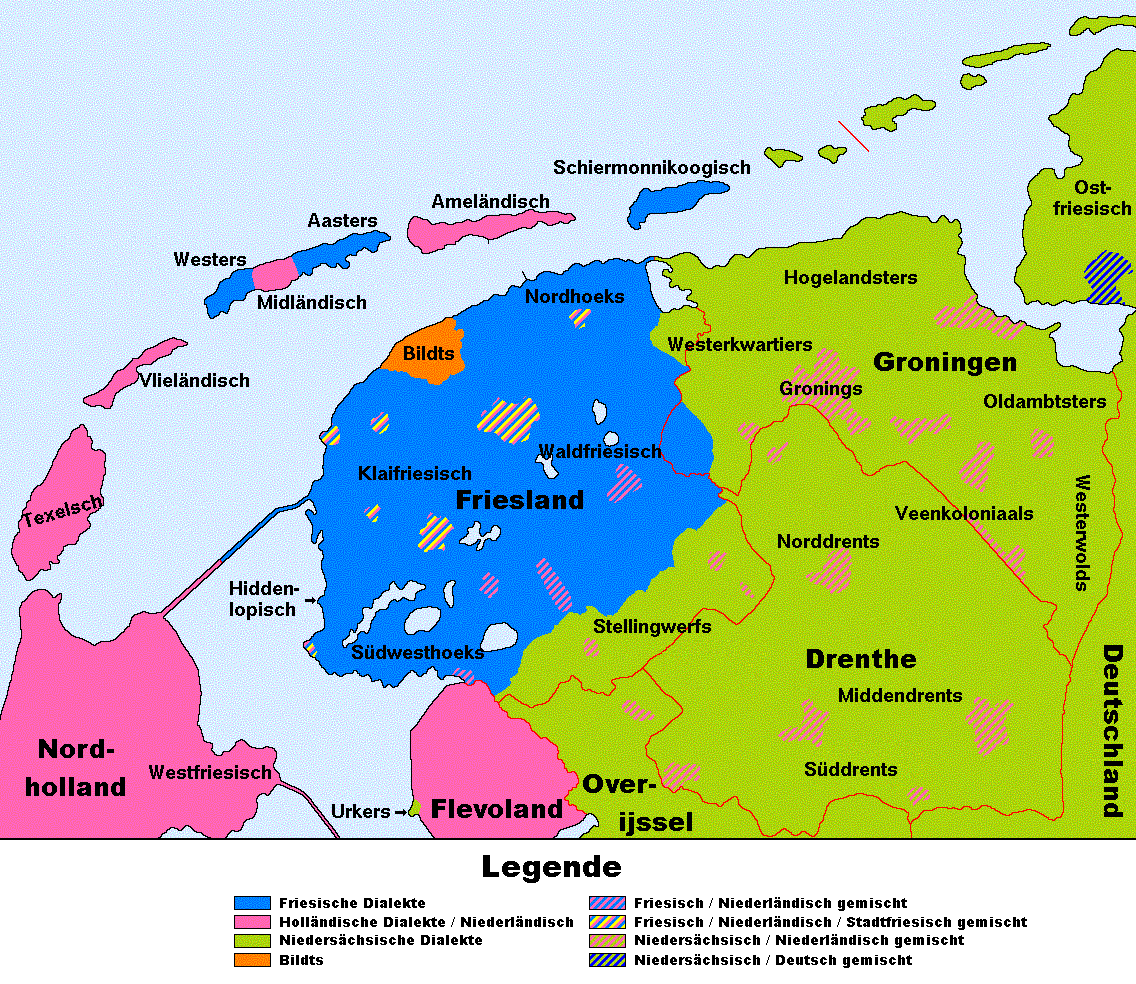
West Frisian (Westerlauwersk Frysk; Dutch: Westerlauwers Fries),[needs IPA] or simply Frisian (Frysk [frisk]; Dutch: Fries [fris]), is a West Germanic language spoken mostly in the province of Friesland (Fryslân) in the north of the Netherlands, mostly by those of Frisian ancestry. It is the most widely spoken of the Frisian languages.
In the study of the evolution of English, West Frisian is notable as being the most closely related foreign tongue to the various dialects of Old English spoken across the Heptarchy, these being part of the Anglo-Frisian branch of the West Germanic family.
The name "West Frisian" is used only outside the Netherlands, to distinguish this language from the closely related Frisian languages of East Frisian, including Saterland Frisian, and North Frisian spoken in Germany. Within the Netherlands, however, "West Frisian" refers to the West Frisian dialect of the Dutch language while the West Frisian language is almost always just called "Frisian" (in Dutch: Fries for the Frisian language and Westfries for the Dutch dialect). The unambiguous name used for the West Frisian language by linguists in the Netherlands is Westerlauwers Fries [ˈʋɛstərˌlʌu.ərs ˈfris] (West Lauwers Frisian), the Lauwers being a border river that separates the Dutch provinces of Friesland and Groningen.
In the early Middle Ages, the Frisian lands stretched from the area around Bruges, in what is now Belgium, to the river Weser, in northern Germany. At that time, the Frisian language was spoken along the entire southern North Sea coast. Today this region is sometimes referred to as "Greater Frisia" or Frisia Magna, and many of the areas within it still treasure their Frisian heritage, even though in most places the Frisian language has been lost.
Old Frisian bore a striking similarity to Old English. This similarity was reinforced in the late Middle Ages by the Ingvaeonic sound shift, which affected Frisian and English, but the other West Germanic varieties hardly at all. Both English and Frisian are marked by the suppression of the Germanic nasal in a word like us (ús), soft (sêft) or goose (goes): see Ingvaeonic nasal spirant law. Also, when followed by some vowels, the Germanic k developed into a ch sound. For example, the West Frisian for cheese and church is tsiis and tsjerke, whereas in Dutch they are kaas and kerk. Modern English and Frisian on the other hand have become very divergent, largely due to wholesale Old Norse and Anglo-Norman imports into English and similarly heavy Dutch and Low German influences on Frisian.
One major difference between Old Frisian and modern Frisian is that in the Old Frisian period (c. 1150 – c. 1550) grammatical cases still occurred. Some of the texts that are preserved from this period are from the 12th or 13th, but most are from the 14th and 15th centuries. Generally, these texts are restricted to legal documents. Although the earliest definite written examples of Frisian are from approximately the 9th century, there are a few runic inscriptions from the region which are probably older and possibly in the Frisian language. These runic writings, however, usually do not amount to more than single- or few-word inscriptions, and cannot be said to constitute literature as such. The Middle Frisian language period (c. 1550 – c. 1820) is rooted in geopolitics and the consequent fairly abrupt halt in the use of Frisian as a written language.
Until the 16th century, West Frisian was widely spoken and written, but from 1500 onwards it became an almost exclusively oral language, mainly used in rural areas. This was in part due to the occupation of its stronghold, the Dutch province of Friesland (Fryslân), in 1498, by Albert III, Duke of Saxony, who replaced West Frisian as the language of government with Dutch.
This practice was continued under the Habsburg rulers of the Netherlands (Charles V, Holy Roman Emperor, and his son Philip II, King of Spain). When the Netherlands became independent in 1585, West Frisian did not regain its former status, because Holland rose as the dominant part of the Netherlands and its language, Dutch, as the dominant language in judicial, administrative and religious affairs.
Hub AI
West Frisian language AI simulator
(@West Frisian language_simulator)
West Frisian language
West Frisian (Westerlauwersk Frysk; Dutch: Westerlauwers Fries),[needs IPA] or simply Frisian (Frysk [frisk]; Dutch: Fries [fris]), is a West Germanic language spoken mostly in the province of Friesland (Fryslân) in the north of the Netherlands, mostly by those of Frisian ancestry. It is the most widely spoken of the Frisian languages.
In the study of the evolution of English, West Frisian is notable as being the most closely related foreign tongue to the various dialects of Old English spoken across the Heptarchy, these being part of the Anglo-Frisian branch of the West Germanic family.
The name "West Frisian" is used only outside the Netherlands, to distinguish this language from the closely related Frisian languages of East Frisian, including Saterland Frisian, and North Frisian spoken in Germany. Within the Netherlands, however, "West Frisian" refers to the West Frisian dialect of the Dutch language while the West Frisian language is almost always just called "Frisian" (in Dutch: Fries for the Frisian language and Westfries for the Dutch dialect). The unambiguous name used for the West Frisian language by linguists in the Netherlands is Westerlauwers Fries [ˈʋɛstərˌlʌu.ərs ˈfris] (West Lauwers Frisian), the Lauwers being a border river that separates the Dutch provinces of Friesland and Groningen.
In the early Middle Ages, the Frisian lands stretched from the area around Bruges, in what is now Belgium, to the river Weser, in northern Germany. At that time, the Frisian language was spoken along the entire southern North Sea coast. Today this region is sometimes referred to as "Greater Frisia" or Frisia Magna, and many of the areas within it still treasure their Frisian heritage, even though in most places the Frisian language has been lost.
Old Frisian bore a striking similarity to Old English. This similarity was reinforced in the late Middle Ages by the Ingvaeonic sound shift, which affected Frisian and English, but the other West Germanic varieties hardly at all. Both English and Frisian are marked by the suppression of the Germanic nasal in a word like us (ús), soft (sêft) or goose (goes): see Ingvaeonic nasal spirant law. Also, when followed by some vowels, the Germanic k developed into a ch sound. For example, the West Frisian for cheese and church is tsiis and tsjerke, whereas in Dutch they are kaas and kerk. Modern English and Frisian on the other hand have become very divergent, largely due to wholesale Old Norse and Anglo-Norman imports into English and similarly heavy Dutch and Low German influences on Frisian.
One major difference between Old Frisian and modern Frisian is that in the Old Frisian period (c. 1150 – c. 1550) grammatical cases still occurred. Some of the texts that are preserved from this period are from the 12th or 13th, but most are from the 14th and 15th centuries. Generally, these texts are restricted to legal documents. Although the earliest definite written examples of Frisian are from approximately the 9th century, there are a few runic inscriptions from the region which are probably older and possibly in the Frisian language. These runic writings, however, usually do not amount to more than single- or few-word inscriptions, and cannot be said to constitute literature as such. The Middle Frisian language period (c. 1550 – c. 1820) is rooted in geopolitics and the consequent fairly abrupt halt in the use of Frisian as a written language.
Until the 16th century, West Frisian was widely spoken and written, but from 1500 onwards it became an almost exclusively oral language, mainly used in rural areas. This was in part due to the occupation of its stronghold, the Dutch province of Friesland (Fryslân), in 1498, by Albert III, Duke of Saxony, who replaced West Frisian as the language of government with Dutch.
This practice was continued under the Habsburg rulers of the Netherlands (Charles V, Holy Roman Emperor, and his son Philip II, King of Spain). When the Netherlands became independent in 1585, West Frisian did not regain its former status, because Holland rose as the dominant part of the Netherlands and its language, Dutch, as the dominant language in judicial, administrative and religious affairs.
Recent media