



Community hub
Recent from talks
Knowledge base stats:
Talk channels stats:
Members stats:
Guadix
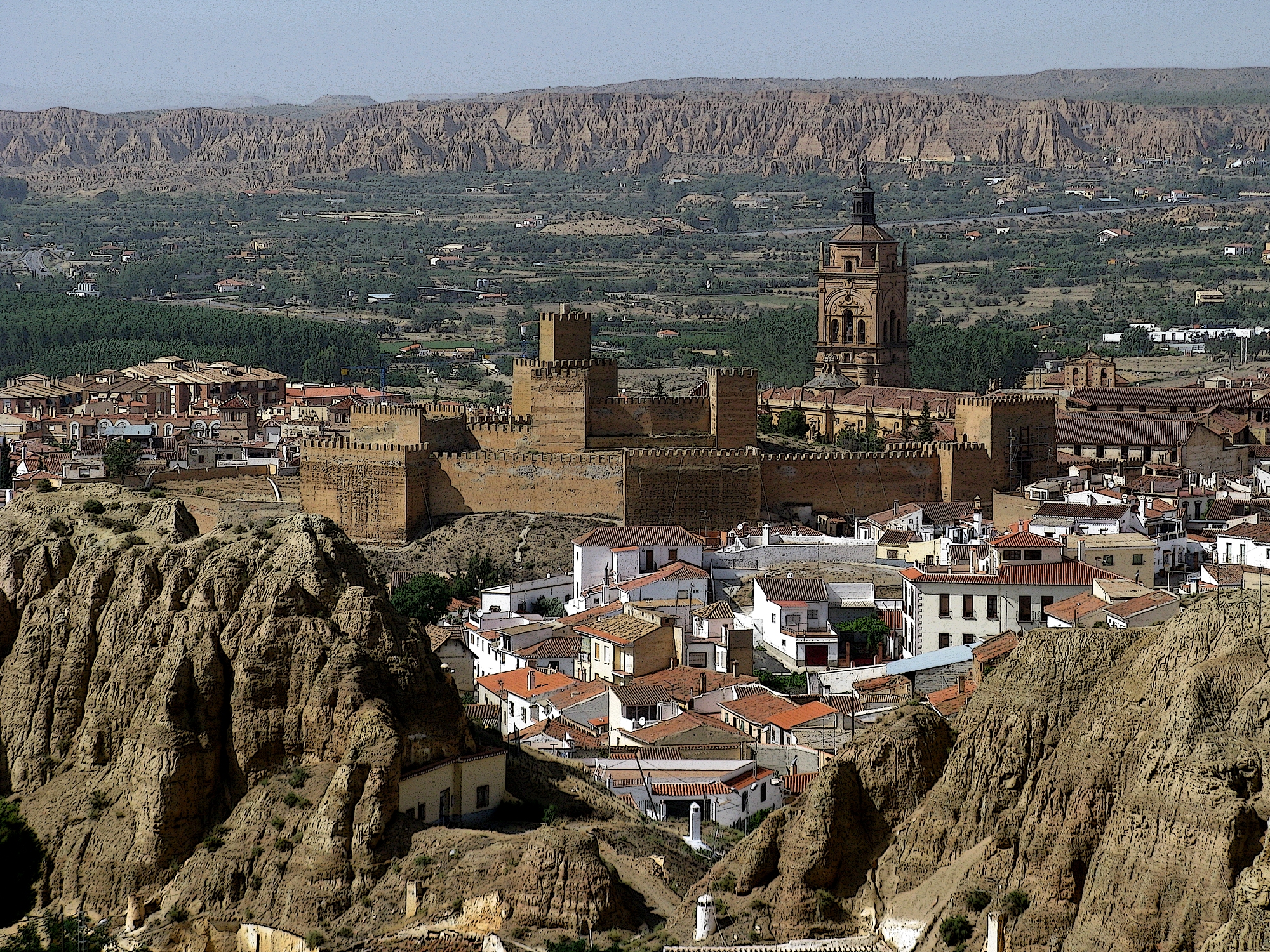
Guadix (Spanish pronunciation: [ɡwaˈðiks], locally [waˈðih]) is a city and municipality in southern Spain, in the province of Granada.
The city lies at an altitude of 913 metres, in the centre of the Hoya of Guadix, a high plain at the northern foothills of the Sierra Nevada. It is located on the Linares Baeza–Almería railway. The city was built in the vicinity of gullies and badlands.
Evidence of human settlement in the area surrounding Guadix goes back to at least the Bronze Age.
Guadix el Viejo, 6 km northwest, was the Roman Acci (also Accitum) mentioned in Pliny's Natural History and as Akki by Ptolemy, who placed it among the Bastetani, whose capital was Basti. It is not known for certain whether it is of Phoenician or of early Spanish origin. The existence of an oppidum with a well-defined urban plan from the 6th century BC has been documented; archeological excavations have revealed complex spaces with straight walls and red adobe floors. Kilns and silos have also been found, demonstrating a high level of development in the settlement. Throughout the Iberian era, there was a shift in planning regarding the construction methods and the alignment of residences. The importance of craftsmanship and industry in the area has been shown by the discovery of what might be an oil press below Calle Palacio. Excavations at Cine Acci have uncovered a slate dwelling from the 5th century BC.
According to Macrobius, the primitive inhabitants paid homage to Mars under the name of Neton. Julius Caesar established the Roman colony called Julia Gemella. According to tradition, it was the seat of the first bishopric in Hispania, in the 2nd century.
Roman coins were minted at Julia Gemella, and the settlement continued to be an important centre of commerce, leaving artifacts such as the Pedestal of Isis, as well as the ruins of a Roman theatre. In addition, a network of sewers, galleries and water conduits have been uncovered in the city, as well as the possible remains of a Roman temple.
Acci would have enjoyed the benefits of the Ius Italicum, which would have favoured social and economic development.
The fall of the Western Roman Empire negatively influenced the status of Acci, whose population may have in large part moved to rural areas, and the city is known to have been one of the first in the Iberian Peninsula to adopt Catholicism. Few remains have been found dating from the IV to the XI century.
Hub AI
Guadix AI simulator
(@Guadix_simulator)
Guadix
Guadix (Spanish pronunciation: [ɡwaˈðiks], locally [waˈðih]) is a city and municipality in southern Spain, in the province of Granada.
The city lies at an altitude of 913 metres, in the centre of the Hoya of Guadix, a high plain at the northern foothills of the Sierra Nevada. It is located on the Linares Baeza–Almería railway. The city was built in the vicinity of gullies and badlands.
Evidence of human settlement in the area surrounding Guadix goes back to at least the Bronze Age.
Guadix el Viejo, 6 km northwest, was the Roman Acci (also Accitum) mentioned in Pliny's Natural History and as Akki by Ptolemy, who placed it among the Bastetani, whose capital was Basti. It is not known for certain whether it is of Phoenician or of early Spanish origin. The existence of an oppidum with a well-defined urban plan from the 6th century BC has been documented; archeological excavations have revealed complex spaces with straight walls and red adobe floors. Kilns and silos have also been found, demonstrating a high level of development in the settlement. Throughout the Iberian era, there was a shift in planning regarding the construction methods and the alignment of residences. The importance of craftsmanship and industry in the area has been shown by the discovery of what might be an oil press below Calle Palacio. Excavations at Cine Acci have uncovered a slate dwelling from the 5th century BC.
According to Macrobius, the primitive inhabitants paid homage to Mars under the name of Neton. Julius Caesar established the Roman colony called Julia Gemella. According to tradition, it was the seat of the first bishopric in Hispania, in the 2nd century.
Roman coins were minted at Julia Gemella, and the settlement continued to be an important centre of commerce, leaving artifacts such as the Pedestal of Isis, as well as the ruins of a Roman theatre. In addition, a network of sewers, galleries and water conduits have been uncovered in the city, as well as the possible remains of a Roman temple.
Acci would have enjoyed the benefits of the Ius Italicum, which would have favoured social and economic development.
The fall of the Western Roman Empire negatively influenced the status of Acci, whose population may have in large part moved to rural areas, and the city is known to have been one of the first in the Iberian Peninsula to adopt Catholicism. Few remains have been found dating from the IV to the XI century.