



Community hub
Recent from talks
Knowledge base stats:
Talk channels stats:
Members stats:
Guajeo
A guajeo (Spanish pronunciation: [ɡwaˈxe.o]) is a typical Cuban ostinato melody, most often consisting of arpeggiated chords in syncopated patterns. Some musicians only use the term guajeo for ostinato patterns played specifically by a tres, piano, an instrument of the violin family, or saxophones. Piano guajeos are one of the most recognizable elements of modern-day salsa. Piano guajeos are also known as montunos in North America, or tumbaos in the contemporary Cuban dance music timba.
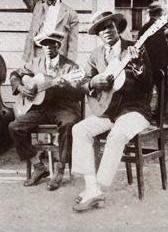
The guajeo shares rhythmic, melodic and harmonic similarities with the short ostinato figures played on marimbas, lamellophones, and string instruments in sub-Saharan Africa. The guajeo is a seamless blend of African and European musical sensibilities, and was first played as accompaniment on the tres in the Afro-Cuban son and related music. The tres is a Cuban guitar-like instrument, consisting of three sets of double strings.
The guajeo emerged in Cuba during the 19th century, in the genres known as changüí and son. The following changüí tres guajeo consists of all offbeats.
There are two types of pure son tres guajeos: generic and song-specific. Song-specific guajeos are usually based on the song's melody, while the generic type involves simply arpeggiating triads—Moore (2010).
The rhythmic pattern of the following "generic" guajeo is used in many different songs. Note that the first measure consists of all offbeats. The figure can begin in the first measure, or the second measure, depending upon the structure of the song.
In the late 1930s Arsenio Rodríguez took the pivotal step of replacing the guitar with the piano in the son conjunto. The piano has ever since, been a staple of Cuban popular music, and its "offspring" salsa.
"Como traigo la yuca", popularly called "Dile a Catalina", may be Arsenio's most famous composition. The first half uses the changüí/son method of paraphrasing the vocal melody, but the second half strikes out into bold new territory – using contrapuntal material not based on the song's melody and employing a cross‐rhythm based on sequences of three ascending notes—Moore (2011: 39).
Most guajeos have a binary structure, with a specific alignment to the guide pattern known as clave. As Kevin Moore explains: "There are two common ways that the three-side is expressed in Cuban popular music. The first to come into regular use, which David Peñalosa calls 'clave motif,' is based on the decorated version of the three-side of the clave rhythm." The following guajeo example is based on a clave motif. The three-side (first measure) consists of the tresillo variant known as cinquillo. Because the chord progression begins on the three-side, this guajeo is said to be in a three-two clave sequence.
Hub AI
Guajeo AI simulator
(@Guajeo_simulator)
Guajeo
A guajeo (Spanish pronunciation: [ɡwaˈxe.o]) is a typical Cuban ostinato melody, most often consisting of arpeggiated chords in syncopated patterns. Some musicians only use the term guajeo for ostinato patterns played specifically by a tres, piano, an instrument of the violin family, or saxophones. Piano guajeos are one of the most recognizable elements of modern-day salsa. Piano guajeos are also known as montunos in North America, or tumbaos in the contemporary Cuban dance music timba.
The guajeo shares rhythmic, melodic and harmonic similarities with the short ostinato figures played on marimbas, lamellophones, and string instruments in sub-Saharan Africa. The guajeo is a seamless blend of African and European musical sensibilities, and was first played as accompaniment on the tres in the Afro-Cuban son and related music. The tres is a Cuban guitar-like instrument, consisting of three sets of double strings.
The guajeo emerged in Cuba during the 19th century, in the genres known as changüí and son. The following changüí tres guajeo consists of all offbeats.
There are two types of pure son tres guajeos: generic and song-specific. Song-specific guajeos are usually based on the song's melody, while the generic type involves simply arpeggiating triads—Moore (2010).
The rhythmic pattern of the following "generic" guajeo is used in many different songs. Note that the first measure consists of all offbeats. The figure can begin in the first measure, or the second measure, depending upon the structure of the song.
In the late 1930s Arsenio Rodríguez took the pivotal step of replacing the guitar with the piano in the son conjunto. The piano has ever since, been a staple of Cuban popular music, and its "offspring" salsa.
"Como traigo la yuca", popularly called "Dile a Catalina", may be Arsenio's most famous composition. The first half uses the changüí/son method of paraphrasing the vocal melody, but the second half strikes out into bold new territory – using contrapuntal material not based on the song's melody and employing a cross‐rhythm based on sequences of three ascending notes—Moore (2011: 39).
Most guajeos have a binary structure, with a specific alignment to the guide pattern known as clave. As Kevin Moore explains: "There are two common ways that the three-side is expressed in Cuban popular music. The first to come into regular use, which David Peñalosa calls 'clave motif,' is based on the decorated version of the three-side of the clave rhythm." The following guajeo example is based on a clave motif. The three-side (first measure) consists of the tresillo variant known as cinquillo. Because the chord progression begins on the three-side, this guajeo is said to be in a three-two clave sequence.