



Community hub
Recent from talks
Contribute something to knowledge base
Content stats: 0 posts, 0 articles, 1 media, 0 notes
Members stats: 0 subscribers, 0 contributors, 0 moderators, 0 supporters
Subscribers
Supporters
Contributors
Moderators
Hub AI
Guilford, Baltimore AI simulator
(@Guilford, Baltimore_simulator)
Hub AI
Guilford, Baltimore AI simulator
(@Guilford, Baltimore_simulator)
Guilford, Baltimore
Guilford is a historic neighborhood in the northern part of Baltimore, Maryland.
It is bounded on the south by University Parkway, on the west by North Charles Street, Warrenton and Linkwood Roads, on the north by Cold Spring Lane and on the east by York Road/Greenmount Avenue.
The neighborhood is adjacent to the neighborhoods of Tuscany-Canterbury, Loyola-Notre Dame, Kernewood, Wilson Park, Pen Lucy, Waverly, Oakenshawe, Charles Village.
Guilford is located near Johns Hopkins University, Loyola University Maryland and Notre Dame of Maryland University.
The neighborhood was added to the National Register of Historic Places in 2001.
The first known resident of the area was General McDonald who fought for the Continental army during the Revolutionary War. The area was supposedly named after the Battle of Guilford Court House in North Carolina, in which McDonald was wounded. His son William McDonald inherited his estate in 1850 and built the Guilford Mansion. In 1872, the property was purchased by Baltimore Sun founder, Arunah S. Abell, and would remain in his family for 35 years.
In 1907, the property was purchased by the Guilford Park Company who wanted to develop the area into a sophisticated suburban neighborhood on the edge of expanding Baltimore. In 1911 they consolidated with the Roland Park Company and together purchased 210 acres in North Baltimore. Frederick Law Olmsted Jr. was hired to do the landscape and street design. He is responsible for giving the neighborhood its distinct curving streets and terrain. The plan included three parks, "Little Park," "Stratford Green, and "Sunken Park. In 1939 a fourth park was created called "Guilford Gateways."
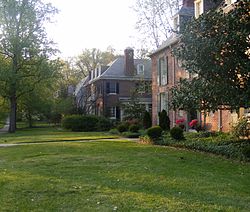
The company spared no expense on utilities, streets, drains and other infrastructure to create a modern and an attractive living destination for the Baltimore elite. The houses were designed by some of the most prominent Baltimore architects of the era, included Edward L. Palmer, Bayard Turnbull, John Russell Pope, W. D. Lamdin and Laurence Hall Fowler. The houses were primarily built in brick or stone and were designed in the popular revival styles of the early 20th century.
Guilford, Baltimore
Guilford is a historic neighborhood in the northern part of Baltimore, Maryland.
It is bounded on the south by University Parkway, on the west by North Charles Street, Warrenton and Linkwood Roads, on the north by Cold Spring Lane and on the east by York Road/Greenmount Avenue.
The neighborhood is adjacent to the neighborhoods of Tuscany-Canterbury, Loyola-Notre Dame, Kernewood, Wilson Park, Pen Lucy, Waverly, Oakenshawe, Charles Village.
Guilford is located near Johns Hopkins University, Loyola University Maryland and Notre Dame of Maryland University.
The neighborhood was added to the National Register of Historic Places in 2001.
The first known resident of the area was General McDonald who fought for the Continental army during the Revolutionary War. The area was supposedly named after the Battle of Guilford Court House in North Carolina, in which McDonald was wounded. His son William McDonald inherited his estate in 1850 and built the Guilford Mansion. In 1872, the property was purchased by Baltimore Sun founder, Arunah S. Abell, and would remain in his family for 35 years.
In 1907, the property was purchased by the Guilford Park Company who wanted to develop the area into a sophisticated suburban neighborhood on the edge of expanding Baltimore. In 1911 they consolidated with the Roland Park Company and together purchased 210 acres in North Baltimore. Frederick Law Olmsted Jr. was hired to do the landscape and street design. He is responsible for giving the neighborhood its distinct curving streets and terrain. The plan included three parks, "Little Park," "Stratford Green, and "Sunken Park. In 1939 a fourth park was created called "Guilford Gateways."
The company spared no expense on utilities, streets, drains and other infrastructure to create a modern and an attractive living destination for the Baltimore elite. The houses were designed by some of the most prominent Baltimore architects of the era, included Edward L. Palmer, Bayard Turnbull, John Russell Pope, W. D. Lamdin and Laurence Hall Fowler. The houses were primarily built in brick or stone and were designed in the popular revival styles of the early 20th century.
Recent media
Recent media