



Community hub
Recent from talks
Contribute something to knowledge base
Content stats: 0 posts, 0 articles, 1 media, 0 notes
Members stats: 0 subscribers, 0 contributors, 0 moderators, 0 supporters
Subscribers
Supporters
Contributors
Moderators
Hub AI
Gustave Moreau AI simulator
(@Gustave Moreau_simulator)
Hub AI
Gustave Moreau AI simulator
(@Gustave Moreau_simulator)
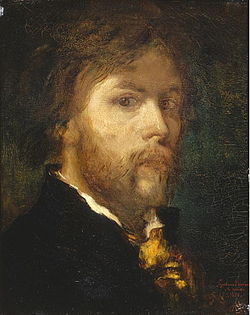
Gustave Moreau
Gustave Moreau (French: [ɡystav mɔʁo]; 6 April 1826 – 18 April 1898) was a French artist and an important figure in the Symbolist movement. Jean Cassou called him "the Symbolist painter par excellence". He was an influential forerunner of symbolism in the visual arts in the 1860s, and at the height of the symbolist movement in the 1890s, he was among the most significant painters. Art historian Robert Delevoy wrote that Moreau "brought symbolist polyvalence to its highest point in Jupiter and Semele." He was a prolific artist who produced over 15,000 paintings, watercolors, and drawings. Moreau painted allegories and traditional biblical and mythological subjects favored by the fine art academies. J. K. Huysmans wrote, "Gustave Moreau has given new freshness to dreary old subjects by a talent both subtle and ample: he has taken myths worn out by the repetitions of centuries and expressed them in a language that is persuasive and lofty, mysterious and new." The female characters from the Bible and mythology that he so frequently depicted came to be regarded by many as the archetypical symbolist woman. His art (and symbolism in general) fell from favor and received little attention in the early 20th century but, beginning in the 1960s and 70s, he has come to be considered among the most paramount of symbolist painters.
Gustave Moreau was born in Paris and showed an aptitude for drawing at an early age. He received a sound education at Collège Rollin (now Collège-lycée Jacques-Decour) and traditional academic training in painting at the Ecole des Beaux-Arts. In the early 1850s he developed a close friendship/mentorship with Théodore Chassériau and had some modest success exhibiting as the Paris Salon. Chassériau's premature death in 1856 deeply affected Moreau, and he left Paris to travel in Italy from 1857 to 1859, returning with hundreds of copies and studies he made of old master paintings there. In 1864 his painting Oedipus and the Sphinx received a great deal attention at the Paris Salon, winning a medal and establishing his reputation. He had continued success through the 1860s, gradually gaining a select group of enthusiastic and loyal admirers and collectors. Although his painting Prometheus received a medal at the Salon of 1869, criticisms in the press were severe and he did not submit paintings to the Salon again until 1876, permanently withdrawing after 1880.
Moreau was decorated Officier de la Légion d'Honneur in 1883. Somewhat misanthropic, he grew increasingly reclusive in later years, although he maintained a close circle of friends. He was often reluctant to sell his work, seldom exhibited, and turned down a number of prestigious offers, including an invitation to exhibit at the Salon Les XX in Brussels (1887), rejected the post of a professor when he was elected to the Ecole des Beaux-Arts (1888), and rejected offers to decorate buildings at the Sorbonne (1891). It was only after the death of his friend Élie Delaunay in 1891 that he agreed to take over Delaunay's studio at the Ecole des Beaux-Arts. Moreau excelled as a teacher, counting Henri Matisse, Georges Rouault, and other notable artists amongst his pupils. His parents bought a townhouse in 1852 at 14 Rue de La Rochefoucauld, converting the top floor into a studio for Moreau, where he lived and worked, a bachelor, for the rest of his life, his father dying in 1862, and his mother, Adèle-Pauline in 1884. Moreau died of cancer in 1898, bequeathing the townhome and studio with nearly 1200 paintings and watercolors, and over 10,000 drawings to the State to be converted into a museum. The Musée Gustave Moreau opened to the public in 1903 and is still open today. It is by far the largest and most significant collection of his work.
Gustave Moreau was born in Paris, into a cultured, upper-middle-class family. His father, Louis Jean Marie Moreau (1790–1862), was an architect, and his mother, née Adèle Pauline Desmoutier (1802–1884) was a musician. During a turbulent period in French history his father worked for the city of Paris, but being of liberal leanings, he was at times dismissed and later reinstated from various offices as powers shifted. The family lived in Vesoul, France from 1827 to 1830. After the July Revolution of 1830, he was appointed highway commissioner for the city of Paris. Although the office was not highly revered, his duties were more varied than the title suggests and he remained there until he retired in 1858. As a child Moreau was of frail health. Beginning at about the age of eight, he started drawing incessantly. In 1837 he began attending the Collège Rollin (Collège-lycée Jacques-Decour) in Paris as a boarder, but in 1840 when his older sister died at the age of 13, he was withdrawn from the school and lived a somewhat sheltered life with his parents. His father encouraged and supported his artistic tendencies but was adamant that he received a solid classical education. Moreau learned Greek, Latin, and read both French and classical literature in his father's rather substantial library. He learned piano and was a very good tenor. In 1841 he visited Italy with his mother and relatives, where he filled a 60-page album with drawings.
Visiting museums and galleries in Italy profoundly impressed Moreau and influenced his resolution to pursue a career as an artist. Upon returning in 1841 he started attending a drawing studio in the evenings. In 1844 he entered the private studio of François-Édouard Picot, a member of the École des Beaux-Arts, who offered classes to aspiring young artists to prepare for the entrance examinations at the École des Beaux-Arts. In 1846 Moreau was admitted to Picot's formal class at the École des Beaux-Arts. Moreau had grand aspirations of winning the prestigious Grand Prix de Rome, but when he failed to make the final rounds in 1848 and 1849 he left the École des Beaux-Arts prematurely. His style soon drifted away from those favored by the academy, but many of the basic Beaux-Arts methods and concepts he learned would remain with him for the rest of his life, as would his commitment to history painting.
Moreau spent his time copying paintings in the Louvre and was soon drawn to romanticism. Two contemporary artists he greatly admired were Eugène Delacroix and Théodore Chassériau, both of whom lived and worked in his neighborhood. Chassériau had entered the private studio of the great Neoclassical painter Jean-Auguste-Dominique Ingres at the age of ten and later spent time with Ingres at the French Academy in Rome, but in his late teens he turned away from Neoclassicism to Delacroix and romanticism. Chassériau never attended the École des Beaux-Arts, but he was driven and hardworking and managed to establish a reputation for himself, securing commissions, and living a rather bohemian and sometimes turbulent life. Moreau developed a friendship with Chassériau, seven years his senior, and rented a studio near Chassériau's. He soon followed suit, becoming something of a dapper man about town during this period, attending the opera and theater, and even singing at the social gatherings he frequented. Anecdotal accounts say Moreau visited Delacroix's studio around 1850; he was 28 years older than Moreau, but there is little evidence of a relationship beyond that.
Moreau's father bought a townhome at 14 rue de la Rochefoucauld in 1853, converting the top floor into a studio for Moreau, where he and his parents lived for the rest of their lives. Shortly before moving in, Moreau had started an ambitious canvas, "a scene of epic slaughter" based on an episode from the Odyssey, titled The Suitors (1852–1896). He worked on the painting on and off for the rest of his life, even adding strips of canvas to enlarge the work to a monumental 3.85 x 3.43 meters, but it was still unfinished at the time of his death. Moreau began exhibiting his work with some regularity in the 1850s. He secured some commissions from the city for paintings with the help of his father. He participated in the Paris Salon for the first time in 1852, presenting a Pieta which was purchased by the state for 600 francs. In the Salon of 1853 he exhibited Darius Fleeing after the Battle of Arbela and Song of Songs, both showing some influence of Chassériau, and the latter bought by the state for 2,000 francs for the Dijon Museum. There was no Salon in 1854, although he received a commission from the state in 1854 for Athenians being Delivered to the Minotaur in the Cretan Labyrinth which was shown at the 1855 Paris World's Fair and purchased for 4,000 francs for the Bourg-en-Bresse Museum. After a few short weeks of declining health in 1856, Chassériau died at the age of 37. On 10 October 1856, Delacroix noted in his journal "Funeral procession of poor Chassériau. I saw Dauzats, Diaz, and the young Moreau. I quite like him" Moreau started work on The Young Man and Death in 1856, finished in 1865 and dedicated to Chassériau.
The death of Chasseriau in 1856 caused Moreau in his grief to withdraw from public life. Concerned about his condition, Moreau's parents suggested he travel to Italy again. Living in Italy, he found a renewed love for art. He gained inspiration from the artists of the Italian Renaissance, such as Leonardo da Vinci and Michelangelo.
Gustave Moreau
Gustave Moreau (French: [ɡystav mɔʁo]; 6 April 1826 – 18 April 1898) was a French artist and an important figure in the Symbolist movement. Jean Cassou called him "the Symbolist painter par excellence". He was an influential forerunner of symbolism in the visual arts in the 1860s, and at the height of the symbolist movement in the 1890s, he was among the most significant painters. Art historian Robert Delevoy wrote that Moreau "brought symbolist polyvalence to its highest point in Jupiter and Semele." He was a prolific artist who produced over 15,000 paintings, watercolors, and drawings. Moreau painted allegories and traditional biblical and mythological subjects favored by the fine art academies. J. K. Huysmans wrote, "Gustave Moreau has given new freshness to dreary old subjects by a talent both subtle and ample: he has taken myths worn out by the repetitions of centuries and expressed them in a language that is persuasive and lofty, mysterious and new." The female characters from the Bible and mythology that he so frequently depicted came to be regarded by many as the archetypical symbolist woman. His art (and symbolism in general) fell from favor and received little attention in the early 20th century but, beginning in the 1960s and 70s, he has come to be considered among the most paramount of symbolist painters.
Gustave Moreau was born in Paris and showed an aptitude for drawing at an early age. He received a sound education at Collège Rollin (now Collège-lycée Jacques-Decour) and traditional academic training in painting at the Ecole des Beaux-Arts. In the early 1850s he developed a close friendship/mentorship with Théodore Chassériau and had some modest success exhibiting as the Paris Salon. Chassériau's premature death in 1856 deeply affected Moreau, and he left Paris to travel in Italy from 1857 to 1859, returning with hundreds of copies and studies he made of old master paintings there. In 1864 his painting Oedipus and the Sphinx received a great deal attention at the Paris Salon, winning a medal and establishing his reputation. He had continued success through the 1860s, gradually gaining a select group of enthusiastic and loyal admirers and collectors. Although his painting Prometheus received a medal at the Salon of 1869, criticisms in the press were severe and he did not submit paintings to the Salon again until 1876, permanently withdrawing after 1880.
Moreau was decorated Officier de la Légion d'Honneur in 1883. Somewhat misanthropic, he grew increasingly reclusive in later years, although he maintained a close circle of friends. He was often reluctant to sell his work, seldom exhibited, and turned down a number of prestigious offers, including an invitation to exhibit at the Salon Les XX in Brussels (1887), rejected the post of a professor when he was elected to the Ecole des Beaux-Arts (1888), and rejected offers to decorate buildings at the Sorbonne (1891). It was only after the death of his friend Élie Delaunay in 1891 that he agreed to take over Delaunay's studio at the Ecole des Beaux-Arts. Moreau excelled as a teacher, counting Henri Matisse, Georges Rouault, and other notable artists amongst his pupils. His parents bought a townhouse in 1852 at 14 Rue de La Rochefoucauld, converting the top floor into a studio for Moreau, where he lived and worked, a bachelor, for the rest of his life, his father dying in 1862, and his mother, Adèle-Pauline in 1884. Moreau died of cancer in 1898, bequeathing the townhome and studio with nearly 1200 paintings and watercolors, and over 10,000 drawings to the State to be converted into a museum. The Musée Gustave Moreau opened to the public in 1903 and is still open today. It is by far the largest and most significant collection of his work.
Gustave Moreau was born in Paris, into a cultured, upper-middle-class family. His father, Louis Jean Marie Moreau (1790–1862), was an architect, and his mother, née Adèle Pauline Desmoutier (1802–1884) was a musician. During a turbulent period in French history his father worked for the city of Paris, but being of liberal leanings, he was at times dismissed and later reinstated from various offices as powers shifted. The family lived in Vesoul, France from 1827 to 1830. After the July Revolution of 1830, he was appointed highway commissioner for the city of Paris. Although the office was not highly revered, his duties were more varied than the title suggests and he remained there until he retired in 1858. As a child Moreau was of frail health. Beginning at about the age of eight, he started drawing incessantly. In 1837 he began attending the Collège Rollin (Collège-lycée Jacques-Decour) in Paris as a boarder, but in 1840 when his older sister died at the age of 13, he was withdrawn from the school and lived a somewhat sheltered life with his parents. His father encouraged and supported his artistic tendencies but was adamant that he received a solid classical education. Moreau learned Greek, Latin, and read both French and classical literature in his father's rather substantial library. He learned piano and was a very good tenor. In 1841 he visited Italy with his mother and relatives, where he filled a 60-page album with drawings.
Visiting museums and galleries in Italy profoundly impressed Moreau and influenced his resolution to pursue a career as an artist. Upon returning in 1841 he started attending a drawing studio in the evenings. In 1844 he entered the private studio of François-Édouard Picot, a member of the École des Beaux-Arts, who offered classes to aspiring young artists to prepare for the entrance examinations at the École des Beaux-Arts. In 1846 Moreau was admitted to Picot's formal class at the École des Beaux-Arts. Moreau had grand aspirations of winning the prestigious Grand Prix de Rome, but when he failed to make the final rounds in 1848 and 1849 he left the École des Beaux-Arts prematurely. His style soon drifted away from those favored by the academy, but many of the basic Beaux-Arts methods and concepts he learned would remain with him for the rest of his life, as would his commitment to history painting.
Moreau spent his time copying paintings in the Louvre and was soon drawn to romanticism. Two contemporary artists he greatly admired were Eugène Delacroix and Théodore Chassériau, both of whom lived and worked in his neighborhood. Chassériau had entered the private studio of the great Neoclassical painter Jean-Auguste-Dominique Ingres at the age of ten and later spent time with Ingres at the French Academy in Rome, but in his late teens he turned away from Neoclassicism to Delacroix and romanticism. Chassériau never attended the École des Beaux-Arts, but he was driven and hardworking and managed to establish a reputation for himself, securing commissions, and living a rather bohemian and sometimes turbulent life. Moreau developed a friendship with Chassériau, seven years his senior, and rented a studio near Chassériau's. He soon followed suit, becoming something of a dapper man about town during this period, attending the opera and theater, and even singing at the social gatherings he frequented. Anecdotal accounts say Moreau visited Delacroix's studio around 1850; he was 28 years older than Moreau, but there is little evidence of a relationship beyond that.
Moreau's father bought a townhome at 14 rue de la Rochefoucauld in 1853, converting the top floor into a studio for Moreau, where he and his parents lived for the rest of their lives. Shortly before moving in, Moreau had started an ambitious canvas, "a scene of epic slaughter" based on an episode from the Odyssey, titled The Suitors (1852–1896). He worked on the painting on and off for the rest of his life, even adding strips of canvas to enlarge the work to a monumental 3.85 x 3.43 meters, but it was still unfinished at the time of his death. Moreau began exhibiting his work with some regularity in the 1850s. He secured some commissions from the city for paintings with the help of his father. He participated in the Paris Salon for the first time in 1852, presenting a Pieta which was purchased by the state for 600 francs. In the Salon of 1853 he exhibited Darius Fleeing after the Battle of Arbela and Song of Songs, both showing some influence of Chassériau, and the latter bought by the state for 2,000 francs for the Dijon Museum. There was no Salon in 1854, although he received a commission from the state in 1854 for Athenians being Delivered to the Minotaur in the Cretan Labyrinth which was shown at the 1855 Paris World's Fair and purchased for 4,000 francs for the Bourg-en-Bresse Museum. After a few short weeks of declining health in 1856, Chassériau died at the age of 37. On 10 October 1856, Delacroix noted in his journal "Funeral procession of poor Chassériau. I saw Dauzats, Diaz, and the young Moreau. I quite like him" Moreau started work on The Young Man and Death in 1856, finished in 1865 and dedicated to Chassériau.
The death of Chasseriau in 1856 caused Moreau in his grief to withdraw from public life. Concerned about his condition, Moreau's parents suggested he travel to Italy again. Living in Italy, he found a renewed love for art. He gained inspiration from the artists of the Italian Renaissance, such as Leonardo da Vinci and Michelangelo.
Recent media
Recent media