Hubbry Logo
Salon (Paris)Salon (Paris)Main
Open search
Salon (Paris)
Community hub
Salon (Paris)
logo
8 pages, 0 posts
0 subscribers
Be the first to start a discussion here.
Contribute something
Salon (Paris)
Salon (Paris)
from Wikipedia
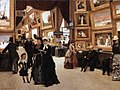
Formally dressed patrons at the Salon in 1890. Un Jour de vernissage au palais des Champs-Élysées by Jean-André Rixens featuring Tigresse apportant un paon à ses petits by Auguste Cain.

The Salon, or sometimes Paris Salon (French: Salon de Paris [salɔ̃ d(ə) paʁi]), beginning in 1667,[1] was the official art exhibition of the Académie des Beaux-Arts in Paris. Between 1748 and 1890 it was arguably the greatest annual or biennial art event in the Western world.

At the Salon of 1761, thirty-three painters, nine sculptors, and eleven engravers contributed.[2] From 1881 onward, it was managed by the Société des Artistes Français.

Origins

[edit]

In 1667, the royally sanctioned French institution of art patronage, the Académie royale de peinture et de sculpture[1] (a division of the Académie des beaux-arts), held its first semi-public art exhibit at the Salon Carré. The Salon's original focus was the display of the work of recent graduates of the École des Beaux-Arts, which was created by Cardinal Mazarin, chief minister of France, in 1648. Exhibition at the Salon de Paris was essential for any artist to achieve success in France for at least the next 200 years. Exhibition in the Salon marked a sign of royal favor.

Charles X Distributing Awards to Artists for the Salon of 1824. An 1827 painting by François Joseph Heim, now in the Louvre.

In 1725, the Salon was held in the Palace of the Louvre, when it became known as Salon or Salon de Paris. In 1737, the exhibitions, held from 18 August 1737 to 5 September 1737 at the Grand Salon of the Louvre,[3] became public. They were held, at first, annually, and then biennially, in odd-numbered years. They would start on the feast day of St. Louis (25 August) and run for some weeks. Once made regular and public, the Salon's status was "never seriously in doubt."[4] In 1748 a jury of awarded artists was introduced. From this time forward, the influence of the Salon was undisputed.

Prominence (1748–1890)

[edit]
This portrait by John Singer Sargent of Virginie Amélie Avegno Gautreau depicting her cleavage caused considerable controversy when it was displayed at the 1884 Salon.

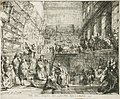
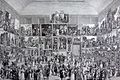
The Salon exhibited paintings floor-to-ceiling and on every available inch of space. The jostling of artwork became the subject of many other paintings, including Pietro Antonio Martini's Salon of 1785. Printed catalogues of the Salons are primary documents for art historians. Critical descriptions of the exhibitions published in the gazettes mark the beginning of the modern occupation of art critic. The French salon, a product of the Enlightenment in the early 18th century, was a key institution in which women played a central role. Salons provided a place for women and men to congregate for intellectual discourse.

The French Revolution opened the exhibition to foreign artists. The Salon of 1824 was noted for its displays of British paintings by John Constable, Thomas Lawrence and Richard Parkes Bonington. In the 19th century the idea of a public Salon extended to an annual government-sponsored juried exhibition of new painting and sculpture, held in large commercial halls, to which the ticket-bearing public was invited. The vernissage (varnishing) of opening night was a grand social occasion, and a crush that gave subject matter to newspaper caricaturists like Honoré Daumier. Charles Baudelaire, Denis Diderot and others wrote reviews of the Salons.

After the French Revolution of 1848 liberalized the Salon, far fewer works were refused. Medals were introduced in 1849.

Early splinter groups

[edit]

The increasingly conservative and academic juries were not receptive to the Impressionist painters,[5] whose works were usually rejected, or poorly placed if accepted. The Salon opposed the Impressionists' shift away from traditional painting styles. In 1863 the Salon jury turned away an unusually high number of the submitted paintings.[6] An uproar resulted, particularly from regular exhibitors who had been rejected. In order to prove that the Salons were democratic, Napoleon III instituted the Salon des Refusés, containing a selection of the works that the Salon had rejected that year. It opened on 17 May 1863, marking the birth of the avant-garde. The Impressionists held their own independent exhibitions in 1874, 1876, 1877, 1879, 1880, 1881, 1882 and 1886.

In 1881 the government withdrew official sponsorship from the annual Salon, and a group of artists organized the Société des Artistes Français to take responsibility for the show.[1]

Secessions

[edit]

In December 1890, the leader of the Société des Artistes Français, William-Adolphe Bouguereau, proposed that the Salon should be an exhibition of young, not-yet-awarded, artists. Ernest Meissonier, Puvis de Chavannes, Auguste Rodin and others rejected the proposal and broke way to create the Société Nationale des Beaux-Arts, with its own exhibition, immediately referred to in the press as the Salon du Champ de Mars [7] or the Salon de la Société Nationale des Beaux–Arts.[8] Soon, it was also widely known as the Nationale.

In 1903, in response to what many artists at the time felt was a bureaucratic and conservative organization, a group of painters and sculptors, led by Pierre-Auguste Renoir and Auguste Rodin, organized the Salon d'Automne.

As the number of salons increased, American newspapers sometimes referred to the original salon as the Salon of the Champs Elysees.[9]

See also

[edit]
[edit]

References

[edit]

Sources

[edit]
  • J. J. Marquet de Vasselot: Répertoire des catalogues du musée du Louvre, 1793–1917
  • Thomas Crow: Painters and Public Life in 18th Century Paris. Yale University Press 1987
  • Patricia Mainardi: The End of the Salon: Art and the State in the Early Third Republic, Cambridge University Press, 1993.
  • Fae Brauer, Rivals and Conspirators: The Paris Salons and the Modern Art Centre, Newcastle upon Tyne, Cambridge Scholars, 2013.
  • Albert Boime, "The Salon des Refuses and the Evolution of Modern Art", Art Quarterly 32 (Winter 1969): 41 1–26
  • Margo Bistis, "Bad Art: The Decline of Academic Art in the Caricatural Salon", International Journal of Comic Art 7, no.1 (Spring 2005); 126–148.
[edit]
Revisions and contributorsEdit on WikipediaRead on Wikipedia
from Grokipedia
The Paris Salon was the official exhibition of art organized by the Académie Royale de Peinture et de Sculpture, first held in 1667 under the sponsorship of as a showcase for the academy's members in the of the . Initially intermittent, the Salon became a regular event by the mid-18th century, with a jury system introduced in 1748 to select submissions favoring traditional genres such as and realistic styles, thereby enforcing academic standards that dominated for over two centuries. Held primarily in the , it drew massive public attendance—up to hundreds of thousands—and served as a critical venue for artists' careers, awards, and sales, while printed catalogs and reviews by figures like amplified its cultural influence. The Salon's rigid curation sparked controversies, notably rejections of innovative works that prompted alternatives like the 1863 Salon des Refusés decreed by Napoleon III to exhibit denied pieces, including Édouard Manet's Le Déjeuner sur l'herbe, and later fueled the independent exhibitions of Impressionists in 1874. Its emphasis on hierarchy of genres and classical training shaped European artistic norms but waned in authority by the late 19th century amid rising modernism, though it persisted in various forms.

Origins and Early Development

Founding under Louis XIV

The inaugural Salon was convened in April 1667 at the in , marking the inception of a state-sponsored dedicated exclusively to works by members of the newly established Académie Royale de Peinture et de Sculpture. This event, opening on April 23, featured representative paintings and from approximately 18 artists, primarily Académie affiliates, and served as a deliberate instrument of royal absolutism under . Jean-Baptiste Colbert, the king's superintendent of arts and controller general of finances, orchestrated the exhibition to consolidate artistic authority under centralized control, thereby fostering a national school of art capable of rivaling Italian precedents and enhancing France's cultural prestige. Colbert's initiative aligned with mercantilist principles, wherein state of functioned as a means to cultivate skilled practitioners for royal commissions, standardize aesthetic doctrines like French , and generate public critique as a tool for refinement. By restricting display to Académie-approved works, the Salon differentiated itself from prior informal or guild-based showings, instituting a hierarchical framework that prioritized disciplined emulation of antiquity over individualistic expression. Early successes, such as contributions from —the Académie's inaugural rector and a proponent of the event—demonstrated the model's efficacy in elevating collective output, without which the codification of French artistic norms might have remained fragmented amid competing influences. This foundational exhibition laid the empirical groundwork for institutionalized patronage, as its modest scale and royal endorsement catalyzed subsequent displays, embedding art production within the machinery of state power and economic policy.

Initial Exhibitions and Académie Royale

The sporadic exhibitions organized by the Académie Royale de Peinture et de Sculpture in the late 17th and early 18th centuries began irregularly, with the first recorded in 1673, followed by others in 1699 and 1704, primarily to showcase member artists' works and affirm institutional standards. The 1699 event, held in the Louvre's Salon Carré—allocated to the Académie in 1692—established this space as a semi-permanent venue, displaying paintings and sculptures that exemplified the Académie's preference for structured composition over decorative excess. These early shows, limited to academy affiliates, numbered in the dozens to low hundreds of works and reinforced doctrines favoring dessin (precise line and form) as the foundation of intellectual rigor, prioritizing anatomical accuracy through direct study of live models and classical casts over the sensuous effects of couleur. The Académie's internal facilitated this emphasis on disciplined : aspiring artists first gained agréé status via preliminary submission and approval, then advanced to full académicien by producing a morceau de réception—a masterwork demonstrating mastery of form, , and empirical —which was publicly critiqued and judged by peers. This progression, structured under roles from rectors and professors to , ensured systematic training in genres ranked by at the apex for its moral and causal s—yielding outputs like Poussin-inspired works that prioritized verifiable proportions and human over fleeting coloristic experiments associated with Rubens's influence. Such methods countered subjective tendencies by grounding art in measurable realities, as evidenced by the persistence of académicien productions in royal commissions versus ephemeral trends. By the mid-18th century, exhibitions like the 1751 Salon—marking a shift toward biennial regularity from 1737 onward—featured several hundred works in the , attracting broader scrutiny from Enlightenment figures. , including in his inaugural 1759 review, began voicing reservations about the Académie's formulaic constraints, praising select pieces for truthful depiction (e.g., Chardin's still lifes) while decrying overly idealized narratives that deviated from lived , though acknowledging the exhibitions' role in elevating through enforced observational discipline. These critiques highlighted tensions between the Académie's causal focus on form as a vehicle for enduring truth and emerging preferences for expressive liberty, yet the early Salons solidified classical precepts that dominated until later upheavals.

Institutional Framework

Governance by the Académie des Beaux-Arts

The Académie Royale de Peinture et de Sculpture, founded by royal decree on January 27, 1648, under Louis XIV, established centralized governance over French artistic institutions, including oversight of the Salon exhibitions from their inaugural official iteration in 1667. This structure enforced a hierarchy of genres—privileging history painting above portraiture or still life—and required artists to adhere to prescribed techniques and subjects, with academy members serving as the primary selectors to maintain uniformity in quality assessment. Such oversight derived from the academy's charter, which vested authority in a limited body of elected peers, thereby insulating decisions from external commercial or popular pressures. The academy was dissolved in 1793 amid the , with its functions temporarily absorbed by revolutionary assemblies that sporadically organized exhibitions without the prior rigid protocols. It was reconstituted on March 21, 1816, as the Académie des Beaux-Arts within the , reinstating its administrative control over the Salon and integrating sections for painting, sculpture, architecture, engraving, and music to broaden yet preserve elite adjudication. This revival preserved the foundational exclusivity, capping total membership at 40 across disciplines—with allocations such as 14 seats reserved for painters—to curtail expansion and uphold selective expertise in governance. Under academy direction, the Salon's jury process, drawn exclusively from members and associates, applied consistent criteria rooted in classical ideals, resulting in rejection rates that frequently surpassed 50% by the mid-19th century amid surging submissions from aspiring artists. This selectivity, enforced without democratic mechanisms, sustained competitive rigor by limiting exhibition space to works meeting empirical benchmarks of draftsmanship and thematic elevation, rather than accommodating volume-driven inclusion. State funding, originating from royal stipends under and extending through Napoleonic and subsequent regimes, underwrote operations—including venue provision at the —ensuring the system's persistence as a conduit for patronage that rewarded conformity to upheld standards over innovation unbound by tradition.

Jury Selection Process and Criteria

The jury for the Paris Salon, established in 1748 and typically drawn from members of the Académie des Beaux-Arts or its predecessor institutions, convened to evaluate submissions from non-academician artists prior to each exhibition, with academicians granted automatic inclusion until reforms in the late 18th century. By 1795, submissions were opened to all artists regardless of membership status, requiring jury approval based on technical execution and alignment with established artistic principles, though the process remained selective to maintain standards of representational fidelity. Jury composition shifted over time; from 1831 under the July Monarchy, it was dominated by the first four sections of the Académie des Beaux-Arts—painting, sculpture, architecture, and engraving—ensuring decisions reflected institutional expertise in classical techniques. Selection criteria emphasized verifiable technical proficiency, including precise draftsmanship, harmonious composition, and subordination of effect to underlying structure, mirroring the Académie's focus on idealized representation derived from antique models and rational observation of nature. Works were assessed for avoidance of excess or vulgarity, prioritizing moral and intellectual elevation in subject matter over mere novelty or sentiment, with the genre hierarchy placing histoire (history painting) at the apex due to its demand for multifaceted skills in anatomy, perspective, and narrative coherence—demands empirically linked to enduring canonical status, as seen in Jacques-Louis David's Oath of the Horatii (exhibited 1785), which exemplified large-scale (grandes machines) integration of figures and architecture that withstood stylistic shifts unlike many transient genre pieces. This preference for history over subordinate genres like landscape or still life stemmed from causal assessment of skill complexity: mastering human form and dramatic unity provided a rigorous test of ability, fostering outputs with proven longevity in collections and pedagogy, whereas lesser genres often prioritized superficial appeal without equivalent structural rigor. Defenders of the system analogized it to in emerging sciences, arguing that vetting filtered for causal efficacy in conveying enduring truths of form and proportion, consistently elevating proven masters like and whose accepted works demonstrated repeatable technical excellence across Salons from the 1780s to 1830s, countering accusations of caprice by highlighting the mechanism's role in institutionalizing verifiable merit over subjective whim. Empirical patterns in accepted oeuvres—favoring compositions with demonstrable preparatory studies and anatomical accuracy—reinforced this, as deliberations prioritized evidence of laborious mastery, yielding a corpus that prioritized causal realism in depiction over ephemeral trends.

Exhibition Logistics and Public Access

The Salon exhibitions were conducted in the of the from 1725 onward, utilizing the room's central location for displaying accepted works in a characteristic dense arrangement known as the salon hang, where paintings covered walls from floor to ceiling in multiple tiers. This setup accommodated thousands of submissions while prioritizing visibility for select pieces, with arrangements ordered by the Académie's genre hierarchy—history paintings, deemed highest, positioned at eye level alongside works by senior members, relegating landscapes, genre scenes, and still lifes to upper or lower placements. Such spatial organization guided viewers through a progression that underscored academic values of artistic excellence and thematic precedence. Public access was established in 1737, marking the transition to broader attendance beyond academy insiders, with free entry on Sundays and holidays drawing heterogeneous crowds that numbered in the thousands during the and exceeded 100,000 by the early 1800s. Exhibitions typically spanned six to eight weeks starting in spring, enabling sustained public exposure that propagated refined aesthetic standards amid growing urban populations. Incentives for superior submissions included mentions honorables from the late and formalized medals introduced in , awarded post-exhibition to recognize merit and encourage adherence to institutional criteria. This system, combined with the curated spatial flow, maintained the Salon's role as a controlled pedagogical venue contrasting later unstructured displays.

Periods of Prominence

18th-Century Expansion and Annualization

Following the resumption of exhibitions in 1737 after a period of irregularity, the Salon evolved into a more predictable event, occurring annually or biennially throughout much of the . This shift reflected the Académie Royale's growing institutional confidence and the increasing demand from artists and the public for regular showcases of . By the mid-century, the Salons drew substantial crowds, with catalogs listing hundreds of works, underscoring their consolidation as a of French artistic life. The 1759 Salon initiated a pivotal tradition of detailed criticism through Denis Diderot's reviews in the Correspondance littéraire, where he evaluated artworks not merely on technical merit but on their capacity to evoke moral sentiment and philosophical depth. Diderot's approach, emphasizing the viewer's emotional engagement and the artwork's ethical implications, influenced subsequent and elevated the Salon's intellectual prestige. This period of annualization in the and facilitated broader participation, with exhibitors numbering in the hundreds annually, fostering a competitive environment that honed French artistic standards. The Salon of 1767 exemplified the era's cultural tensions, particularly through Jean-Baptiste Greuze's moralistic genre scenes, which Diderot praised for their vivid portrayal of familial virtue and emotional realism, countering the perceived decadence of styles. Greuze's works, such as depictions of pious domesticity, sparked debate over art's societal role, affirming the Salon's function in promoting didactic themes aligned with Enlightenment values of moral instruction. Despite Greuze's later frustrations with academic hierarchy—his 1769 history painting submission failing to secure full membership—the 1767 exhibition highlighted the Salon's endorsement of virtue-enforcing narratives, which resonated amid shifting tastes toward sentimentality. This maturation paralleled France's artistic hegemony, as Salon-validated techniques and compositions were emulated across European academies, exporting French neoclassical and genre influences. By the late 1760s, the Salon's regularity supported its expansion, though it transitioned to biennial from 1774 to 1792, allowing time for preparation amid growing submissions. This institutional stability entrenched the event's authority, with public access broadening to include the , thereby amplifying its impact on taste formation and artistic careers.

Revolutionary and Napoleonic Influences (1789–1815)

The Paris Salon endured the upheavals of the through adaptive governance shifts, reopening in under republican administration after the dissolution of royal patronage, which drew record crowds and expanded access beyond members. Exhibitions in 1789 and featured works like Jacques-Louis David's paintings, which resonated with revolutionary themes of virtue and sacrifice, though the event's classical hierarchy persisted amid emerging political critiques. Political instability, including the from September 1793 to July 1794, halted regular Salons after 1791, with no exhibitions recorded until 1798 under the Directory, as the Académie Royale was abolished in 1793 and replaced by provisional bodies like the École des Beaux-Arts in 1795, disrupting but not eradicating structured artistic evaluation. This interregnum reflected broader causal disruptions in institutional continuity, yet surviving academy-trained artists maintained neoclassical techniques informally, preventing wholesale deviation into unstructured expression. Napoleon Bonaparte's ascent after the 18 Brumaire coup in November repurposed the Salon for regime consolidation, with annual exhibitions from 1800 onward showcasing state-commissioned works to glorify military triumphs and imperial legitimacy, such as Antoine-Jean Gros's Bonaparte Visiting the Plague-Stricken at (exhibited 1804), which depicted heroic leadership to counter reports of abandoning sick troops during the 1799 Egyptian campaign. David's neoclassical output, including contributions aligned with Napoleonic , dominated selections, as the —initially influenced by government appointees—reverted toward merit-based criteria rooted in antique-inspired rigor rather than fleeting ideological tests. This period's Salons reinforced causal continuity in artistic formation by integrating revolutionary survivors into imperial structures, legitimizing as a stabilizing force against potential anarchy; attendance surged to over 100,000 by , affirming the event's role in channeling public taste toward disciplined emulation of Greco-Roman models over radical experimentation. By , amid Napoleon's defeat, the had weathered ideological impositions without abandoning its foundational emphasis on technical mastery and hierarchical .

Restoration to Second Empire Zenith (1815–1870)

Following the Bourbon Restoration in 1815, the Salon resumed operations with the exhibition of 1819 at the Louvre, marking the return to regular public displays after the disruptions of the Napoleonic era. Initially held biennially during the Restoration period, the event transitioned to annual scheduling under the July Monarchy of Louis-Philippe, reflecting growing institutional stability and public demand. These exhibitions drew substantial crowds, with attendance reaching up to 500,000 visitors over the typical two-month duration, underscoring the Salon's role as a central cultural institution that shaped artistic hierarchies and market preferences through jury validation and elite patronage. The Salon maintained its prominence even amid political upheaval, as evidenced by the 1848 exhibition held during the Revolution of that year, which still attracted over a million visitors collectively in the preceding decades under Louis-Philippe, demonstrating the event's resilience and empirical appeal as a stabilizing force in French cultural life. Under the Second Empire of Napoleon III (1852–1870), the Salon's scale expanded further, with biennial or annual iterations dominating the art scene and incorporating thousands of works from numerous artists. State involvement intensified through systematic purchases of exhibited works, bolstering artist livelihoods and ensuring the Salon's influence extended globally by certifying aesthetic standards rooted in academic traditions. A notable innovation occurred in as part of the Exposition Universelle, where the Salon featured dedicated sections for living French artists alongside international and retrospective displays, allowing contemporary works to compete directly while honoring historical masters like Ingres and Delacroix, each allocated prominent spaces. This structure highlighted the Salon's zenith in fostering a hierarchical yet dynamic ecosystem, where empirical success—measured in attendance, sales, and commissions—affirmed its causal primacy in dictating European artistic norms without yielding to emerging dissonant voices.

Challenges and Secessions

Early Splinter Exhibitions

As early as the 1830s, Paris art galleries began mounting small-scale, private exhibitions featuring works rejected by the official Salon's jury, providing limited outlets for dissenting artists outside the Académie's control. These efforts typically involved dozens rather than thousands of pieces, contrasting sharply with the Salon's biennial displays of up to 4,000 submissions, and drew modest audiences unable to rival the official event's prestige and state-backed visibility. Organized by individual artists or informal groups, such shows often showcased marginalized figures experimenting with realist or non-academic styles, yet they lacked institutional rigor, consistent funding, or broad critical engagement, resulting in negligible long-term influence on artistic markets or standards. A prominent example occurred in 1855 during the Exposition Universelle, when , frustrated by the rejection of his submission The Artist's Studio, independently financed and erected the Pavilion of Realism adjacent to the official venue on . This temporary structure housed approximately 40 of Courbet's own paintings, emphasizing everyday subjects and direct observation over idealized , and attracted around 50,000 visitors over two months—impressive for a private initiative but dwarfed by the Exposition's millions. Despite generating debate on realism's viability, the pavilion closed after the event, exemplifying how such splinter efforts underscored growing jury conservatism without eroding the Salon's monopoly, as most artists remained dependent on its validation for and sales. These pre-1863 initiatives, while signaling underlying tensions between academic gatekeeping and innovative impulses, empirically demonstrated the Salon's enduring dominance: private alternatives rarely sustained beyond single seasons, failed to cultivate rival networks, and saw limited commercial success, with works often unsold due to the absence of endorsement. Organized by artists on the periphery rather than collectives with broad support, they highlighted causal barriers like inadequate promotion and jury-biased public perception, reinforcing the Salon's role as the primary arbiter of French artistic legitimacy until state intervention altered the landscape.

The Salon des Refusés and 1863 Controversy

In 1863, the Salon jury received over 5,000 submissions but accepted fewer than 2,218 works, rejecting approximately 2,783 and prompting widespread protests from artists and their supporters who decried the selections as overly conservative and exclusionary. Emperor , facing public pressure during a period of political liberalization under the Second Empire, personally decreed the creation of a parallel exhibition, the ("Salon of the Rejected"), to display the spurned works at the ; it opened on May 15, 1863, alongside the official Salon. The event featured 2,217 pieces, including Édouard Manet's , which depicted a nude woman picnicking with clothed men in a modern setting, igniting scandal for its perceived indecency and challenge to academic conventions of nudity reserved for mythological subjects. The Refusés attracted substantial attendance, with contemporary accounts reporting over 1,000 visitors daily and crowds pushing to enter, though reactions were sharply divided. Traditional critics, such as those aligned with the Académie, derided the show as a confirmation of the jury's discernment, arguing it showcased mostly amateurish, unskilled, or imitative efforts that validated the Salon's standards rather than undermining them. In contrast, a smaller cadre of reformers, including writer , hailed outliers like Manet's work for introducing bold realism and compositional innovation, viewing the exhibition as a necessary counter to institutional rigidity. Napoleon III visited and even purchased pieces, but the overall empirical outcome leaned toward the critics' assessment: few exhibited works achieved enduring istic merit or influence beyond incidental publicity for select modernists, with the majority fading into obscurity. A second edition in 1864 repeated the format amid continued rejections but generated waning interest and further exposed the predominance of subpar submissions, leading the government to discontinue the Refusés thereafter and revert to the official Salon's sole authority. This termination affirmed the jury's role in upholding quality thresholds, as the parallel show's limited long-term impact—despite its role in spotlighting transitional figures—did not erode the Académie's hierarchical selection process or prompt systemic reforms.

Rise of Independent Salons

Following the controversy of the 1863 Salon des Refusés, which exhibited rejected works and drew public attention to alternative voices, artists increasingly organized independent exhibitions to bypass the official jury's selectivity. This momentum culminated in the founding of the Société des Artistes Indépendants on July 29, 1884, by figures including Georges Seurat and Paul Signac, who sought an open platform without juries or awards. The inaugural Salon des Indépendants, held from May to July 1884, displayed over 5,000 works by more than 400 artists, marking a deliberate challenge to the Académie's gatekeeping. Despite this expansion, the independent salon's reach remained limited initially compared to the official Salon's established draw; the latter consistently attracted hundreds of thousands of visitors annually in the late , such as 518,892 in alone, reflecting its entrenched role in public engagement and . The Indépendants' no-jury model democratized submission—anyone could exhibit for a fee—but attendance figures started modestly, underscoring the official venue's persistent dominance in shaping artistic visibility until institutional shifts later redistributed influence. Building on this precedent, the emerged in 1903, founded by architect Frantz Jourdain and associates as a seasonal to spring exhibitions, emphasizing progressive works outside academic norms. Held first at the starting October 31, 1903, it provided another jury-free space that gained traction for showcasing emerging styles, though early iterations drew far fewer visitors than the official Salon's peak crowds exceeding one million in prior decades. These venues fostered competition through broader access, yet empirical data on visitor numbers highlights how the official Salon retained superior scale and cultural authority into the , tying independent growth to niche appeal rather than immediate mass displacement. Independent salons often prioritized innovative expression over the classical technical rigor—such as precise draftsmanship and anatomical accuracy—enforced by the Académie, works that critics of the viewed as sacrificing proficiency for novelty. This shift reflected a broader of but correlated with observable divergences from the Salon's standards of disciplined execution, as evidenced in contemporaneous reviews decrying lapses in foundational skills among avant-garde entrants.

Decline and Transition

Late 19th-Century Institutional Shifts

Following the and the proclamation of the Third Republic in 1870, the Paris Salon underwent adaptive reforms to align with republican governance, transitioning from imperial patronage to state oversight emphasizing public access and while retaining a system rooted in academic traditions. These changes diluted the event's monarchical origins, incorporating broader ideological influences from republican institutions, yet preserved rigorous vetting to uphold artistic standards amid growing external pressures from emerging independent exhibitions and private dealer networks. Rejection rates remained high throughout the , frequently surpassing 50% of submissions—for instance, thousands of works were excluded annually—prompting internal debates among artists and officials on inclusivity and the balance between and broader representation. In response, discussions intensified by regarding artist involvement in governance, culminating in preparatory steps for a more autonomous structure, including proposals for elected to mitigate perceptions of . By 1880, the Salon was renamed the Salon des Artistes Français and relocated to the Palais des Champs-Élysées, opening on May 1, marking an institutional pivot toward artist-driven administration under continued state auspices. Attendance figures held steady, drawing substantial crowds reflective of sustained public interest, yet the event's cultural dominance waned as movements increasingly bypassed it via dealer sales and splinter shows, signaling causal shifts in market dynamics.

Discontinuation of the Official Salon (1881)

In 1881, the French Third Republic's government formally discontinued its sponsorship of the official Salon, ending over two centuries of on the nation's premier . Minister of Public Instruction and Fine Arts initiated the transfer of organizational authority to the Société des Artistes Français, an artist-led association established that year from prior Salon exhibitors, thereby relinquishing the Académie des Beaux-Arts' direct oversight. This handover reflected mounting pressures from artistic dissent and administrative burdens, as the prior year's had swelled to a record 7,311 submitted works, straining jury processes and venue capacities under centralized control. The Société des Artistes Français assumed responsibility for the annual event, retaining traditional elements like but introducing reforms such as electing jurors from among exhibiting artists rather than appointing them from the , which reduced prescriptive academic influence. Exhibitions continued in state-provided venues initially, preserving some continuity, yet the absence of monopoly spurred immediate fragmentation: artists increasingly submitted to emerging alternatives, diluting the unified influx that had characterized the official era. Empirical patterns post-1881, including the rise of rival societies like the Société Nationale des Beaux-Arts by , evidenced this dispersal, with total submissions across exhibitions proliferating but the former Salon's dominance waning as pluralism eroded singular standards of quality and prestige. While the change empowered artist autonomy and accommodated diverse styles amid rapid modernist shifts, it traded the Salon's role as a cohesive arbiter of French artistic excellence for a decentralized landscape, where competitive exhibitions competed for visibility and sales without enforced hierarchical ideals. This transition, driven by republican decentralization rather than outright rejection of classical principles, nonetheless accelerated the official institution's decline into one among many venues.

Artistic and Cultural Impact

Notable Artists, Works, and Awards

Jacques-Louis David's (1784), exhibited at the 1785 Salon, exemplified neoclassical rigor and propelled David's career through its emphasis on patriotic virtue and compositional clarity. Théodore Géricault's (1818–1819), shown at the 1819 Salon, depicted the harrowing aftermath of a , attracting over 40,000 visitors and challenging academic conventions with its raw emotional intensity. Eugène Delacroix's (1822), his debut at the 1822 Salon, introduced Romantic dynamism through its turbulent infernal scene, contrasting with prevailing neoclassical order. John Singer Sargent's Portrait of Madame X (1884), unveiled at the 1884 Salon, featured the off-the-shoulder gown of Virginie Amélie Avegno Gautreau, sparking outrage yet affirming Sargent's technical mastery in society portraiture. ![Charles X distributing rewards to exhibiting artists at the Salon de 1824, Louvre, January 15, 1825 (by François Joseph Heim)](./assets/Charles_X_distribuant_des_r%C3%A9compenses_aux_artistes_exposants_du_salon_de_1824_au_Louvre%252C_le_15_Janvier_1825_byFranby_Fran%C3%A7ois_Joseph_Heim Medals and prizes, formalized from onward, conferred prestige; first-class medals frequently initiated sustained professional trajectories, as evidenced by systematic awards from 1850 to 1880 that correlated with career advancement for recipients. The Salon launched most major French artists of its era, with exhibition records showing that prominent figures like David, Géricault, and Delacroix gained initial recognition there; today, numerous prizewinning works from these exhibitions form core collections in museums such as the Louvre and the Metropolitan Museum of Art.

Role in Shaping French Artistic Standards

The Paris Salon, through its juried selection process tied to the Académie des Beaux-Arts, codified and perpetuated the hierarchy of artistic genres originating in 17th-century academic doctrine, elevating histoire peinte (history painting) as the supreme category for its ability to depict elevated subjects—mythological, historical, or allegorical—with moral instruction and intellectual depth, surpassing portraiture or landscape in prestige. This framework demanded anatomical precision, idealized proportions, and compositional unity derived from classical antiquity and Renaissance masters, training artists via prix de Rome competitions and atelier systems to prioritize measurable skills like accurate foreshortening and chiaroscuro over expressive improvisation. By enforcing these criteria across biennial exhibitions from 1737 onward, the Salon sustained a causal chain wherein rigorous peer adjudication filtered for technical excellence, yielding quantifiable peaks in figurative mastery, such as the hyper-detailed musculature in Ingres's Apotheosis of Homer (1827), which preserved representational fidelity amid Romantic impulses. The doctrinal insistence on objective benchmarks—verifiable through life drawing sessions and studies—fostered long-term advancements in French art's capacity for illusionistic depth, contrasting with post-1880s shifts toward Impressionist and Post-Impressionist techniques that traded anatomical exactitude for optical effects and emotional subjectivity, resulting in empirically observable reductions in large-scale narrative precision as gallery surveys of 20th-century output reveal fewer equivalents to Salon's multi-figure epics. This hierarchy's benefits manifested in sustained innovation within constraints, as artists like Delacroix refined dynamic poses while adhering to underlying structural rigor, arguably averting earlier declines into mannerism seen in less regulated traditions. Salon's standards extended transnationally via reproductive engravings of accepted works, which circulated in folios across and America, modeling curricula on French methods; for instance, Pietro Antonio Martini's etched series of the 1781 and 1787 Salons disseminated compositions to institutions like London's Royal and Philadelphia's Pennsylvania , embedding preferences for heroic scale and moral clarity in nascent national schools. By 1820, over 200 such engravings from Salon highlights had influenced U.S. artists training abroad, prioritizing draftsmanship that enabled realistic war and scenes over abstract experimentation. The accompanying livret—the official catalog numbering thousands of entries per exhibition and often including artist-provided explanations or jury notes—cultivated a rational critical grounded in first-principles evaluation of form, content, and execution, as seen in Denis Diderot's 1759–1781 reviews that dissected deviations from ideal clarity, thereby institutionalizing assessment as a public, rather than mere preference. This mechanism, evolving from sparse 18th-century listings to detailed 19th-century annotations, promoted , with critiques referencing specific flaws like disproportionate limbs, reinforcing standards that prioritized enduring over transient novelty.

Criticisms, Defenses, and Controversies

Charges of Elitism and Suppression of Innovation

Critics of the Paris Salon have long charged its jury with elitism, asserting that selection processes favored entrenched academic artists and classical ideals, thereby marginalizing emerging talents and styles perceived as threats to established hierarchies. , a pioneer of realism, encountered multiple rejections in the prior to his first acceptance in 1844, with his early submissions dismissed for prioritizing unidealized rural subjects over heroic or mythological themes. By 1855, the jury rejected Courbet's The Painter's Studio: A Real Allegory of a Seven-Year Phase of My Artistic and Moral Life, citing its departure from conventional narrative structures and scale typically reserved for historical . These practices extended to proto-Impressionist artists, whose works were denied entry for rejecting polished finishes, idealized compositions, and genre precedence in favor of everyday scenes rendered with loose brushwork and effects. and , among others, faced consistent exclusions in the , interpreted by contemporaries as deliberate suppression of modernist experimentation to preserve the jury's insider dominance. Such decisions reinforced perceptions of the Salon as a gatekeeper enforcing conformity over innovation. The 1863 edition intensified these accusations, with the jury rejecting over 2,200 of approximately 5,000 submissions—roughly two-thirds—prompting widespread claims of arbitrary favoritism and barriers to artistic access. This rejection rate, higher than in prior years, was framed by detractors as emblematic of institutional resistance to , where public taste and diverse aesthetics clashed with the elite curation prioritizing technical conformity and thematic conservatism.

Justifications for Hierarchical Selection and Classical Ideals

The hierarchical selection process upheld by the Salon's jury drew from the Académie Royale's hierarchy of genres, which prioritized subjects according to their potential to morally edify and intellectually instruct viewers. History painting ranked highest for requiring synthesis of narrative depth, anatomical precision, and compositional harmony—skills rooted in classical antiquity—to convey timeless virtues, heroic ideals, and historical truths, thereby fostering civic improvement over mere sensory appeal. Lower genres, such as landscapes or still lifes, were subordinated as they demanded less cognitive engagement and ethical substance, reflecting a principled view that art's superior forms inherently elevated society by mirroring ordered reality rather than indulging caprice. This curation countered egalitarian impulses by enforcing merit-based standards, where jury members—accomplished academicians—evaluated entries for demonstrable proficiency in fundamentals like linear perspective, , and human proportion, preventing an oversupply of rudimentary efforts that might commodify art and dilute public appreciation for mastery. Causally, such filtering aligned with talent's uneven distribution, as rigorous training and competition amplified exceptional abilities, producing outputs with objective durability: works excelling in technical outlast subjective novelties by sustaining scrutiny across eras, as evidenced by persistent status over transient fads. Salon-endorsed artists exemplified this yield, with Jean-Auguste-Dominique Ingres's meticulously rendered figures—prizes at Salons of 1806 and 1824—enduring in collections like the for their anatomical fidelity and formal purity, fetching multimillion-dollar auctions reflective of lasting value. The process proved adaptive, not ossified; Eugène Delacroix's (1822), blending romantic dynamism with classical structure, gained Salon acceptance and state purchase, illustrating incorporation of expressive evolution sans abandonment of skill-based ideals.

Broader Debates on Art's Purpose and Quality

The Salon's adjudications crystallized philosophical tensions over art's , particularly whether its quality inhered in objective emulation of classical ideals—serving moral and narrative ends—or in subjective evocation of sensory immediacy. Drawing from Johann Joachim Winckelmann's History of the Art of Antiquity (1764), which defined supreme beauty through Greek sculpture's harmonious proportions and "noble simplicity," Salon juries enforced standards prioritizing rational form, ethical content, and historical as means to cultivate and elevate spectators beyond mere pleasure. This framework aligned with Enlightenment causal reasoning, positing art's efficacy in transmitting timeless truths via disciplined technique rather than idiosyncratic expression. These views contrasted with emergent emphases on art as purveyor of unmediated sensation, echoing the 17th-century Academy querelle des Poussinistes et Rubenistes, where proponents of valorized line (disegno) for its intellectual clarity and moral hierarchy, against advocates of who exalted color (colore) for its direct appeal to the senses and emotional vitality—a schism refracted in Salons through preferences for compositional rigor over chromatic exuberance. Charles Baudelaire's Salon critiques exemplified this ambivalence: in his 1846 review, he assailed the exhibition's stalwart for stifling vitality while lauding Eugène Delacroix's works for harmonizing absolute beauty with modern transience, insisting art's duty lay in distilling the era's "strangeness" into revelatory forms that transcend utility or . Baudelaire's appraisal further critiqued photography's mechanical mimicry, reaffirming painting's province as imaginative synthesis over empirical replication, yet his endorsements of sensation-infused innovation revealed no wholesale rejection of narrative depth, underscoring debates' nuance over . Empirically, the persistence of Salon-vetted academic canvases in core holdings of institutions like the —housing thousands of 19th-century French paintings—and the , dedicated to that era's output, attests to the causal durability of these purpose-driven criteria, as opposed to 20th-century modernist paradigms that, while prompting niche deaccessions amid taste shifts, failed to displace such works' institutional entrenchment.

Legacy and Modern Perspectives

Influence on Global Art Exhibitions

The Paris Salon's juried exhibition format, emphasizing hierarchical genre classifications and technical mastery, served as a blueprint for emerging art academies abroad, particularly through the dissemination of French academic principles by traveling artists and émigrés during the late 18th and early 19th centuries. In the United States, the , founded on January 19, 1825, by artists including Samuel F. B. Morse and Asher B. Durand, explicitly modeled its annual exhibitions after the Salon's structure, implementing a selection process by elected academicians to promote proficiency in , composition, and historical over unrefined expression. This adaptation exported the Salon's causal mechanism of state-endorsed standards, where jury approval conferred prestige and commissions, influencing American art markets to prioritize Salon-like rigor until the mid-19th century. Similarly, the Royal Academy of Arts in , established in 1768 but evolving its Summer Exhibitions in the , incorporated elements of the Salon's monopoly on public patronage and critical discourse, as noted in contemporaneous accounts of cross-Channel artistic exchanges. French émigré artists fleeing revolutionary upheavals, such as those during the 1790s Terror, carried pedagogical methods and exhibition norms to Britain, reinforcing adaptations like hierarchies and medal awards that mirrored the Salon's empirical focus on observable skill metrics—e.g., anatomical accuracy and —over nascent romantic individualism. These borrowings sustained a global pre-modernist emphasis on verifiable craftsmanship, with pre-Salon international fairs (e.g., Dutch guild shows) favoring demonstrable technique, whereas post-adoption jury subjectivities gradually eroded such standards. In contemporary contexts, international biennales retain vestigial Salon structures through curatorial juries but diverge in rigor, prioritizing thematic curation and conceptual provocation over the Salon's insistence on classical execution. The Venice Biennale, inaugurated in 1895, employs a pre-selection jury akin to the Salon's académiciens, yet empirical analyses highlight its leniency toward subjective innovation—e.g., admitting installations with minimal draughtsmanship—contrasting the Salon's rejection rates exceeding 50% in peak years like 1863, which enforced causal links between training and output quality. This evolution reflects a broader post-Salon shift, where global exhibitions absorbed the jury mechanism without its truth-oriented calibration to skill, enabling the rise of abstraction and readymades by the mid-20th century.

Continuations and Revivals in Contemporary Contexts

The Société des Artistes Français, founded in 1881 as a successor to the official Salon, has organized annual exhibitions continuing the tradition of juried displays of primarily representational and classical-leaning works. These events, held under the umbrella of Art Capital since 2006, persist at the Grand Palais in , with the 235th edition occurring from February 19 to 22, 2025, featuring over 600 artists selected through a competitive process emphasizing technical proficiency and thematic coherence. Unlike the state-sponsored original, these modern iterations operate independently, attracting tens of thousands of visitors annually and awarding prizes based on evaluations of skill in mediums like , , and . Twentieth-century adaptations remained limited, with the Société des Artistes Français maintaining the core format amid rising , but without widespread revival of the pre-1881 scale or state patronage; parallel events like the Salon des Indépendants introduced jury-free models in , prioritizing accessibility over curation. In contemporary scholarship, particularly from the , reevaluations highlight the Salon's historical role in fostering enduring technical standards, countering narratives of obsolescence by demonstrating how juried selection preserved quality against commodified, unfiltered displays prevalent in today's art markets. For instance, visitor studies indicate greater dwell time and with classical works—such as Hogarth's historical scenes—compared to abstract contemporary pieces, suggesting a persistent public preference for mastered representation over novelty-driven experimentation. This legacy informs causal critiques of jury-less exhibitions, where empirical patterns of diluted standards emerge: open-access formats, while democratizing entry, correlate with viewer and lower perceived excellence, as unvetted submissions overwhelm discerning audiences, whereas the Salon's selective rigor—rooted in empirical assessment of —sustains appeal amid contemporary art's market-driven fragmentation, evidenced by stable attendance at representational-focused events versus the volatility of avant-garde shows. Such dynamics underscore the practical value of hierarchical evaluation in averting quality erosion, aligning with on sustained interest in tradition-bound over transient trends.

References

Add your contribution
Related Hubs
Contribute something
User Avatar
No comments yet.